"Head Trauma," the new film from producer, director and writer Lance Weiler, was released on DVD on Sept. 26 and Weiler has avoided the sophomore curse.
Weiler and Stefan Avalos made history in 1998 when the pair produced "The Last Broadcast," the first motion picture that was shot digitally and then transmitted by satellite to theaters which used a digital projector to present the film.
What made the pair's accomplishment all so much more impressive is they did it as independents working far outside of the studio system.
While other filmmakers have tried to obscure this milestone, Weiler and Stefan made movie history. They also made a good movie, the premise of which was stolen by the producers of "The Blair Witch Project."
"The Last Broadcast" is being re-released on DVD in a new edition packed with extras on Sept. 26 as well.
Weiler is now back with his second film, which is a taut psychological thriller. Undoubtedly one of the savviest independents making films today, Weiler has been touring the nation with a theatrical release of "Head Trauma" prior to the home video release to build up a buzz among critics and fans.
He recently appeared at the Latchis Theater in Brattleboro, Vermont, with the film.
***
"Head Trauma" tells the story of George Walker, a homeless man who returns to his grandmother's house after a lengthy absence. Walker hopes to fix up the now condemned house - his grandmother has been dead for five years - and turn his life around.
It's not easy as there is a neighbor who wants the house demolished and Walker has no real resources to do the work that needs to be done.
What's worse though are the dreams he is having about a figure in a parka who clearly wants him out of the house. Walker increasingly is having problems distinguishing whether or not the hooded figure is actually real.
Anyone who has waken from a sound sleep wondering if what they experienced was just a dream will identify with Walker's situation.
The film is well directed and keeps viewers off-balance, as any good thriller should. Josh Cramer's editing and Sam Levy's photography matches the tone of the story perfectly.
Shot in an actual condemned house in Scranton, Penn., the film transcends many other current horror and thriller films by actually being about something - a man's redemption. Vince Mola as Walker is quite good in conveying the desperation of a man who yearns to be "normal" but has problems that prevent him from doing so.
Although Weiler could have added the elements that have become standard in the horror and thriller genres - sex and explicit violence - he avoids them. He opts for a clever story and a solid lead performance instead to carry the film.
"Head Trauma" shows what the potential is for independent films. In an era when bloated Hollywood films can fail to deliver the story-telling goods, Weiler proves again you don't need $50 million to make an enjoyable film.
***
Weiler shot "Head Trauma" on a 90-day schedule that was stretched over much of 2004. The complete production budget for the film was $126,000 - peanuts by Hollywood standards.
The film's story was inspired by a very bad car accident that Weiler had 12 years ago. His car was struck head-on by a garbage truck and Weiler spent five days in intensive care. He had very lucid dreams that he couldn't tell if they were real or not.
After spending two and half years and $1 million developing a television show for FOX only to have a new executive regime kill it, Weiler said he wanted to work on something over which he had complete control.
Based in Pennsylvania, Weiler asked city officials in Scranton if they could help him find an abandoned house that would be the centerpiece of the film. Since the city has lost 75,000 people with the closing of nearby coalmines, Weiler had many houses from which to choose.
"They were incredibly disturbing and disgusting," he said. He noted that the house he chose made the crew uncomfortable and few wanted to work in the house by themselves.
Weiler joked that working on the film "felt like head trauma."
True independent film makers - unlike those whose projects are backed by major studio boutique labels - have to "wear 15 hats," he said.
"Film making is problem solving. You're always trying to find creative ways to solve problems," he said.
For more information, log onto www.hereticfilms.com.
© 2006 by Gordon Michael Dobbs. These are my words alone.

Saturday, September 30, 2006

Friday, September 29, 2006
New England's great state fair is in town....here's some observations...
WEST SPRINGFIELD - The mixing of agriculture, state pride, gimmicks, gadgets, performances and corn dogs that is known as the Big E is back for its annual run and as usual the fair is its usual a blend of the familiar and the new.
This reporter spent an afternoon at the Big E looking for both the new and old and is happy to report he found both.
This year's edition posed the question whether or not martinis and state fairs are a good mixture. From the satisfied looks of the people enjoying the fair's new signature cocktail, the "E-tini," one might surmise the unlikely combination seemed to work.
Rick Hebert was behind the bar and he said the "E-tini" was a blend of locally produced V 1 Vodka, Godiva Dark Chocolate Liquor, vanilla extract, cream and chocolate sauce.
The idea behind the drink was to replicate the flavor of the popular Big E creampuff.
The "E-tini" was one of several being offered at the price of $8 and Hebert said that they were a hit with fair goers.
***
Some people may go to the Big E for the entertainment, while others enjoy the selection of fair food. I'm an example of taking the boy off the farm, but not taking the farm out of the boy.
The Mallory Complex is a favorite of mine with its "milking parlor" that allows children and adults like to see cows being milked to its exhibit of products made from New England wool.
I just like to wander around and look at the various animals. While I was there sheep judging was going on. The complex was filled with sheep and cows and the people were getting many of their livestock ready for the ring.
The animals in the Mallory Complex change over 13 times during the fair, so if you go multiple times to the Big E, you'll see something new there.
Other agricultural displays can be seen in the Farm-a-rama building. The displays of all that is grown on family farms had quite a few winners from western Massachusetts with Michael Pietruska of Southwick picking up third place.
***
I love gadgets and the Big E remains a serious gadget destination point. This year displays of wood stoves seem to be everywhere as well as various devices that pick up pet hair from furniture.
What always amazes me is the Big E continues to be one of the few places for a very old-fashioned - but effective - way of selling merchandise. The company that makes Oxy Clean has been at the fair for years and despite the fact they are selling their products in stores supported by national television commercials, they are back at the fair with an Oxy Clean detergent ball.
Their representatives do demonstrations that result in substantial sales - I saw dozens of people walking around with the detergent balls.
It's reassuring in this time, when so many exchanges between people are made through technology, to see this one-on-one salesmanship.
Now despite the promise I make to my wife every year, I couldn't resist getting something. As I've got a lot of painting to do I was intrigued by a device that rolls your masking tape onto windows and molding apparently effortlessly.
I elected, however, to buy a painting device that rolls your paint right next to molding perfectly without having to mask it. I'll let you know how it works.
***
I sometimes yearn for the days of 20 years ago when the fair had numerous traveling attractions from a car supposedly owned by Adolph Hitler to a wax museum on wheels to the world's smallest horse to the world's largest lobster.
Today there are fewer and fewer of these kind of features, but the best one at the fair is Bear Country. For $1, you get to see a variety of obviously contented and well-kept bears from a conservation farm in a clean and air-conditioned trailer. It's probably the best buck you'll spend at the fair.
Those attractions are part of what I call the inexplicable part of the fair: things you don't expect to see and are not quite sure why you're seeing them, but they are there.
For instance, there is one booth near the Better Living Center featuring items from Mexico and among them were rows and rows of colorful Mexican wrestling masks. Is there a demand for them? I don't know.
There was Bryan Berg in the New England Building who was building a replica of Fenway Park out of playing cards. It was fascinating in an odd way.
For $20, a company called "Dance Heads" would make you a DVD featuring three people lip-syncing to a popular song while their heads were superimposed onto animated cartoon bodies. The booth was drawing quite a few on-lookers to watch the process.
***
The State Buildings are always interesting because of the image each state wants to advance to the one million-plus Big E attendees. Each building has a delicate balance between industry, tourism and commerce.
Of course, I'm a partisan, so I like the Massachusetts offerings a lot because so many of them are from here, western Massachusetts. Koffee Kup Bakery, Chicopee Provisions, Wilbraham & Monson Academy, local farmers and honey producers, Atkins Farms, Shriners Hospital and the Western Massachusetts Master Gardeners were among those with displays.
So the face of Massachusetts the state chooses to present at the Big E is largely our face. Well, it is the Commonwealth's best side.
***
The Big E runs through Oct. 1.
©2006 Gordon Michael Dobbs. My words alone.
WEST SPRINGFIELD - The mixing of agriculture, state pride, gimmicks, gadgets, performances and corn dogs that is known as the Big E is back for its annual run and as usual the fair is its usual a blend of the familiar and the new.
This reporter spent an afternoon at the Big E looking for both the new and old and is happy to report he found both.
This year's edition posed the question whether or not martinis and state fairs are a good mixture. From the satisfied looks of the people enjoying the fair's new signature cocktail, the "E-tini," one might surmise the unlikely combination seemed to work.
Rick Hebert was behind the bar and he said the "E-tini" was a blend of locally produced V 1 Vodka, Godiva Dark Chocolate Liquor, vanilla extract, cream and chocolate sauce.
The idea behind the drink was to replicate the flavor of the popular Big E creampuff.
The "E-tini" was one of several being offered at the price of $8 and Hebert said that they were a hit with fair goers.
***
Some people may go to the Big E for the entertainment, while others enjoy the selection of fair food. I'm an example of taking the boy off the farm, but not taking the farm out of the boy.
The Mallory Complex is a favorite of mine with its "milking parlor" that allows children and adults like to see cows being milked to its exhibit of products made from New England wool.
I just like to wander around and look at the various animals. While I was there sheep judging was going on. The complex was filled with sheep and cows and the people were getting many of their livestock ready for the ring.
The animals in the Mallory Complex change over 13 times during the fair, so if you go multiple times to the Big E, you'll see something new there.
Other agricultural displays can be seen in the Farm-a-rama building. The displays of all that is grown on family farms had quite a few winners from western Massachusetts with Michael Pietruska of Southwick picking up third place.
***
I love gadgets and the Big E remains a serious gadget destination point. This year displays of wood stoves seem to be everywhere as well as various devices that pick up pet hair from furniture.
What always amazes me is the Big E continues to be one of the few places for a very old-fashioned - but effective - way of selling merchandise. The company that makes Oxy Clean has been at the fair for years and despite the fact they are selling their products in stores supported by national television commercials, they are back at the fair with an Oxy Clean detergent ball.
Their representatives do demonstrations that result in substantial sales - I saw dozens of people walking around with the detergent balls.
It's reassuring in this time, when so many exchanges between people are made through technology, to see this one-on-one salesmanship.
Now despite the promise I make to my wife every year, I couldn't resist getting something. As I've got a lot of painting to do I was intrigued by a device that rolls your masking tape onto windows and molding apparently effortlessly.
I elected, however, to buy a painting device that rolls your paint right next to molding perfectly without having to mask it. I'll let you know how it works.
***
I sometimes yearn for the days of 20 years ago when the fair had numerous traveling attractions from a car supposedly owned by Adolph Hitler to a wax museum on wheels to the world's smallest horse to the world's largest lobster.
Today there are fewer and fewer of these kind of features, but the best one at the fair is Bear Country. For $1, you get to see a variety of obviously contented and well-kept bears from a conservation farm in a clean and air-conditioned trailer. It's probably the best buck you'll spend at the fair.
Those attractions are part of what I call the inexplicable part of the fair: things you don't expect to see and are not quite sure why you're seeing them, but they are there.
For instance, there is one booth near the Better Living Center featuring items from Mexico and among them were rows and rows of colorful Mexican wrestling masks. Is there a demand for them? I don't know.
There was Bryan Berg in the New England Building who was building a replica of Fenway Park out of playing cards. It was fascinating in an odd way.
For $20, a company called "Dance Heads" would make you a DVD featuring three people lip-syncing to a popular song while their heads were superimposed onto animated cartoon bodies. The booth was drawing quite a few on-lookers to watch the process.
***
The State Buildings are always interesting because of the image each state wants to advance to the one million-plus Big E attendees. Each building has a delicate balance between industry, tourism and commerce.
Of course, I'm a partisan, so I like the Massachusetts offerings a lot because so many of them are from here, western Massachusetts. Koffee Kup Bakery, Chicopee Provisions, Wilbraham & Monson Academy, local farmers and honey producers, Atkins Farms, Shriners Hospital and the Western Massachusetts Master Gardeners were among those with displays.
So the face of Massachusetts the state chooses to present at the Big E is largely our face. Well, it is the Commonwealth's best side.
***
The Big E runs through Oct. 1.
©2006 Gordon Michael Dobbs. My words alone.
Thursday, September 28, 2006
Just how do you view other states?
Quick, take my lightning round quiz. If I say "Alabama," you would say? How about Wyoming? New Jersey? Delaware?
In my e-mail box this week was an intriguing report from Global Market Insite, an international polling organization. The company undertook an international survey of how people view each of the 50 states in terms of branding.
The poll attempts to qualify each state as if it was a product and whether or not the survey participants identify each state as a positive, well-known brand.
The surveys reports "the most striking thing about the State Brands Index is the high level of knowledge of the respondents. Looking at the responses of over 21,000 people in 16 countries to a large number of questions about the 50 states of the Union really emphasizes the power and familiarity of Brand America. Surely no other country is - or has ever been - so famous that a sample of consumers from around the world know so much about its individual administrative regions.
The survey noted that different nationalities gave high marks to different states. The British ranked New England higher. Mexicans liked New Mexico, Illinois and Utah, while the Germans liked states that had traditional German immigrant populations.
The survey's questions ranked the states on their presence in the national arena; the climate and topography; the potential for business and the potential for recreation; the efficiency of the state's government; and who lives there.
Overall, California was ranked first; Florida, second and Hawaii, third. The last states were Delaware at 47, Michigan at 48, Alabama at 49 and New Jersey in the final spot of 50.
In New England, the top state was Vermont at 14, Maine at 21, Connecticut at 26, Massachusetts at 29, New Hampshire at 30 and Rhode Island at 35.
So what does this mean? The survey's author, Simon Anholt, notes that "most interestingly it is clear that quite a few states have a genuinely international brand that could prove to be an enormous business advantage in the increasingly border-less world, if the power of those images can be properly harnessed."
So here's a challenge to our elected leaders: how do we improve the image of the Bay State? And how do we make our current image work for us?
Here's one idea: how about asking - not legislating - that every product made in the state carries a symbol denoting it was made in Massachusetts?
© 2006 by Gordon Michael Dobbs
Quick, take my lightning round quiz. If I say "Alabama," you would say? How about Wyoming? New Jersey? Delaware?
In my e-mail box this week was an intriguing report from Global Market Insite, an international polling organization. The company undertook an international survey of how people view each of the 50 states in terms of branding.
The poll attempts to qualify each state as if it was a product and whether or not the survey participants identify each state as a positive, well-known brand.
The surveys reports "the most striking thing about the State Brands Index is the high level of knowledge of the respondents. Looking at the responses of over 21,000 people in 16 countries to a large number of questions about the 50 states of the Union really emphasizes the power and familiarity of Brand America. Surely no other country is - or has ever been - so famous that a sample of consumers from around the world know so much about its individual administrative regions.
The survey noted that different nationalities gave high marks to different states. The British ranked New England higher. Mexicans liked New Mexico, Illinois and Utah, while the Germans liked states that had traditional German immigrant populations.
The survey's questions ranked the states on their presence in the national arena; the climate and topography; the potential for business and the potential for recreation; the efficiency of the state's government; and who lives there.
Overall, California was ranked first; Florida, second and Hawaii, third. The last states were Delaware at 47, Michigan at 48, Alabama at 49 and New Jersey in the final spot of 50.
In New England, the top state was Vermont at 14, Maine at 21, Connecticut at 26, Massachusetts at 29, New Hampshire at 30 and Rhode Island at 35.
So what does this mean? The survey's author, Simon Anholt, notes that "most interestingly it is clear that quite a few states have a genuinely international brand that could prove to be an enormous business advantage in the increasingly border-less world, if the power of those images can be properly harnessed."
So here's a challenge to our elected leaders: how do we improve the image of the Bay State? And how do we make our current image work for us?
Here's one idea: how about asking - not legislating - that every product made in the state carries a symbol denoting it was made in Massachusetts?
© 2006 by Gordon Michael Dobbs
Thursday, September 21, 2006
New post at That's Thirty as well.
Two very different films are featured in this week's DVD column.
Beavis and Butt-head Do America
Ah, this film makes me nostalgic for those wonderful days in the 1990s when animation aimed at adults actually had originality and edge.
Nostalgic for Beavis and Butt-head? How long does it take for nostalgia to set in? Well "Beavis and Butt-head Do America" is 10 years old, but the decade has not dulled the film's satiric edge.
Once a staple of MTV, "Beavis and Butthead" showed what one could accomplish in limited animation given a clever concept, sharp writing and good vocal performances. B & B are two apparently unsupervised teenagers who are remarkably thick about everything else in the world except music videos. Their critique of the music they watch on MTV is as cutting as their behavior in the real world is dumb.
The premise of the feature film is to bring B&B out of their house, school and fast food jobs and into the country as a whole. When someone breaks into their home and steals their television set, they set out on a quest to find it.
They become implicated in the theft of a deadly viral weapon and are pursued by a FBI agent who orders cavity searches for everyone he encounters. They also may actually meet their fathers, although the four men are too dense to realize it.
The film is funny, although I readily admit that B&B's antics are an acquired taste.
The DVD features a pretty candid interview with B&B creator Mike Judge on the making of the film as well as a commentary by Judge and animation director Yvette Kaplan. It also has a useless bit called "The Smackdown," which features every scene in the film in which someone is getting slapped.
For more information, log onto www.paramount.com/
homeentertainment.
Mountain Patrol: Kekexili
This 2004 Chinese film is the first production bearing the label of "National Geographic World Films," and although it is not a documentary, the story it presents is based on fact and was shot in Tibet where the real story took place.
Zhang Lei plays a Beijing journalist who comes to Tibet in 1996 to write a story on a group of civilians who are attempting to strop the poaching of the endangered Tibetan antelope that is prized for its pelts.
He gets more than just a story, though, as he is accepted in the volunteer group headed by Ri Tai (played by Duo Bujie). When the poachers murder one of Ri Tai's men, there is a new level of intensity brought to the effort to stop the poachers.
As the patrol travels further in the desolate Kekexili region, they are the victims of unforgiving weather and terrain. As they go deeper into the area, more about the group and their motivations is revealed as well.
Shot in Tibet, the film has a riveting look. It shows us a part of the world that few of us are ever going to see. Chaun Lu's direction is understated. He understands that the land and the challenges that go with it have a greater impact on the viewer than flashy editing or over-the-top performances ever could.
It's interesting to read the production journal about this film on the National Geographic web site for it (www.nationalgeographic.com/mountainpatrol) as the filmmakers risked their health and lives making this movie in the high attitudes and the thin atmosphere of the Tibetan plains.
This is the kind of movie that is an antidote for the standard Hollywood fare that deadens our cinematic taste buds. Go rent it.
Two very different films are featured in this week's DVD column.
Beavis and Butt-head Do America
Ah, this film makes me nostalgic for those wonderful days in the 1990s when animation aimed at adults actually had originality and edge.
Nostalgic for Beavis and Butt-head? How long does it take for nostalgia to set in? Well "Beavis and Butt-head Do America" is 10 years old, but the decade has not dulled the film's satiric edge.
Once a staple of MTV, "Beavis and Butthead" showed what one could accomplish in limited animation given a clever concept, sharp writing and good vocal performances. B & B are two apparently unsupervised teenagers who are remarkably thick about everything else in the world except music videos. Their critique of the music they watch on MTV is as cutting as their behavior in the real world is dumb.
The premise of the feature film is to bring B&B out of their house, school and fast food jobs and into the country as a whole. When someone breaks into their home and steals their television set, they set out on a quest to find it.
They become implicated in the theft of a deadly viral weapon and are pursued by a FBI agent who orders cavity searches for everyone he encounters. They also may actually meet their fathers, although the four men are too dense to realize it.
The film is funny, although I readily admit that B&B's antics are an acquired taste.
The DVD features a pretty candid interview with B&B creator Mike Judge on the making of the film as well as a commentary by Judge and animation director Yvette Kaplan. It also has a useless bit called "The Smackdown," which features every scene in the film in which someone is getting slapped.
For more information, log onto www.paramount.com/
homeentertainment.
Mountain Patrol: Kekexili
This 2004 Chinese film is the first production bearing the label of "National Geographic World Films," and although it is not a documentary, the story it presents is based on fact and was shot in Tibet where the real story took place.
Zhang Lei plays a Beijing journalist who comes to Tibet in 1996 to write a story on a group of civilians who are attempting to strop the poaching of the endangered Tibetan antelope that is prized for its pelts.
He gets more than just a story, though, as he is accepted in the volunteer group headed by Ri Tai (played by Duo Bujie). When the poachers murder one of Ri Tai's men, there is a new level of intensity brought to the effort to stop the poachers.
As the patrol travels further in the desolate Kekexili region, they are the victims of unforgiving weather and terrain. As they go deeper into the area, more about the group and their motivations is revealed as well.
Shot in Tibet, the film has a riveting look. It shows us a part of the world that few of us are ever going to see. Chaun Lu's direction is understated. He understands that the land and the challenges that go with it have a greater impact on the viewer than flashy editing or over-the-top performances ever could.
It's interesting to read the production journal about this film on the National Geographic web site for it (www.nationalgeographic.com/mountainpatrol) as the filmmakers risked their health and lives making this movie in the high attitudes and the thin atmosphere of the Tibetan plains.
This is the kind of movie that is an antidote for the standard Hollywood fare that deadens our cinematic taste buds. Go rent it.
Thursday, September 14, 2006
A fun but very dramatized bio pic, a blast from the 1980s and a movie that will still galvinize audiences 20 years after its release are in this week’s DVD offerings.
Take the Lead
Antonio Banderas proves once again he is one of the charismatic actors working today in the film based on the life and work of dancer and teacher Pierre Dulaine.
Now the movie is only "inspired" by Duliane's groundbreaking work in the New York City schools teaching ballroom dancing. If you want to see an accurate version of Duliane's work, then rent a copy of "Mad Hot Ballroom."
If you're looking for a fun and inspirational film on which kids with behavior problems work through their difficulties thanks to the discipline of learning how to dance, then this is your movie. It's not a classic, but it is a film that is thoroughly entertaining.
Banderas not only looks the part of the soft-spoke dance instructor, but he shows he can dance as well. His young co-stars also carry off the dance duties quite well.
Although Alfre Woodward plays the role of the doubting high school principal a little too broad and the conclusion of the film is sheer Hollywood hokum, these are minor distractions to an otherwise enjoyable film.
For more information, log onto www.taketheleadmovie.com
Tom Snyder's Electric Kool-Aid Talk Show
Deadheads and fans of the peace and love generation will want to see this new release from Shout Factory that packages several segments from Tom Snyder's "Tomorrow Show" from 1979, '80 and '81.
Snyder was a great conversationalist whose interview style could include hard-hitting questions mixed with personal observations. His long-running program on NBC came on after "The Tonight Show," and often featured guests who wouldn't be considered for prime time.
This DVD has two interviews with author Tom Wolfe, one with Dr. Timothy Leary, and another with author Ken Kesey and Jerry Garcia of the Grateful Dead, who performs four songs.
The interviews with Wolfe are pretty interesting as the veteran social observer speaks with Snyder about American society. The Leary interview is a little odd as Snyder clearly has some doubts about Leary and the role he played in make legitimizing illegal drugs.
If Shout Factory is going to mine "the Tomorrow Show" archives as it has with those of "The Dick Cavett Show," there should be many more interesting compilations.
By the way this DVD is of particular interest locally as Leary was a native of Springfield and Wolfe mentions Springfield in one of his interviews. He was a reporter for the former "Morning Union," in the 1950s.
For more information, go to www.shoutfactory.com
Body Double
Just in time to help promote the new Brian DePalma thriller, "The Black Dahlia," is one of the director's most controversial films. When released in 1984, "Body Double" angered many critics with what some people saw as anti-woman movie.
I saw the film then and haven't seen it again until the release of this DVD. It's no more misogynynistic than a million other Hollywood films. Actually it's a pretty clever collage of various cinematic styles and influences.
Craig Wasson plays Jake Scully, an unemployed actor, who gets a housesitting gig from another actor. The perk is not only the opulent house and amenities, but also the view of a beautiful neighbor who performs an erotic dance in front of her window every night.
What Scully doesn't realize is that he is being set up as a witness to a murder of that neighbor. The only person who can help him discover who the killer is a porn star named Holly Body, played by Melanie Griffith.
DePalma had made a name for himself as a latter day Hitchcock with films such as "Sisters," "Dressed to Kill" and "Blow Out." This film may be his most overt homage to Hitchcock with a little bit of "Vertigo" and "Rear Window."
The cinematic ingredients don't stop there, though. DePalma pulled a Quentin Taratino by adding a grisly murder straight out of a drive-in film. He also dabbled with "porno chic" by considering casting a prominent porn actress in the documentary on the film, DePalma wouldn't name just who in the "Holly Body" role. DePalma said that this actress did work with Griffith on her role.
With its lurid plot, significant violence and porn backdrop, "Body Double" still is a film that can polarize an audience. It's not for everybody, but if you like DePalma's work and if you've not seen this one as yet, it's well worth checking out.
For more information, log onto www.paramount.com/homeentertainment.
Take the Lead
Antonio Banderas proves once again he is one of the charismatic actors working today in the film based on the life and work of dancer and teacher Pierre Dulaine.
Now the movie is only "inspired" by Duliane's groundbreaking work in the New York City schools teaching ballroom dancing. If you want to see an accurate version of Duliane's work, then rent a copy of "Mad Hot Ballroom."
If you're looking for a fun and inspirational film on which kids with behavior problems work through their difficulties thanks to the discipline of learning how to dance, then this is your movie. It's not a classic, but it is a film that is thoroughly entertaining.
Banderas not only looks the part of the soft-spoke dance instructor, but he shows he can dance as well. His young co-stars also carry off the dance duties quite well.
Although Alfre Woodward plays the role of the doubting high school principal a little too broad and the conclusion of the film is sheer Hollywood hokum, these are minor distractions to an otherwise enjoyable film.
For more information, log onto www.taketheleadmovie.com
Tom Snyder's Electric Kool-Aid Talk Show
Deadheads and fans of the peace and love generation will want to see this new release from Shout Factory that packages several segments from Tom Snyder's "Tomorrow Show" from 1979, '80 and '81.
Snyder was a great conversationalist whose interview style could include hard-hitting questions mixed with personal observations. His long-running program on NBC came on after "The Tonight Show," and often featured guests who wouldn't be considered for prime time.
This DVD has two interviews with author Tom Wolfe, one with Dr. Timothy Leary, and another with author Ken Kesey and Jerry Garcia of the Grateful Dead, who performs four songs.
The interviews with Wolfe are pretty interesting as the veteran social observer speaks with Snyder about American society. The Leary interview is a little odd as Snyder clearly has some doubts about Leary and the role he played in make legitimizing illegal drugs.
If Shout Factory is going to mine "the Tomorrow Show" archives as it has with those of "The Dick Cavett Show," there should be many more interesting compilations.
By the way this DVD is of particular interest locally as Leary was a native of Springfield and Wolfe mentions Springfield in one of his interviews. He was a reporter for the former "Morning Union," in the 1950s.
For more information, go to www.shoutfactory.com
Body Double
Just in time to help promote the new Brian DePalma thriller, "The Black Dahlia," is one of the director's most controversial films. When released in 1984, "Body Double" angered many critics with what some people saw as anti-woman movie.
I saw the film then and haven't seen it again until the release of this DVD. It's no more misogynynistic than a million other Hollywood films. Actually it's a pretty clever collage of various cinematic styles and influences.
Craig Wasson plays Jake Scully, an unemployed actor, who gets a housesitting gig from another actor. The perk is not only the opulent house and amenities, but also the view of a beautiful neighbor who performs an erotic dance in front of her window every night.
What Scully doesn't realize is that he is being set up as a witness to a murder of that neighbor. The only person who can help him discover who the killer is a porn star named Holly Body, played by Melanie Griffith.
DePalma had made a name for himself as a latter day Hitchcock with films such as "Sisters," "Dressed to Kill" and "Blow Out." This film may be his most overt homage to Hitchcock with a little bit of "Vertigo" and "Rear Window."
The cinematic ingredients don't stop there, though. DePalma pulled a Quentin Taratino by adding a grisly murder straight out of a drive-in film. He also dabbled with "porno chic" by considering casting a prominent porn actress in the documentary on the film, DePalma wouldn't name just who in the "Holly Body" role. DePalma said that this actress did work with Griffith on her role.
With its lurid plot, significant violence and porn backdrop, "Body Double" still is a film that can polarize an audience. It's not for everybody, but if you like DePalma's work and if you've not seen this one as yet, it's well worth checking out.
For more information, log onto www.paramount.com/homeentertainment.
Sunday, September 10, 2006
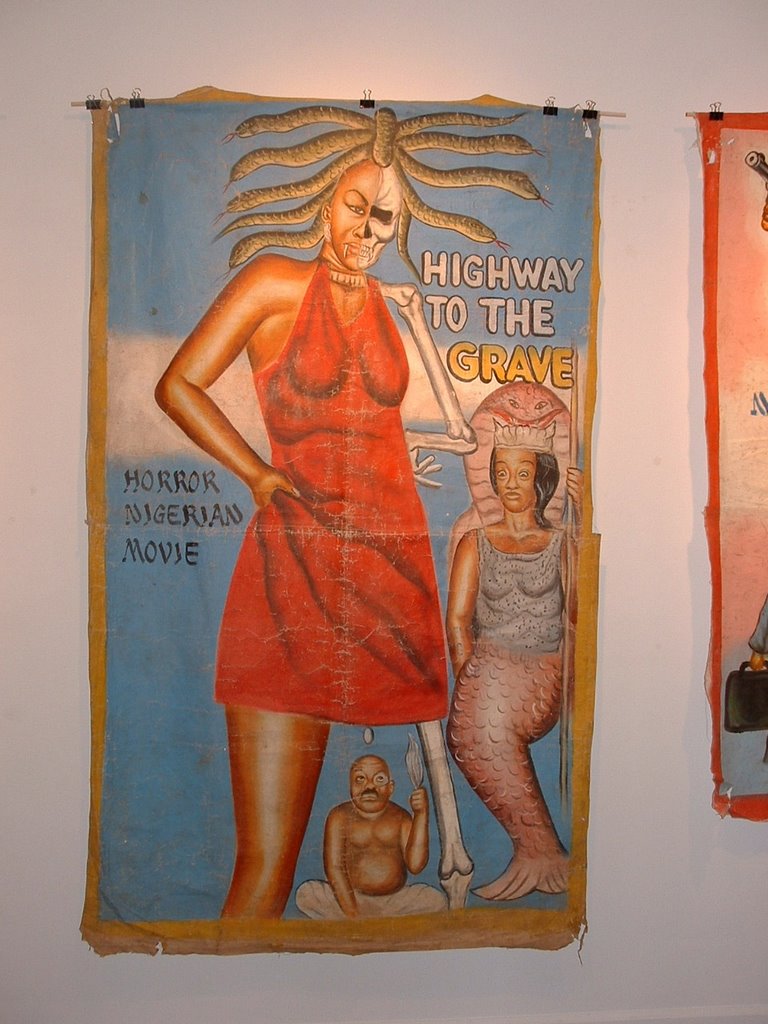

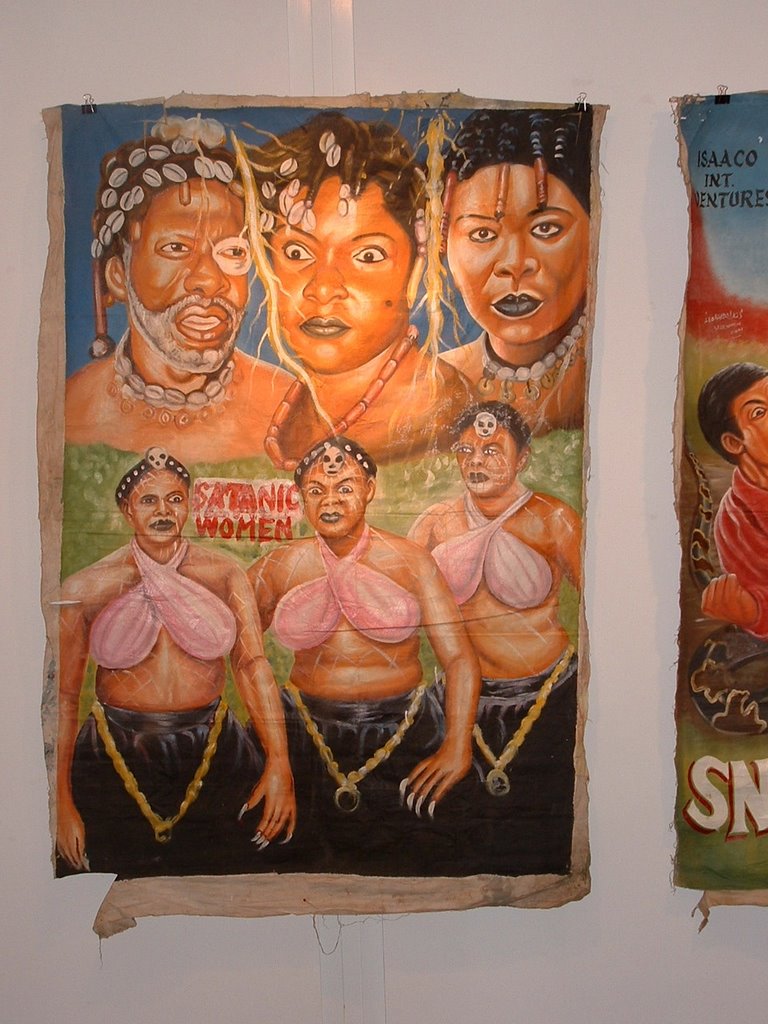
A local note here...Now through Sept. 28, Holyoke Community College is featuring an exhibit titled "Shockers" in the Taber Art Gallerty.
The exhibition features one-of-a-kind hand-painted movies posters from Ghana from the 1980s. At that time exhibitors would bring a TV and vcr from village to village to present movies. They commissioned local artists to paint these posters on cloth so they could be easily rolled up and carried from site to site.
Often times the artist had nothing more than a title to work on and they were told to emphasized those elements that would best draw in an audience...sex and violence.
The collection is owned by Michelle Gilbert, a faculty member at Sarah Lawrence College, and they are on sale for $350 each. If you search for similiar images on the web, you'll see an African firm selling these kind of posters from around $110 on eBay.
There will be a reception on Sept. 13 from 11 a.m. to 1 p.m. I'll be there!
©2006 Gordon Michael Dobbs. My words alone.
Tuesday, September 05, 2006
I love radio. Yes, I know I sound like a throw-back to some younger people who view it as an antiquated delivery medium for music, but it remains a medium with still untapped potential.
Generally I like a lot of the stuff on NPR because they're trying to use radio to its fullest. "Car Talk," "Wait Wait Don't Tell Me," Market Watch," "This American Life," and even "Fresh Air" are pretty compelling listening.
Having spent five years doing local talk radio, I'm also a talk show junkie. Rachel Maddow, Randi Rhodes and Tom Hartman are my current favorites. Can't really stand Al Franken or Jerry Springer and the conservative types are merely propaganda machines for the Bush administration.
"Says You!" is another good show and it's coming for a local taping.
When this writer asked the producer of the National Public Radio quiz show "Says You!" if the program was inspired by the classic quiz shows of the 1950s and '60s such as "What's My Line?" Richard Sher laughed.
"I see it as outright theft," Sher said. "As my father said, 'If you steal, always steal quality.'"
The show, now starting its 10th season, is coming to Mount Holyoke College's Chapin Auditor
ium on Sept. 10 for a 2 p.m. taping before a live audience. It is heard weekly on 107 stations nationally, including WFCR at 1 p.m. Saturdays.
Described as a "game of words and whimsy, bluff and bluster," "Says You!" has its panelists trying to come up with definitions of words, answer riddles and bluff each other. On the "Says You!" web site (www.wgbh.org/radio/saysyou/) is a daily riddle that is typical of the show's challenges. A current one is "Even though it's all showbiz, no 'Oscar,' 'Emmy,' or 'Tony' winner would ever have a shot at a 'Patsy' award. Why?"
Check out the web site for the answer.
Sher said the older generation of quiz shows featured educated witty people who came into your living room. After coming up with the idea for the game during a round of "Trivial Pursuit," he realized he could devise a game in which it was less important to know an answer than to like the answer you have.
Sher is the president and founder of Pipit & Finch, a marketing and media development company, with clients such as CBS/Westinghouse; Hearst Broadcasting; RISO, INC.; and IBM.
He said that he recorded a pilot for the show and made an appointment with the programming executive at WGBH in Boston. To Sher's amazement, the executive listened to the entire show and eight months later the program was on the air.
"It was the easiest show to bring on the air," Sher said. "Why? I don't know. Maybe people like this kind of stuff."
Sher had little trouble finding panelists because "these were people in my living room. They are friends of long-standing."
Sher will be joined in South Hadley by public radio personality Tony Kahn; television producer and writer Arnie Reisman; "Ladies Home Journal" columnist and WBZ-TV consumer reporter Paula Lyons; public television executive Francine Achbar; actor Tom Kemp; and columnist/critic Carolyn Faye Fox.
Sher had never intended to be the on-air host, but took the role out of necessity.
Known for taping in locations around Boston, Sher said that this year the show is going to Ohio in October and the west coast in the spring.
Another big change for the show is that it will be produced in half-hour and hour versions. Sher is going to syndicate the show himself and wants to offer public radio stations an option.
"This is going to be a big year for us," he said.
The show always features a musical guest and at the South Hadley taping, The Mount Holyoke College Big Band, under the direction of Mark Gionfriddo will appear.
"Holyoke Hi-Jinx," as the South Hadley show is being called, will be part of WFCR's 45th anniversary celebration and is sponsored by Merriam-Webster, Mount Holyoke College and "The Valley Advocate."
Tickets, ranging from $45 to $20, are on sale at the University of Massachusetts Fine Arts Center box-office. Telephone: 413-545-2511 or 800-999-UMASS. Tickets also available online at www.wfcr.org.
© 2006 Gordon Michael Dobbs. My words alone.
Generally I like a lot of the stuff on NPR because they're trying to use radio to its fullest. "Car Talk," "Wait Wait Don't Tell Me," Market Watch," "This American Life," and even "Fresh Air" are pretty compelling listening.
Having spent five years doing local talk radio, I'm also a talk show junkie. Rachel Maddow, Randi Rhodes and Tom Hartman are my current favorites. Can't really stand Al Franken or Jerry Springer and the conservative types are merely propaganda machines for the Bush administration.
"Says You!" is another good show and it's coming for a local taping.
When this writer asked the producer of the National Public Radio quiz show "Says You!" if the program was inspired by the classic quiz shows of the 1950s and '60s such as "What's My Line?" Richard Sher laughed.
"I see it as outright theft," Sher said. "As my father said, 'If you steal, always steal quality.'"
The show, now starting its 10th season, is coming to Mount Holyoke College's Chapin Auditor
ium on Sept. 10 for a 2 p.m. taping before a live audience. It is heard weekly on 107 stations nationally, including WFCR at 1 p.m. Saturdays.
Described as a "game of words and whimsy, bluff and bluster," "Says You!" has its panelists trying to come up with definitions of words, answer riddles and bluff each other. On the "Says You!" web site (www.wgbh.org/radio/saysyou/) is a daily riddle that is typical of the show's challenges. A current one is "Even though it's all showbiz, no 'Oscar,' 'Emmy,' or 'Tony' winner would ever have a shot at a 'Patsy' award. Why?"
Check out the web site for the answer.
Sher said the older generation of quiz shows featured educated witty people who came into your living room. After coming up with the idea for the game during a round of "Trivial Pursuit," he realized he could devise a game in which it was less important to know an answer than to like the answer you have.
Sher is the president and founder of Pipit & Finch, a marketing and media development company, with clients such as CBS/Westinghouse; Hearst Broadcasting; RISO, INC.; and IBM.
He said that he recorded a pilot for the show and made an appointment with the programming executive at WGBH in Boston. To Sher's amazement, the executive listened to the entire show and eight months later the program was on the air.
"It was the easiest show to bring on the air," Sher said. "Why? I don't know. Maybe people like this kind of stuff."
Sher had little trouble finding panelists because "these were people in my living room. They are friends of long-standing."
Sher will be joined in South Hadley by public radio personality Tony Kahn; television producer and writer Arnie Reisman; "Ladies Home Journal" columnist and WBZ-TV consumer reporter Paula Lyons; public television executive Francine Achbar; actor Tom Kemp; and columnist/critic Carolyn Faye Fox.
Sher had never intended to be the on-air host, but took the role out of necessity.
Known for taping in locations around Boston, Sher said that this year the show is going to Ohio in October and the west coast in the spring.
Another big change for the show is that it will be produced in half-hour and hour versions. Sher is going to syndicate the show himself and wants to offer public radio stations an option.
"This is going to be a big year for us," he said.
The show always features a musical guest and at the South Hadley taping, The Mount Holyoke College Big Band, under the direction of Mark Gionfriddo will appear.
"Holyoke Hi-Jinx," as the South Hadley show is being called, will be part of WFCR's 45th anniversary celebration and is sponsored by Merriam-Webster, Mount Holyoke College and "The Valley Advocate."
Tickets, ranging from $45 to $20, are on sale at the University of Massachusetts Fine Arts Center box-office. Telephone: 413-545-2511 or 800-999-UMASS. Tickets also available online at www.wfcr.org.
© 2006 Gordon Michael Dobbs. My words alone.
Monday, September 04, 2006
I love a good horror film. It's the genre that led me into my interest - some would call it obsession - with movies.
Recent horror films have left me cold. The best one I've seen recently was "The Descent" by Neil Marshall, the director of another good monster movie, "Dog Soldiers."
The two most recent horror DVD offerings left me scratching my head and wondering what I am missing.
Final Destination Three
In the third and possibly last of the "Final Destination" series, another group of random teenagers try to out-wit fate. I have not seen the others in this series, but by the lengthy documentary on the second of the two-disc set, the producers and directors speak of the challenge of keeping the franchise true to its format, while coming up with something fresh.
Remember the game "Mousetrap" from the 1960s? Or the great wacky inventions by cartoonist Rube Goldberg? In either case an outcome takes place through the apparently random interaction of unrelated events. This is the hallmark of these "dead teenager" movies.
In the third film, a group of graduating teens realizes that Death has them on his list and they try to figure out ways to cheat fate. There is no characterization. The actors are fulfilling horror film prototypes not giving well-rounded performances.
The thrust of the film is staging these elaborate and quite gory demises. The shocks come from the unexpected quality of these deaths.
For me it's not very involving and the only real entertainment is how the deaths take place. Viewed as abstractions, they're sort of interesting as a rolling ball triggers something else that propels a shelving unit - you get the idea.
The best thing about the DVD is the animated short discussing probability. It's quite well done, as is the documentary that looks at the whole "dead teenager" sub-genre of horror film.
Silent Hill
I'm always dubious about movies based on video games as that genre doesn't seem to have too good a track record, but "Silent Hill" looked very interesting.
And the visual style achieved under director Christopher Gans - the man who directed the over-the-top horror delight "Brotherhood of the Wolves" - is impressive. "Silent Hill" oozes atmosphere and dread.
Radha Mitchell and Sean Bean play adoptive parents to a little girl who sleepwalks and has vivid nightmares. Mitchell decides to take her daughter back to where she was born, a town called Silent Hill. The town has been deserted for years because of an underground coal mine fire that still burns on, but Mitchell doesn't know that, nor does the suspicious police officer who follows her into the sealed off community.
What the two women don't understand is that they are no longer in the "real" world, but have descended to the gates of Hell because of who the little girl really is.
Although its look and action held my attention, the conclusion of the film was just a disappointment.
Look, I know that Roger Ebert will come to my office and slap me if I reveal an ending, but I'm tired of contemporary horror film in which good people suffer. What I always liked about horror film was their element of a morality play. These days the good guys get as bad a fate as the bad guys do.
What does that say about society?
© 2006 by Gordon Michael Dobbs. These are just my wrods.
Recent horror films have left me cold. The best one I've seen recently was "The Descent" by Neil Marshall, the director of another good monster movie, "Dog Soldiers."
The two most recent horror DVD offerings left me scratching my head and wondering what I am missing.
Final Destination Three
In the third and possibly last of the "Final Destination" series, another group of random teenagers try to out-wit fate. I have not seen the others in this series, but by the lengthy documentary on the second of the two-disc set, the producers and directors speak of the challenge of keeping the franchise true to its format, while coming up with something fresh.
Remember the game "Mousetrap" from the 1960s? Or the great wacky inventions by cartoonist Rube Goldberg? In either case an outcome takes place through the apparently random interaction of unrelated events. This is the hallmark of these "dead teenager" movies.
In the third film, a group of graduating teens realizes that Death has them on his list and they try to figure out ways to cheat fate. There is no characterization. The actors are fulfilling horror film prototypes not giving well-rounded performances.
The thrust of the film is staging these elaborate and quite gory demises. The shocks come from the unexpected quality of these deaths.
For me it's not very involving and the only real entertainment is how the deaths take place. Viewed as abstractions, they're sort of interesting as a rolling ball triggers something else that propels a shelving unit - you get the idea.
The best thing about the DVD is the animated short discussing probability. It's quite well done, as is the documentary that looks at the whole "dead teenager" sub-genre of horror film.
Silent Hill
I'm always dubious about movies based on video games as that genre doesn't seem to have too good a track record, but "Silent Hill" looked very interesting.
And the visual style achieved under director Christopher Gans - the man who directed the over-the-top horror delight "Brotherhood of the Wolves" - is impressive. "Silent Hill" oozes atmosphere and dread.
Radha Mitchell and Sean Bean play adoptive parents to a little girl who sleepwalks and has vivid nightmares. Mitchell decides to take her daughter back to where she was born, a town called Silent Hill. The town has been deserted for years because of an underground coal mine fire that still burns on, but Mitchell doesn't know that, nor does the suspicious police officer who follows her into the sealed off community.
What the two women don't understand is that they are no longer in the "real" world, but have descended to the gates of Hell because of who the little girl really is.
Although its look and action held my attention, the conclusion of the film was just a disappointment.
Look, I know that Roger Ebert will come to my office and slap me if I reveal an ending, but I'm tired of contemporary horror film in which good people suffer. What I always liked about horror film was their element of a morality play. These days the good guys get as bad a fate as the bad guys do.
What does that say about society?
© 2006 by Gordon Michael Dobbs. These are just my wrods.
Tuesday, August 29, 2006

Remember when magazines had illustrations?
I picked up this pulp magazine for $1 at a local flea market just for the cover. It's not the best pulp cover ever done but it's a small example of an era when the illustrator was king in the magazine world.
For that matter, the use of illustration was also dominant in the movie posters as well for generations.
When was the last time you saw a magazine (non-comic book related) with an illustration on the its cover?
These days, of course, photography is the way to go. Now there is a trend among art directors to save money by not commissioning original photography but buy collections of stock art.
It used to be the exercise of creativity was the way to acheive a market share. Now it's more important to cut expenses to make a profit than to make one through having a singular product.
Grumble. Grumble.
©2006 by Gordon Michael Dobbs. These words are mine alone.
Monday, August 28, 2006
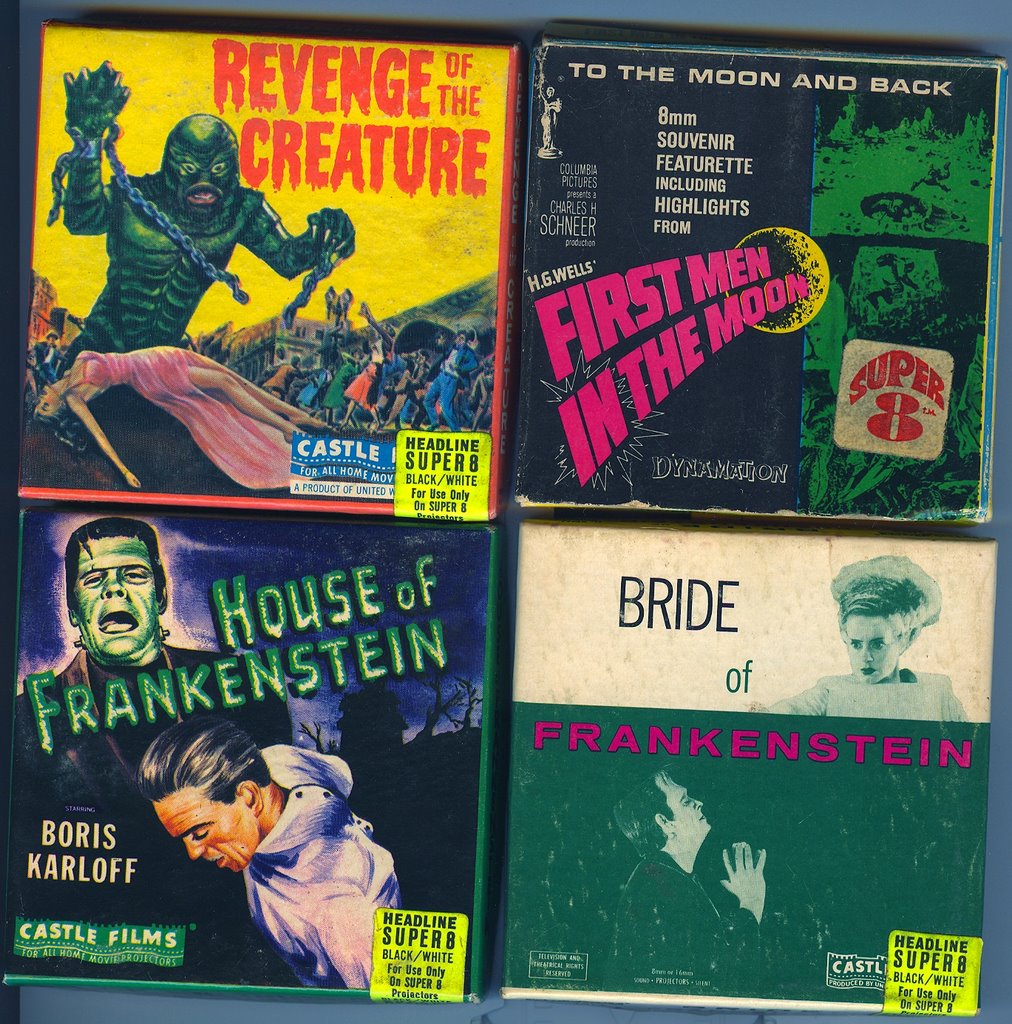
Hey, look what my father-in-law gave me!
Eight mm and Super Eight mm movies ! Three minute cut-downs of feature-length movies!
In the DVD age, young people might scratch their heads and wonder why I'm so impressed. Back in the day....old school...hardcore, this was what movie collecting was all about.
Sweet, sweet nostalgia!
You'd go to the camera department of a department store and there would be a display of these things. Of course, if you were a real buff, you'd order entire silent films on Eight or Super Eight from Blackhawk Films or from Sears.
I always wanted to order these amazing looking films I had read about...Phantom of the Opera, Nosferatu...but that never happened.
By the 1980s when people were starting to make student movies with Super 8, you could even get Super 8 sound prints of films. The prints had a magnetic sound track so you had to be sure you did wave any magnets around them!
I know it hard to believe that anyone would make an evening's entertainment out of these edited films ( there were also cut-downs that ran about 10 minutes), but people did. In the home movie world having these little films gave you the feeling that you were a collector, and exhibitor.
The cost? These still have the price stickers on the back: $1.99 in 1970s dollars.
I still have my cut-downs of Captain Marvel and some W.C. Fields films. My father-in-law also gave me two projectors so I will be running all of them.
Anyone want to come over for a movie show?
© 2006 by G. Michael Dobbs. My words alone.
Sunday, August 20, 2006
You know, there's too much going on in our lives. I just don't mean getting our jobs done every week, petting the puppy, driving the kids to activities and making sure the lawn looks half-way neat.
There's all that and then there's more. If you read, watch or listen to more than three media outlets you know there are dozens of significant stories that get a little play but then they evaporate when Lindsey Lohan gets slapped by her boss for being a party girl or Christie Brinkley's husband cheats on her with a 19 year-old.
That's real news, folks, right? "Insider" stuff, indeed!
Well, did you know, for instance, the Bush administration is planning a new highway system that would link Mexico with the mid-western United States? Container vessels would unload goods in Mexico that would then be transported through to Kansas City where there would be a distribution hub.
If you go on the Internet you'll find this is one issue that actually links conservatives and liberals. There are concerns about how an additional influx of foreign-made goods will affect American manufacturing, as well as legitimate security worries.
By unloading goods in Mexico, shippers don't have to deal with American unions as well.
Now, according to one of the web sites that promotes the plan (www.kcsmartport.com), the new "inland port" of Kansas City would create thousands of new jobs. What is left unsaid is what kinds of jobs would be undermined by this plan.
Apparently the trucks from Mexico wouldn't be checked thoroughly by customs until they reach Kansas City.
Now, because Britney Spear's husband is apparently not involved in this plan, there has been little coverage of it in the press.
Now how about the issue of net neutrality? Have you heard much about that one? It seems the Federal Communications Commission has removed certain protections that prevent large telecommunications companies from altering the Internet to suit their commercial purposes.
Under the new rules it's possible for Internet service providers to begin charging web sites more money in order to assure high-speed downloading. If you don't pay, your site may be seen at a speed that will prevent people from going there twice.
The folks at Google, Amazon, eBay and other large Internet sites are fighting right now to have these protections put back in place.
Check out http://www.itsournet.org for more information on this under-reported subject. I'll warn you now: no new boy bands or rappers will be involved.
Now if we could only get Madonna interested in either topic, the national media just might give them a little more attention.
© 2006 by Gordon Michael Dobbs. My words alone.
There's all that and then there's more. If you read, watch or listen to more than three media outlets you know there are dozens of significant stories that get a little play but then they evaporate when Lindsey Lohan gets slapped by her boss for being a party girl or Christie Brinkley's husband cheats on her with a 19 year-old.
That's real news, folks, right? "Insider" stuff, indeed!
Well, did you know, for instance, the Bush administration is planning a new highway system that would link Mexico with the mid-western United States? Container vessels would unload goods in Mexico that would then be transported through to Kansas City where there would be a distribution hub.
If you go on the Internet you'll find this is one issue that actually links conservatives and liberals. There are concerns about how an additional influx of foreign-made goods will affect American manufacturing, as well as legitimate security worries.
By unloading goods in Mexico, shippers don't have to deal with American unions as well.
Now, according to one of the web sites that promotes the plan (www.kcsmartport.com), the new "inland port" of Kansas City would create thousands of new jobs. What is left unsaid is what kinds of jobs would be undermined by this plan.
Apparently the trucks from Mexico wouldn't be checked thoroughly by customs until they reach Kansas City.
Now, because Britney Spear's husband is apparently not involved in this plan, there has been little coverage of it in the press.
Now how about the issue of net neutrality? Have you heard much about that one? It seems the Federal Communications Commission has removed certain protections that prevent large telecommunications companies from altering the Internet to suit their commercial purposes.
Under the new rules it's possible for Internet service providers to begin charging web sites more money in order to assure high-speed downloading. If you don't pay, your site may be seen at a speed that will prevent people from going there twice.
The folks at Google, Amazon, eBay and other large Internet sites are fighting right now to have these protections put back in place.
Check out http://www.itsournet.org for more information on this under-reported subject. I'll warn you now: no new boy bands or rappers will be involved.
Now if we could only get Madonna interested in either topic, the national media just might give them a little more attention.
© 2006 by Gordon Michael Dobbs. My words alone.
Saturday, August 19, 2006
New post here today and the introduction to my Fleischer book is on the Made of Pen and Ink blog.
Can Robin Williams find a good script? The answer is in this edition of the DVD review column.
RV
I like Robin Williams as both a comic and actor. He's quite capable of turning in great performances with the right script and director. He is also capable of selecting projects that do his career no good.
"RV" is one of those selections. This tired family comedy succumbs to almost every cliché of the genre. Williams is the busy exec dad who had lost touch with his family. His psycho boss demands that he cancels a family vacation to Hawaii so that he can make a presentation in Colorado. Williams lies to his family, rents a RV and tells them a road trip will be more fun. Along the way, Williams and his brood find the true meaning of life.
Yawn.
I like the idea that the best way to unite your family is by deceiving them. Lies are a great basis for communication with children. And it's hilarious!
A note to Robin: I think you're great. Let me read the script before your agent and I'll steer you clear of such flops. And I'll charge less.
My Summer Story
My favorite Christmas movie is "A Christmas Story" and I think the late writer and broadcaster Jean Shepherd is one of this country's great under-appreciated personalities. Receiving a copy of the 1994 sequel of "A Christmas Story" created some conflicted feelings: I love Shepherd's work, but I was dreading watching a film that received little release or attention over a decade ago.
The news is that while it's not as successful a film as "A Christmas Story," it is certainly worth watching. The film was directed by Bob Clark (who directed the previous film) and co-written by Shepherd based on his stories.
Essentially the film picks up the Parker clan the summer that followed the time of the previous film. Ralphie (Kieran Culkin) is still negotiating the hazards of the playground, the Old Man (Charles Grodin) is engaged in a new fruitless endeavor and mom (Mary Steenburgen) is hold them all together.
This film's story structure is different and is more fragmented than the first in which all of the action culminates in the Christmas celebration. Mom has her own sub-plot, which is quite funny, while Ralphie has his over finding the perfect battling toy top. The Old Man wages an unfunny and stupid conflict with the hillbilly neighbors and he and Ralphie share a story about fishing for crappies.
This looser structure makes the film seem less a cohesive film and more of a series of short stories. The problem is that Grodin is mis-cast as the Old Man. The late Darren McGavin understood not to over-play the role. Grodin is constantly gritting his teeth and growling.
Although not as good as the first, this film is well-wroth discovering.
For more for information, go to www.mgm.com/dvd
Queer Duck: The Movie
I was unaware that a series of Internet cartoon featuring gay animals was a big hit. Sorry, I didn't get the memo.
Apparently these short have been such a hit that Paramount decided it needed to bankroll a full-length movie.
This is perfect example that everything animated is not for children. This low-budget film features simple and unappealing animation coupled with every gay stereotype one can imagine. Although the film's voice actors are its only saving grace even having such performers as Billy West ("Futurama" and "Ren & Stimpy") and Maurice LaMarche ("Pinky and the Brain") can't save it from being an embarrassment.
There's not a laugh in its 72 minutes and I'm not sure who would find the tired sex and scatological humor appealing.
I do know the folks at the Best Buy in Holyoke had this title in its children's section. Please, allow me to repeat: not all animation is for children.
For more information, go to www.paramount.com/homeentertainment.
The Last Mogul: The Life and Times of Lew Wasserman
Lew who? That's the point. In show business where image is everything, the late Lew Wasserman could have cared less. Unlike any other studio head who courted personal publicity, Wasserman was dedicated to the gathering and exercise of power behind the scenes.
This documentary shows the rise and decline of the man who built the MCA/Universal Studios empire in Hollywood. For any film buff, this is essential viewing.
Director and writer Barry Avrich accomplished the near impossible: he creates a satisfying picture of a man who never gave an interview and who didn't keep any notes or papers. Avrich does this by interviewing both the friends and critics of the businessman who is credited by creating the business plan for modern Hollywood.
Wasserman was an agent who understood that by controlling the talent needed to make movies, he would be the industry's power player. Later, he showed insight into television and film production.
This fascinating film fills a gap in contemporary film history.
For more information, log onto www.kino.com.
© 2006 by Gordon Michael Dobbs. Standard disclaimer apples. What is the standard disclaimer? This blog is my publication alone.
Can Robin Williams find a good script? The answer is in this edition of the DVD review column.
RV
I like Robin Williams as both a comic and actor. He's quite capable of turning in great performances with the right script and director. He is also capable of selecting projects that do his career no good.
"RV" is one of those selections. This tired family comedy succumbs to almost every cliché of the genre. Williams is the busy exec dad who had lost touch with his family. His psycho boss demands that he cancels a family vacation to Hawaii so that he can make a presentation in Colorado. Williams lies to his family, rents a RV and tells them a road trip will be more fun. Along the way, Williams and his brood find the true meaning of life.
Yawn.
I like the idea that the best way to unite your family is by deceiving them. Lies are a great basis for communication with children. And it's hilarious!
A note to Robin: I think you're great. Let me read the script before your agent and I'll steer you clear of such flops. And I'll charge less.
My Summer Story
My favorite Christmas movie is "A Christmas Story" and I think the late writer and broadcaster Jean Shepherd is one of this country's great under-appreciated personalities. Receiving a copy of the 1994 sequel of "A Christmas Story" created some conflicted feelings: I love Shepherd's work, but I was dreading watching a film that received little release or attention over a decade ago.
The news is that while it's not as successful a film as "A Christmas Story," it is certainly worth watching. The film was directed by Bob Clark (who directed the previous film) and co-written by Shepherd based on his stories.
Essentially the film picks up the Parker clan the summer that followed the time of the previous film. Ralphie (Kieran Culkin) is still negotiating the hazards of the playground, the Old Man (Charles Grodin) is engaged in a new fruitless endeavor and mom (Mary Steenburgen) is hold them all together.
This film's story structure is different and is more fragmented than the first in which all of the action culminates in the Christmas celebration. Mom has her own sub-plot, which is quite funny, while Ralphie has his over finding the perfect battling toy top. The Old Man wages an unfunny and stupid conflict with the hillbilly neighbors and he and Ralphie share a story about fishing for crappies.
This looser structure makes the film seem less a cohesive film and more of a series of short stories. The problem is that Grodin is mis-cast as the Old Man. The late Darren McGavin understood not to over-play the role. Grodin is constantly gritting his teeth and growling.
Although not as good as the first, this film is well-wroth discovering.
For more for information, go to www.mgm.com/dvd
Queer Duck: The Movie
I was unaware that a series of Internet cartoon featuring gay animals was a big hit. Sorry, I didn't get the memo.
Apparently these short have been such a hit that Paramount decided it needed to bankroll a full-length movie.
This is perfect example that everything animated is not for children. This low-budget film features simple and unappealing animation coupled with every gay stereotype one can imagine. Although the film's voice actors are its only saving grace even having such performers as Billy West ("Futurama" and "Ren & Stimpy") and Maurice LaMarche ("Pinky and the Brain") can't save it from being an embarrassment.
There's not a laugh in its 72 minutes and I'm not sure who would find the tired sex and scatological humor appealing.
I do know the folks at the Best Buy in Holyoke had this title in its children's section. Please, allow me to repeat: not all animation is for children.
For more information, go to www.paramount.com/homeentertainment.
The Last Mogul: The Life and Times of Lew Wasserman
Lew who? That's the point. In show business where image is everything, the late Lew Wasserman could have cared less. Unlike any other studio head who courted personal publicity, Wasserman was dedicated to the gathering and exercise of power behind the scenes.
This documentary shows the rise and decline of the man who built the MCA/Universal Studios empire in Hollywood. For any film buff, this is essential viewing.
Director and writer Barry Avrich accomplished the near impossible: he creates a satisfying picture of a man who never gave an interview and who didn't keep any notes or papers. Avrich does this by interviewing both the friends and critics of the businessman who is credited by creating the business plan for modern Hollywood.
Wasserman was an agent who understood that by controlling the talent needed to make movies, he would be the industry's power player. Later, he showed insight into television and film production.
This fascinating film fills a gap in contemporary film history.
For more information, log onto www.kino.com.
© 2006 by Gordon Michael Dobbs. Standard disclaimer apples. What is the standard disclaimer? This blog is my publication alone.
Saturday, August 12, 2006
Western Mass. readers who are also film fans should make a date to attend this free show.
When the script calls for a film to be set in a busy airport terminal, the question confronting a western Massachusetts director is just where he can shoot it.
The answer to that question is the former Basketball Hall of Fame.
Longmeadow filmmaker Scott Kittredge will debut his new short film, "Terminal Conversation" with a public showing on Aug. 17 at 6:30 at the Basketball Hall of Fame Theater. Admission to the premiere is free.
Kittredge's new 17-minute film is his last short before taking on producing a feature film. He explained to Reminder Publications that he and his creative partner, Brian Jackson, had produced a horror film, a romantic comedy and a children's modern fable.
"Terminal Conversation" was going to stretch the team's abilities even more with a dramatic offering.
Jackson had to bow out of the production early in its development and Kittredge produced, directed and edited the film himself.
Kittredge shot the film in March over two days and was proud to say it was on time and on budget.
The film is about a young man who receives a troubling phone call from his wife while he's traveling and a subsequent conversation he has with an older man while waiting for his flight.
Western Massachusetts residents Clark Smith and Marty Langford wrote the script.
Longmeadow native Douglas Dickerman stars in the film as the younger man. Dickerman has received critical acclaim for his work in plays in New York. He has appeared in a number of short films, commercials and an episode of "Law & Order: Criminal Intent." He currently is pursuing his acting career in Los Angeles.
The other cast member is John Depew, who has appeared in a number of plays in Massachusetts and 12 short films. In his non-acting life, he is CEO of Bradford Medical Associates in North Andover.
Kittredge said the biggest challenge was finding a space that could convincingly double as an airport terminal waiting area. He said he needed a long space with huge windows and the third floor of the former Basketball Hall of Fame had those two requirements.
It was also in "bad disarray," said Kittredge.
One hundred-fifty of the red carpet tiles were missing and Kittredge and his crew had to pull others up from other parts of the building to fill in the gaps.
Benches that were still in the building, large houseplants and realistic signs contributed to the terminal look. When Kittredge added extras walking in and out of the scene as well as the necessary sound effects, the illusion was created.
Although he hadn't inquired about shooting the films at Bradley International Airport, Kittredge said he appreciated the complete control he had over the set something that would have been difficult to have at a working airport.
Kittredge plans to do with this film what he and Jackson did with their last film, "Snacks." He will be submitting it to festivals around the country to gain exposure. Snacks, which was shot at the Wolf Swamp Elementary School and used a local cast of children, has been seen at the Nolita Film Festival in New York City, the Foursite Festival in Salt Lake City, Utah, and Rhode Island International Film Festival.
Besides showing his film at the premiere, Kittredge will also screen previews of other films made in western Massachusetts and conduct a question and answer period.
© 2006 by Gordon Michael Dobbs. My words alone.
When the script calls for a film to be set in a busy airport terminal, the question confronting a western Massachusetts director is just where he can shoot it.
The answer to that question is the former Basketball Hall of Fame.
Longmeadow filmmaker Scott Kittredge will debut his new short film, "Terminal Conversation" with a public showing on Aug. 17 at 6:30 at the Basketball Hall of Fame Theater. Admission to the premiere is free.
Kittredge's new 17-minute film is his last short before taking on producing a feature film. He explained to Reminder Publications that he and his creative partner, Brian Jackson, had produced a horror film, a romantic comedy and a children's modern fable.
"Terminal Conversation" was going to stretch the team's abilities even more with a dramatic offering.
Jackson had to bow out of the production early in its development and Kittredge produced, directed and edited the film himself.
Kittredge shot the film in March over two days and was proud to say it was on time and on budget.
The film is about a young man who receives a troubling phone call from his wife while he's traveling and a subsequent conversation he has with an older man while waiting for his flight.
Western Massachusetts residents Clark Smith and Marty Langford wrote the script.
Longmeadow native Douglas Dickerman stars in the film as the younger man. Dickerman has received critical acclaim for his work in plays in New York. He has appeared in a number of short films, commercials and an episode of "Law & Order: Criminal Intent." He currently is pursuing his acting career in Los Angeles.
The other cast member is John Depew, who has appeared in a number of plays in Massachusetts and 12 short films. In his non-acting life, he is CEO of Bradford Medical Associates in North Andover.
Kittredge said the biggest challenge was finding a space that could convincingly double as an airport terminal waiting area. He said he needed a long space with huge windows and the third floor of the former Basketball Hall of Fame had those two requirements.
It was also in "bad disarray," said Kittredge.
One hundred-fifty of the red carpet tiles were missing and Kittredge and his crew had to pull others up from other parts of the building to fill in the gaps.
Benches that were still in the building, large houseplants and realistic signs contributed to the terminal look. When Kittredge added extras walking in and out of the scene as well as the necessary sound effects, the illusion was created.
Although he hadn't inquired about shooting the films at Bradley International Airport, Kittredge said he appreciated the complete control he had over the set something that would have been difficult to have at a working airport.
Kittredge plans to do with this film what he and Jackson did with their last film, "Snacks." He will be submitting it to festivals around the country to gain exposure. Snacks, which was shot at the Wolf Swamp Elementary School and used a local cast of children, has been seen at the Nolita Film Festival in New York City, the Foursite Festival in Salt Lake City, Utah, and Rhode Island International Film Festival.
Besides showing his film at the premiere, Kittredge will also screen previews of other films made in western Massachusetts and conduct a question and answer period.
© 2006 by Gordon Michael Dobbs. My words alone.
Wednesday, August 02, 2006
I've started an experiment at a new blog titled Made of Pen and Ink. It's the first draft of my book on Max and Dave Fleischer, their cartoons and studio. It will be posted a chunk at a time without illustrations in the effort of pre-selling to an audience and attracting a publisher.
With the announcement that Warner Home Video will be presenting the Fleischer Popeyes on DVD, now is an opportune time for a book on the studio that made these and so many other classic cartoons.
If you're interested in animation, then I hope you'll bookmark Made of Pen and Ink.
With the announcement that Warner Home Video will be presenting the Fleischer Popeyes on DVD, now is an opportune time for a book on the studio that made these and so many other classic cartoons.
If you're interested in animation, then I hope you'll bookmark Made of Pen and Ink.
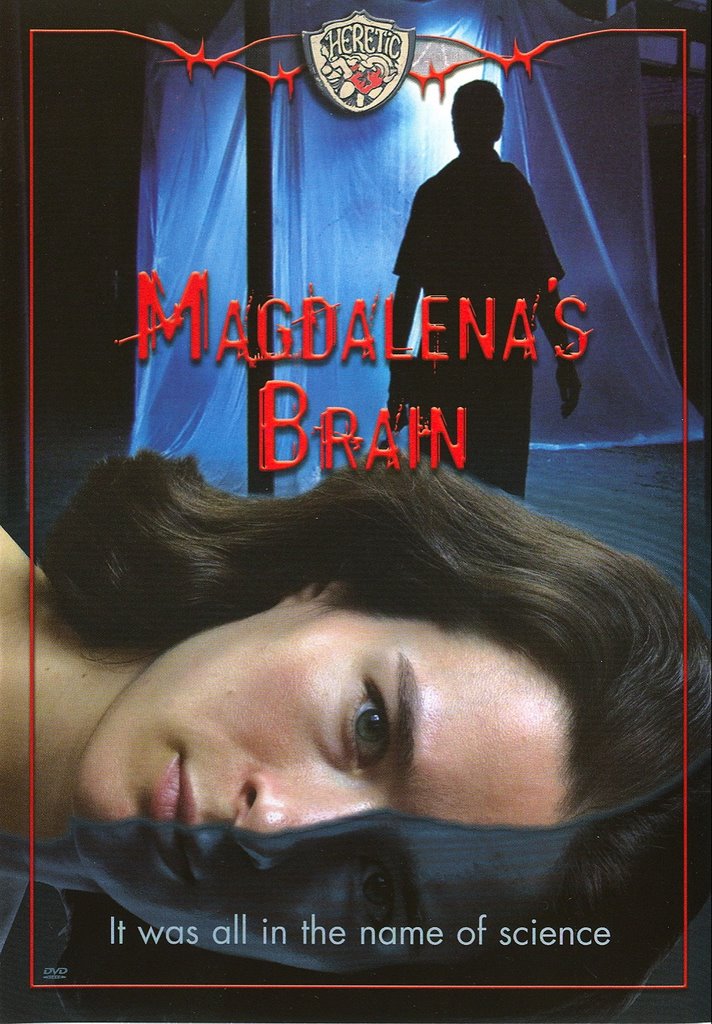
This week it's time to catch up with the torrent of DVD releases that are coming to a store near you.
Magdelena's Brain
In the interest of full disclosure, let me say I'm friends with this homegrown thriller's co-writer and producer Marty Langford.
In all honesty, though, I have to say that Langford and his creative partner Warren Amerman have done something one doesn't see too often in the low-budget horror/ science fiction genre: they've substituted gore and nudity staples of the genres with a story and ideas.
What a concept!
The result is a film that might disappoint hardcore horror fans used to extremes, but reward other viewers who are looking for a thriller that will make them think.
Amy Shelton-White plays Magdelena Welling, an accomplished doctor whose husband Arthur (Sanjiban Sellew) is a researcher working on artificial intelligence. A terrible accident leaves Arthur confined to a wheelchair and able to communicate only through a device they built.
Living alone with Arthur in an old factory building, Magdelena continues Arthur's experiments hoping to perfect a means to restore her husband.
The path to a solution isn't an easy one and Langford and Amerman put plenty of twists in the story.
This is a film that harkens back to the school of horror filmmaking perfected by Val Lewton at RKO in the 1940s. Lewton made films that intrigued audiences for not only what was on the screen, but also what played off it. "Magdelena's Brain's" low-key approach suits the story well.
That's not to say this is problem-free production. Although Shelton's White's performance carries the picture, many of the supporting cast just can't reach her level of competency. Langford and Amerman were smart to spend part of their budget on a lead performer who is really good.
They were also smart to devise a script they could actually afford to shoot. Many low-budget productions falter because the script has aspirations the budget can not fulfill.
The look of the film is quite sharp with excellent photography something else that separates this film from the low-budget pack.
The film is now in video stores and retails outlets due to distribution from Heretic Films.
The Missing
This western from director Ron Howard was not one of his greatest box office success, but I liked it because Howard did something I didn't expect from watching the trailer: he made a western with a horror film sub-plot.
Cate Blanchett is Maggie, a hard-working and embittered rancher who struggles to raise her two daughters and oversee her New Mexican spread. The last thing she wants to do is to see her long-estranged father, played by Tommy Lee Jones. He abandoned his family years before to "go native," and has been living with Native Americans ever since. His reunion with his daughter was on the advice of a native shaman and his visit was well- timed.
One of her daughters is kidnapped by a band of both native and white renegades who sell young women into slavery in Mexico. Maggie unwilling enlists her father's help in tracking down the outlaw band.
Howard clearly has an eye for the requirements of the classic western and he adds his own touch by having the leader of the band a villainous native shaman as a supernatural figure.
The DVD features Howard's extended cut of the film, clocking in at 154 minutes, as well as the 8mm westerns he made as a teen and six featurettes on the making of the film.
The extended cut is unrated, and viewers should know there are moments of pretty brutal violence. John Ford, this isn't.
Having said that, I need to add that "The Missing" is a satisfying western.
Some Like It Hot: Special Edition
In an American Film Institute poll of the best comedy films ever made, this Billy Wilder comedy came in first and with good reason: it's a very funny film.
This new DVD has two discs one with the film and another for a load of features including both archival interviews with the late director and co-star Jack Lemmon as well as a new interview on the making of the film with co-star Tony Curtis.
"Some Like it Hot" tells the story of two hapless musicians (Tony Curtis and Jack Lemmon) in 1929 Chicago who witness a mob murder. Fleeing for their lives, they manage to pass as women and join an all-woman band enroute to an extended gig at a Florida resort hotel.
Their lives are complicated when Curtis falls for the band's singer Sugar Kane (Marilyn Monroe) and a wealthy older playboy (Joe E. Brown) pursues Lemmon's female persona.
The script by Wilder and his long-time writing partner I.A.L. Diamond still sparkles after 47 years and the film still can boast of the best final gag ever filmed.
This is an essential addition to any comedy library.
The Benchwarmers
Okay, I'm a nerd. I've always have been and always will be and I suppose that this new "nerds rule" movie was made for guys like me.
Well, this movie simply recycles some of the themes from previous nerd movies and is only distinguished by giving Rob Schneider the opportunity to play the non-nerd in the cast. After the "Deuce Bigelow" films, he must have relished playing the straight guy who is actually married and has a stable life.
Jon Heder and David Spade are not so lucky. They make up the other two of these modern day stooges who are asked to fight for nerd rights everywhere by challenging Little League teams composed of "normal" kids. In this universe, if you're normal, you're a bully.
At some moments this film has all of the cloying sentiment of an after-school special, while at others it's crude and scatological. It's not one to watch with the kids.
I laughed four times I actually kept track and that's not a very good count for a feature-length comedy.
Saturday, July 22, 2006


I've meant to post something about our trip to Scotland Mary and I took in March, but haven't gotten around to it until one of our publications at work needed a travel piece. There's lot more I could add and I include more material for this post. The first image is yours truly at Castle Doune. The second image is from Edinburgh. Frequent readers of this blog will understand why I took it! The third is the Wallace Memorial as seen from Stirling Castle.
It's a mid-March day in Edinburgh and the snow is blowing sideways on the windshield of our taxicab.
It's springtime in Scotland.
As our cabbie negotiated the medieval streets of the capitol of Scotland, there are signs that spring is actually here - there are flowers in bloom everywhere.
This is my second trip to Scotland - my wife was born in Glasgow and raised in Paisley - and we have the advantage of having generous and hospitable relatives to put us up and give us sight-seeing advice.
Even if we didn't have this wonderful resource, Scotland would still be a relaxing destination. Scots are friendly, the mass transit is abundant and easy to use and there are tourist information centers with plenty of information.
We crammed as much as we could in the period of 12 days. If you're planning a trip to the United Kingdom, give yourself a treat and spend some time in Scotland.
Edinburgh
The capitol of the nation is by far one of most tourist friendly spots I've ever visited. There is a tourist information center in the center of the city on Princes Street near the huge spire that is a memorial to Sir Walter Scott.
The biggest tourist spot is the Royal Mile, the street that begins on the top of a hill and the site of Edinburgh Castle and ends at the Holyrood House where the British royal family stays when they're passing through.
Undoubtedly the best known attraction in the city, Edinburgh Castle is a feast for any history, military or architecture buff. Expect to spend the better part of several hours at the castle.
Tourist Tip Number One: When at the castle, don't ask when the famed one'o'clock gun is fired.
Walking down the Royal Mile you see a wide variety of shops with their guns aimed squarely at tourists. Frankly I enjoy these kinds of shops, as they are the source for all of items you're going to bring home to family and friends.
Off the Royal Mile, on Chambers Street, are the Royal Museum and the Museum of Scotland, two museums in two joined buildings. Admission is free and the museums house wonderful exhibits on the history of the nation as well as decorative arts, archeology and the natural world.
There is a great cafe in the center of the two museums, which is an ideal place to relax after a day of walking. Keep your eyes peeled, here: Harry Potter author J.K. Rowling is a regular. Our friends who were traveling with us actually had a sighting!
Tourist Tip Number Two: Always keep a 20 pence coin or two 10 pence coins with you for the pay toilets.
Across from the museums is the Greyfriars Kirkyard and the resting place of Greyfriars Bobby, a Skye terrier who watch over his master's grave for 14 years and was adopted by the city of Edinburgh.
The Greyfriars Pub is outside the gate of the cemetery and features a haggis sampler. Go ahead and try it. The national dish of Scotland - actually just a mixture of mutton, oats and spices - has a bad reputation, but is quite good, specially when eaten with the traditional mashed potatoes and turnips or tatties and neeps.
Tourist Tip Number Three: When in a Scottish pub, don't order "Scotch." In Scotland it's just whiskey. And you might not find your brand there as much of what we drink here is only available for export.
Glasgow
Just a quick 45-minute train ride away is the largest city on the nation. If Edinburgh is like New York - a flashy tourist destination - then Glasgow is like Chicago. It's a great city with plenty to see and do that some folks just don't think about.
We arrived on a Saturday afternoon and spend most of it just walking through the bustling downtown. That's right. I did just write the word "bustling," "Saturday afternoon" and "downtown" together. In many American cities, down towns are dead on the weekend, but in Glasgow shopping malls haven't sucked the life out of urban areas.
Sauchiehall Street is a blast with great shops, restaurants and pubs. We walked into pub and found a six piece jazz band playing up a storm - something you'd never see on an afternoon in an American bar.
Tourist Tip Number Four: There is a substantial difference in language between Edinburgh and Glasgow, largely thanks to the "Glesgie patter," or slang. As long as they don't call you an "eejit" you're okay.
There are great museums in Glasgow - 13 in fact - ranging from Museum of Transport to the Burrell Collection of paintings, furniture, textile and sculpture to the magnificent Kelvingrove Art Gallery and Museum. Admission is free to the museums, which is helpful on a tight tourist budget.
Other sights
Stirling Castle, in the village of Stirling, is in Braveheart country. This is the second most important castle in the country and is well worth the scenic drive into the foothills of the Highlands.
Aberdeen is known as the "Granite City," and for a very good reason - most of the buildings are made from the native material. It's far from a "grey" town, though thanks to the large student population as well as a hustle and bustle from its large port.
If you love chocolate Scotland is the place to be. Here's words to look for: Cadbury's ( the real stuff...not what we get here) and Tunnock's. I'm in love with the Tunnock's line of wafers and tea cakes. Fabulous!
In Glasgow we found a non-touristy restuarant chain called Jake McPhees (pretty sure of thespellingg) where a slightly surly waitress reminded me that beans come on top of Scotch Pies. I told her I was not stranger to Glasgow and knew that. She seemed a little surprised and was then less surly! We also tried a fish and chip platter ( I know stereotypicall foods, but these you have to try in a foreign country) and it was, as the folks in Glasgow say, "magic."
We loved shopping at Govan market, an outdoors event in a very hard-core section of the city. The stalls sell everything from baked goods to carpeting and I loved watching the portable butcher shop conduct a television-style informerical– holding up various cuts of meat, describing it and talking about the price. The broken glass and dog shite on the sidewalk made me feel at home!
The underground in Glasgow is a dream for the tourist. Much cheaper than a cab, the subway line is a big cricle through the city. If you miss your station, don't worry, you'll get back to it eventually.
For film nuts such as myself, the best place to get DVDs is Fopp, a British chain that features a vast selection at the lowest prices I've seen. Get yourself an all-region player before you go to UK and then hunt down a Fopp.
For me, though, the best moment is when I could walk around Doune Castle, just minutes away from Stirling in the village of Doune. This is where Monty Python filmed much of their second film Monty Python and The Holy Grail. If you're quiet enough, you can still hear the clapping of coconut shells. We' re too late for a tour, so I walked around the castle and picked up a bit of masonry that had fallen on the pathway.
As always we are indebted to wife's Scottish relatives for their unlimited hospitality.
Tourist Tip Number Five: One trip to Scotland isn't enough.
© 2006 by Gordon Michael Dobbs. Yes, I used the word "shite." I take responsibility.
Wednesday, July 19, 2006
Sometimes what I write here helps me construct my column for the newspapers I edit. Here's an example.
You never know what is going to interest people.
In the new Superman film, the Man of Steel returns to Earth after a five-year search in space for his home world. He doesn't find it and comes back to resume his life here.
His return is met with general acceptance, but for Lois Lane the news isn't necessarily good.
You see Lois is hurt that the man she loved took off without an explanation, especially since there was a little complication: a son.
So I thought some folks would be enraged that Superman and Lois had pre-marital relations, but no one seems too upset about that.
Instead some conservative commentators have latched onto the scene in which Perry White, the editor of The Daily Planet, is talking to his staff. He wants to know everything about Superman and his return. He asks if Superman still stands for "truth, justice and all that stuff?"
Apparently the writers and the director wanted not to include the phrase "American way" because this film will play to audiences world-wide and this nation's policies are not uniformly popular.
Carol Platt Liebau writes on the web site for The American Spectator, "Certainly, Hollywood filmmakers want to distribute their films overseas. It's possible that someone felt that explicitly aligning Superman with American values and interests might alienate some foreign audiences. After all, these days, moviegoers abroad are used to seeing American films that depict the worst, rather than the best, of the American character.
"But if that were the case, the phrase 'the American way' could simply be dubbed out of the film's foreign versions, treated like other culturally inappropriate material when films are adapted for an overseas audience. As ridiculous as that arrangement would be, it could, at least, be defended as a business decision, albeit a repugnant one.
"But there's more to it than that. It's not only that the film's creators believe that non-Americans would find the phrase offensive - they themselves do, too.
"According to reports in the New York Post, the screenwriters of the film wanted to avoid 'outdated jingoism.' One of them commented, 'I don't think 'the American way' means what it meant in 1945.' The other noted, 'He's not just for Metropolis and not just for America.' Apparently, he's a new Superman for the global age."
It would be nice is Liebau actually knew something about the character and its history. The 1940s animated cartoons made by the Fleischer Studios used the phrase "truth and justice." There was no mention of the "American way" even in the cartoons produced after the start of WWII.
The early Superman was indeed a champion for the underdog as written by his co-creator Jerry Siegel. He fought mobsters, quacks and dictators and the police didn't like him very much. They considered him a vigilante.
By the time the 1950s rolled around and the production of the popular television series the character was far more establishment. In the light of the cold war, the phrase "American way" was added to the list.
I always thought the phrase was redundant - is truth and justice inherently supposed to be the American way?
This is the kind of subject that some talk show hosts love because it means nothing and yet gets some people very angry.
As a piece of pop culture I found the film to be a fun but thoughtful look on the burden a real Superman would have to carry in this world. The character is not one that would lend itself to a politically charged story.
Liebau doesn't bring up that Superman is the ultimate illegal alien. He was brought into the country illegally, given a fake identity as a child, adopted a second fake identity as an adult, carries no passport and files no flight plans with the FAA.
And we expect him to help us out and no one seems upset that he doesn't get just compensation for his labors.
Perhaps she doesn't want to consider that aspect of "the American way."
©2006 by Gordon Michael Dobbs. Sorry if I hurt your feelings. These are my words alone.
You never know what is going to interest people.
In the new Superman film, the Man of Steel returns to Earth after a five-year search in space for his home world. He doesn't find it and comes back to resume his life here.
His return is met with general acceptance, but for Lois Lane the news isn't necessarily good.
You see Lois is hurt that the man she loved took off without an explanation, especially since there was a little complication: a son.
So I thought some folks would be enraged that Superman and Lois had pre-marital relations, but no one seems too upset about that.
Instead some conservative commentators have latched onto the scene in which Perry White, the editor of The Daily Planet, is talking to his staff. He wants to know everything about Superman and his return. He asks if Superman still stands for "truth, justice and all that stuff?"
Apparently the writers and the director wanted not to include the phrase "American way" because this film will play to audiences world-wide and this nation's policies are not uniformly popular.
Carol Platt Liebau writes on the web site for The American Spectator, "Certainly, Hollywood filmmakers want to distribute their films overseas. It's possible that someone felt that explicitly aligning Superman with American values and interests might alienate some foreign audiences. After all, these days, moviegoers abroad are used to seeing American films that depict the worst, rather than the best, of the American character.
"But if that were the case, the phrase 'the American way' could simply be dubbed out of the film's foreign versions, treated like other culturally inappropriate material when films are adapted for an overseas audience. As ridiculous as that arrangement would be, it could, at least, be defended as a business decision, albeit a repugnant one.
"But there's more to it than that. It's not only that the film's creators believe that non-Americans would find the phrase offensive - they themselves do, too.
"According to reports in the New York Post, the screenwriters of the film wanted to avoid 'outdated jingoism.' One of them commented, 'I don't think 'the American way' means what it meant in 1945.' The other noted, 'He's not just for Metropolis and not just for America.' Apparently, he's a new Superman for the global age."
It would be nice is Liebau actually knew something about the character and its history. The 1940s animated cartoons made by the Fleischer Studios used the phrase "truth and justice." There was no mention of the "American way" even in the cartoons produced after the start of WWII.
The early Superman was indeed a champion for the underdog as written by his co-creator Jerry Siegel. He fought mobsters, quacks and dictators and the police didn't like him very much. They considered him a vigilante.
By the time the 1950s rolled around and the production of the popular television series the character was far more establishment. In the light of the cold war, the phrase "American way" was added to the list.
I always thought the phrase was redundant - is truth and justice inherently supposed to be the American way?
This is the kind of subject that some talk show hosts love because it means nothing and yet gets some people very angry.
As a piece of pop culture I found the film to be a fun but thoughtful look on the burden a real Superman would have to carry in this world. The character is not one that would lend itself to a politically charged story.
Liebau doesn't bring up that Superman is the ultimate illegal alien. He was brought into the country illegally, given a fake identity as a child, adopted a second fake identity as an adult, carries no passport and files no flight plans with the FAA.
And we expect him to help us out and no one seems upset that he doesn't get just compensation for his labors.
Perhaps she doesn't want to consider that aspect of "the American way."
©2006 by Gordon Michael Dobbs. Sorry if I hurt your feelings. These are my words alone.
Tuesday, July 18, 2006

And Carlos was a nice guy!
The deputies of Reno 911! are back – on television and on DVD.
The fourth season of the popular comic police show has started on Comedy Central and the third season has just been released to DVD in a two-disc set.
If you’ve not seen the show, it’s a clever and raucous parody of FOX’s Cops. Set in Reno, Nevada, documentary cameras follow around a group of sheriff deputies during both their professional and personal lives.
Led by the hot pants-wearing Lt. Jim Dangle (Thomas Lennon), The Reno squad includes the in your face Deputy Raineesha Williams (Niecy Nash), the flack-vest wearing depute Travis Junior (Robert Ben Garant), the deeply disturbed Deputy Trudy Weigel (Kerri Kenny), the amorous Deputy Clementine Johnson and ladies’ man Deputy S. Jones (Cedric Yarbrough), the seasoned vet and bigot Deputy James Garcia (Carlos Alazraqui) and the rookie Deputy Cheresa Kimball (Mary Birdsong).
Very politically incorrect, Reno is a show that constantly surprises and sometimes shocks. Viewers are never quite sure how far a gag will be taken. On episode in the third season DVD, Dangle and Junior go undercover at a spa to follow a suspect there for a massage. The suspect takes off in his car and Dangle and Junior rush out of the door of the spa in hot pursuit with only their socks and shoes on. The spa locks its doors behind them and they have to make their way back eight miles to the station house.
The third season opens with episodes that show how the group got kicked off the force, served time in jail and then resumed their lives but as civilians. There is some funny stuff here, especially with Dangle trying out for American Idol and Jones and Garcia relishing their new lives as mall cops.
The third season set also features two groups of extended outtakes which shows how the cast crafts the scene through trial and error. The cast provides commentaries on several episodes, which give insights into the creative process.
***
Carlos Alazraqui
What makes Reno unique in American television is that it’s a sit-com that is almost all improvised and after four seasons cast member Carlos Alazraqui said in an interview with Reminder Publications that the cast is now a lot better at the acting challenge than during the show’s first season.
He attributed the early success of the show to “dumb luck.”
He explained how the show is shot. The cast is given a general description of a scene and then rehearses a short length of time developing some of the dialogue. If the director likes the lines, they start filming. Alazraqui estimated that the actors improvise 70 percent of the show.
The show is not shot in Reno, Alazraqui explained. It’s filmed in the greater Los Angeles area. The sheriff’s station is a real police station in Carson, Calif., and Alazraqui said the officers generally support the show.
“Ninety-five percent really love it,” Alazraqui said.
He added that one officer in particular makes an effort to help them out by telling them about real life incidents that could be used for the comedy. He has told the cast that some of their antics are reflections of what has happened to cops in real life.
Alazraqui’s character is frequently paired off with Yarbrough’s Jones and that was because the two actors hit it off in the pilot. Alazraqui said the producers liked the physical contrast between the men as well as the fact that Garcia was an unapologetic bigot.
Alazraqui added that “the whole staff is racially prejudiced.”
Alazraqui comes to the show from a stand-up comedy background and from a very active career as a voice artist in animation. If you’ve watched Nickelodeon in the past few years, you’ve heard him on shows such as The Fairly Odd Parents (as the evil Mr. Crocker), Camp Lazlo (Lazlo and Clem) and Rocko’s Modern Life (as Rocko).
Rocko was his first animated role and he is again working with Rocko creator Joe Murray on his new show Camp Lazlo.
“I’ve come full circle with Camp Lazlo,” he said.
You also heard him as the voice of the Taco Bell Chihuahua, a commercial campaign that is still remembered six years after it ended.
“That was a bizarre thing to land,” Alazraqui said.
He’s a cast member of the new animated film Happy Feet due for release in November and plays a Latino penguin named Nestor. The voice cast also includes Robin Williams.
That feature film release will be following in January 2007 with the premiere of Reno 911!: Miami. Alazraqui explained that in the movie the Reno deputies travel to Miami to attend a law enforcement convention in Miami. They lack the proper credentials and are not allowed in.
But when a biohazard forced the quarantine of the officer in the convention hall, the Reno deputies takes to the streets of Miami to keep the peace.
The film was shot in the same improv style, although Alazraqui said the cast had to pay much closer attention to creating dialogue and situation that matched the movie’s plot.
Alazraqui still performs stand-up and he said he favors no one aspect of his career.
“It’s so relative to the situation,” he explained. “There is nothing like the live response [to stand-up] when they love you. I get paid to do goofy voices. That’s another high.”
“The benefits of a multi-pronged career is that I get to do different jobs,” he said.
© Gordon Michael Dobbs 2006. My words alone.
Sunday, July 16, 2006
My wife and I have been on vacation this week and have been out of the state and away from computers for part of that time. Here are some observations from the road.
We were in Virginia to visit my mom and we hate taking I 95 all the way to the Richmond area. So, for years, we have been using US 301 for part of the trip to avoid the headaches of traffic around Washington DC. For a long time the route was a joy to drive: mostly small towns and farming areas.
Not any more.
It was astonishing to see just how built-up these one-time sleepy areas are now. Outside of Wilmington, Delaware, there are scores of new houses and big box stores to obviously fill the need of folks escaping from city life and waiting to create suburbs out of the country.
The traffic was horrendous in areas where it was once smooth-sailing.
Now I will admit that I generally despise the 'burbs. They have all of the disadvantages of living in a city (closeness to your neighbors,etc) and none of the fun of country life. The creation of more developments on one-time farmland is a mortal sin in my book.
I'd rather see our cities re-need than our rural areas taken away.
That's just me. But I would also like to see more mass transportation, the development of electric cars, more urban gardening projects and an emphasis on renovation of existing buildings.
***
Seen along the road: crabs fro $99 a bushel basket. You've got to be committed to seafood to pay a hundred bucks to some guy for a big basket of crabs that need to stay alive until you cook them.
***
We love Wa-Wa, a chain of uber-gas stations with a fantastic selection of food items for folks on the move and clean rest rooms.
***
A word on rest rooms: people can't be trusted.
Step into any public facility today and the odds are the toilets and urinals will flush themselves. The faucets and soap dispensers will be automatic as will the paper towels.
Obviously we can be trusted to flush things, turn off the water and tear off the right amount of towels.
Now I know these things are done in the name of cleanliness and thrift, but it goes to the heart of the matter that people are pigs when it comes to the use of public restrooms.
As someone who has had to maintain rest rooms for the public I will never understand the psychology of walking into someplace that will be used by another people and urinating all over it.
Is this our instinctive marking of territory manifesting itself?
Oh, well... Just know that in the South, Wa Wa has clean restrooms. Thank all that is holy!
©Gordon Michael Dobbs 2006. My words alone.
We were in Virginia to visit my mom and we hate taking I 95 all the way to the Richmond area. So, for years, we have been using US 301 for part of the trip to avoid the headaches of traffic around Washington DC. For a long time the route was a joy to drive: mostly small towns and farming areas.
Not any more.
It was astonishing to see just how built-up these one-time sleepy areas are now. Outside of Wilmington, Delaware, there are scores of new houses and big box stores to obviously fill the need of folks escaping from city life and waiting to create suburbs out of the country.
The traffic was horrendous in areas where it was once smooth-sailing.
Now I will admit that I generally despise the 'burbs. They have all of the disadvantages of living in a city (closeness to your neighbors,etc) and none of the fun of country life. The creation of more developments on one-time farmland is a mortal sin in my book.
I'd rather see our cities re-need than our rural areas taken away.
That's just me. But I would also like to see more mass transportation, the development of electric cars, more urban gardening projects and an emphasis on renovation of existing buildings.
***
Seen along the road: crabs fro $99 a bushel basket. You've got to be committed to seafood to pay a hundred bucks to some guy for a big basket of crabs that need to stay alive until you cook them.
***
We love Wa-Wa, a chain of uber-gas stations with a fantastic selection of food items for folks on the move and clean rest rooms.
***
A word on rest rooms: people can't be trusted.
Step into any public facility today and the odds are the toilets and urinals will flush themselves. The faucets and soap dispensers will be automatic as will the paper towels.
Obviously we can be trusted to flush things, turn off the water and tear off the right amount of towels.
Now I know these things are done in the name of cleanliness and thrift, but it goes to the heart of the matter that people are pigs when it comes to the use of public restrooms.
As someone who has had to maintain rest rooms for the public I will never understand the psychology of walking into someplace that will be used by another people and urinating all over it.
Is this our instinctive marking of territory manifesting itself?
Oh, well... Just know that in the South, Wa Wa has clean restrooms. Thank all that is holy!
©Gordon Michael Dobbs 2006. My words alone.
Tuesday, July 04, 2006

The Curse of Superman?
Believe it or not, some of the TV entertainment shows are bringing up the old chestnut that there is a curse assigned to playing Superman. Kirk Alyn lived to a ripe old age and Bud Collier seemed to do all right himself. I'm sorry about George Reeves and Christopher Reeve and this story belittles their lives.
More much ado about nothing; typical TV.
However there is a great lesson about Superman: creators need to own their creations.
Now I'm entering my close friend Steve Bissette's territory here. He's been talking and writing about this subject for years. Hell, even Mark Martin ( the great comix artist NOT the race car driver) even will write about creator rights. He's another close friend. So I guess I'm caving in to peer pressure!
The photo above is from that June 21, 1941 article on Superman. As you can see, Siegel and Shuster are shown as living now in relative luxury. We all know now that in just a few years they were screwed in ways by DC Comics that affected the rest of their lives.
Max Fleischer did not benefit from his experience with Superman. He didn't own the character. He didn't own his most popular character, Popeye, either. He did eventually own Betty Boop, but only after a court battle and wound up not owning a single one of the films he produced. His heirs, though, have greatly benefited from the court case and have made a ton of dough in merchandising. Too late for Max, though.
The writers of the Mutual radio series, which introduced us to kryptonite and Jimmy Olson and other conventions which the comic adopted, got paid for their efforts and that was that.
Over 60 years later, creators are still fighting this corporate battle and in a way you can't blame the corporations. Corporations that publish or produce want something in exchange for the risk they take. Anticipating a success, they want some sort of long-term participation in the property.
It is always a balancing act between the two parties. Creators must always know what they are willing to give up in order to get their product out to the public.
One of the great "geniuses" in comics (insert sarcastic tone here; in fact probably the only "genius") talked about how the Internet was going to liberate many creative types from corporate bondage by setting up a new economic model. You create something, put it on your web site and people will pay for it. You eliminate the middle man.
Perhaps with music, we've see the beginnings of that kind of commerce. You notice though that most of the attention is generated by big recording companies partnering with other big Internet companies. And that success has come about because of a device that allows you to download the music and carry it everywhere.
Considering that many people don't have high speed connections, downloading a comic book, a novel or a poster is out of the question. Many people would not want to print a 24 page color comic on their home printer.
The web is still years away from being that direct pipeline from creator to consumer when it comes to a viable economic model, despite what "geniuses" say.
Today many creative types can learn a lot from Siegel and Shuster. They can avoid some of the landmines in the creative process that these two stumbled upon. Most importantly, they should learn not to give up on their dreams.
©2006 by Gordon Michael Dobbs. You know the drill.
Sunday, July 02, 2006

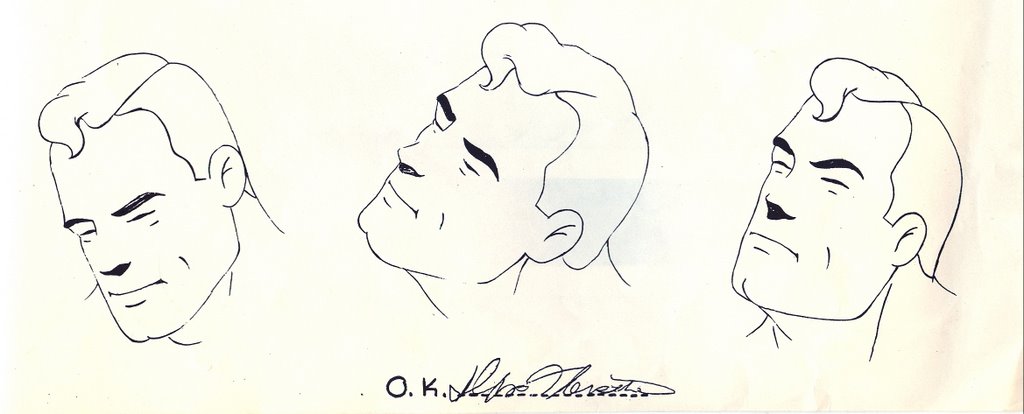
Here is a Superman model sheet to instruct artist how to draw his face ( in two images)
I think the thing people forget is just how much a departure the Superman shorts were to everything being produced in commercial animation at the time.
With the exeptions of Bob Clampett's attempt to bring Eedgar Rice Burrough's John Carter of Mars to the screen, no one had thought of using animation for non-humorous subjects.
And although the funny comic strips were raided for characters to bring to the big screen, no one thought of bringing the adventure strips to animation. If advenrure strips were adapted, it was always with live action.
Imagine some one bringing Terry and the Pirates or Flash Gordon to animation and preserving the style and tone of the strip?
And the Fleischers only did it because they were forced to by Paramount. Granted, they did a great job and the series is outstanding, however they obviously did not see animation as a vehicle for adventure, fantasy (except fairy tales) or science fiction.
Animation was worthy of humor and sentiment and that was about it.
I once had an exchange of critical letters with the late animation director Shamus Culhane. He charged the Superman shorts were failures because they didn't start a trend in the industry. Culhane was incorrect in his anaylsis.
The shorts made money and were popular. But they were expensive and a big risk. It was easier for the studios to take the easy path and keep producing humorous shorts.
© 2006 Gordon Michael Dobbs. These are my words alone.
Saturday, July 01, 2006
Marky Mark asked what I thought of the controversy over the deletion of the words "American way" from a description of what Superman stands for. I've not seen the movie yet but apparently Perry White says something like "truth, justice and all that stuff."
The Fleischer cartoons only had "truth and justice. There's a good piece at the New York Times site (http://www.nytimes.com/2006/06/30/opinion/30lundegaard.html?hp) about the history of the phrase.
Trivial pursuit is the name of the political game today. Major real issues from the cost of gas to the out-sourcing of jobs to how they hell we are going to get out of Iraq seem to get less political traction than something like this with too many people.
Now there is a debate over whether or not Superman is an American! Okay fan boys and girls, Superman is a classic illegal. He entered this country illegally and Pa and Ma Kent hid his real identity. He's suspect because he has two identities! But we are willing to overlook his illegal status because of the work he does for us! Think Superman has a passport? He comes in and out of this nation without papers. He doesn't go through customs. No one wands him at an airport. He doesn't file flight plans with the FAA. In effect he is a licensed pilot.
Hey picking fruit, watching our kids, sewing clothes and saving the planet: it's all the same!
I spent five years in talk radio and I understand this is exactly the kind of fluff issues that some talk show hosts love to present . It doesn't mean a damn thing, but it gets people angry and calling: Another example of the godless liberals who run Hollywood! They've taken Superman from us!
In the current press environment when the popular morning "news" show can feature hatemonger Ann Coulter spewing her filth and packaging it as "news," what can you expect about something nonsensical as this?
If Superman were actually real, don't you think he either be the dictator of the planet or the most apolitical person in the world? I figure for his own sanity he'd either have to one or the other.
More stuff on real things....the Fleischer Superman shorts tomorrow!
© 2006 by Gordon Michael Dobbs. My word alone here.
The Fleischer cartoons only had "truth and justice. There's a good piece at the New York Times site (http://www.nytimes.com/2006/06/30/opinion/30lundegaard.html?hp) about the history of the phrase.
Trivial pursuit is the name of the political game today. Major real issues from the cost of gas to the out-sourcing of jobs to how they hell we are going to get out of Iraq seem to get less political traction than something like this with too many people.
Now there is a debate over whether or not Superman is an American! Okay fan boys and girls, Superman is a classic illegal. He entered this country illegally and Pa and Ma Kent hid his real identity. He's suspect because he has two identities! But we are willing to overlook his illegal status because of the work he does for us! Think Superman has a passport? He comes in and out of this nation without papers. He doesn't go through customs. No one wands him at an airport. He doesn't file flight plans with the FAA. In effect he is a licensed pilot.
Hey picking fruit, watching our kids, sewing clothes and saving the planet: it's all the same!
I spent five years in talk radio and I understand this is exactly the kind of fluff issues that some talk show hosts love to present . It doesn't mean a damn thing, but it gets people angry and calling: Another example of the godless liberals who run Hollywood! They've taken Superman from us!
In the current press environment when the popular morning "news" show can feature hatemonger Ann Coulter spewing her filth and packaging it as "news," what can you expect about something nonsensical as this?
If Superman were actually real, don't you think he either be the dictator of the planet or the most apolitical person in the world? I figure for his own sanity he'd either have to one or the other.
More stuff on real things....the Fleischer Superman shorts tomorrow!
© 2006 by Gordon Michael Dobbs. My word alone here.
Thursday, June 29, 2006

Here's a model sheet from the Superman cartoon Terror on the Midway
Directed by Dan Gordon, Terror on the Midway boasts of some great non-typical cartoon editing and camera angles. The Superman cartoons were directed and laid out much more like live-action films than "typical" cartoons. I've always loved the sequence in which Superman and the ape are shown in tight cropped close-ups. It's such a radical scene for 1940s animation.
The model sheet is interesting as it shows the studio filmed a live gorilla for some rotoscope work. To the best of my knowledge they did not ever rotoscope Superman. The great animation is just that.
Fleischer animator and director Myron Waldman told me the Superman cartoons represented a challenge and a lot of work to the Fleischer crew. He noted how the characters, especially Superman, had to be animated to give the impression of weight and power.
More Fleischer Superman tomorrow.
© 2006 by Gordon Michael Dobbs. My words alone here.
Wednesday, June 28, 2006
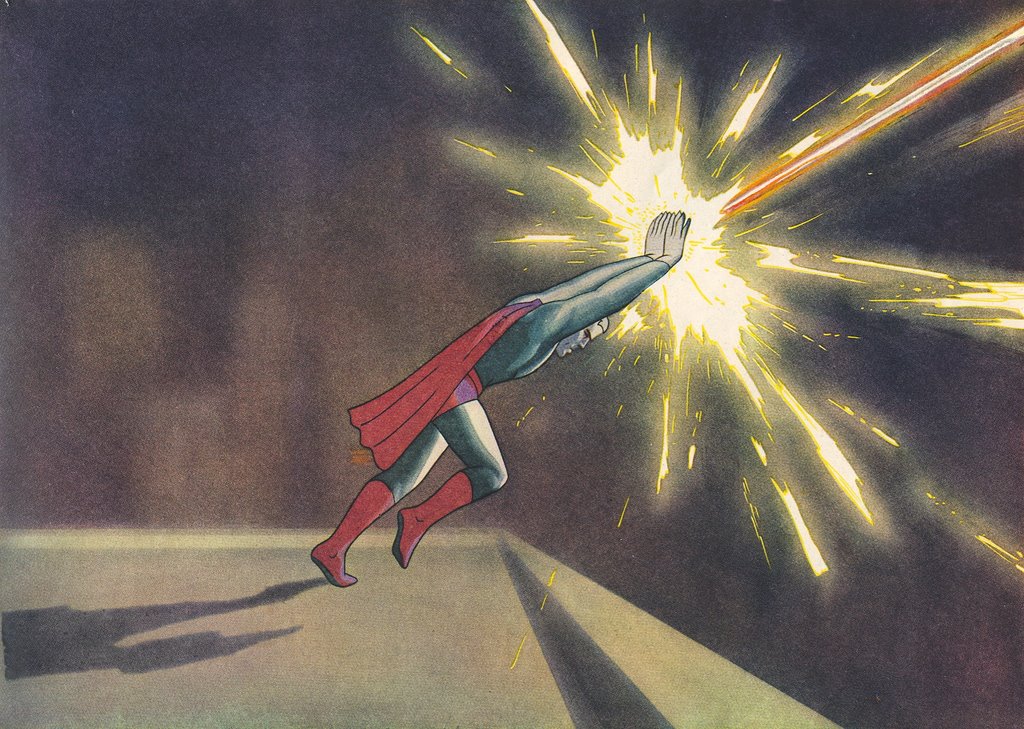
With the opening of the new Superman film, I thought it would be appropriate to post a number of items over the next few days from the first Superman cartoons: the Fleischer shorts from the early 1940s.
Here's a cel from the first Superman short that was published in an article about Superman creators Siegel and Shuster in the June 21 1941 edition of the Saturday Evening Post.
The article is quite interesting as it paints the two Cleveland guys as as babes in the woods when it comes to business; foreshadowing their years of struggle to come. I'm going to try to scan and post it.
More tomorrow!
© 2006 by Gordon Michael Dobbs. Now who could object to this post? Well, I'm to blame!
Thursday, June 22, 2006
Wisdom from Springer’s mouth to your eyes
There are not many definitive statements in life these days, but part of the conventional wisdom that floats in or collective subconscious is the idea that one wouldn’t expect profound statements from Jerry Springer.
Springer was one of the speakers at last week’s gathering of the radio talk show industry in New York City sponsored by Springfield-based Talkers Magazine.
Now I’m no hypocrite. I’ve watched plenty of Springer’s infamous television show and yes, I know it’s a very, very guilty pleasure.
The interesting thing about the former Ohio politician and television news anchor is that he has always been up front about the trash level of the program that bears his name.
He made one reference to the “ridiculously privileged life [he’s led] thanks to my stupid television show.”
It’s has been rumored that Springer has political ambitions and his current talk show on Air America (not heard in this area at this time) is an effort to rehabilitate his image so people would actually vote for him.
Now I think there are probably a whole bunch of people right now who would elect Springer to public office, but he believes he needs to be an issue-oriented media personality instead of someone who is introducing people who are their own grandpa.
I have heard his radio show and he is painfully sincere on it.
After admitting with a broad smile that he “has been everything people don’t respect,” Springer spoke about the difference between news and entertainment.
He said that the news is honest but doesn’t tell the truth, while entertainment is dishonest, but does tell the truth.
He explained that the news that is reported is the interpretation of a group of people and should not be considered the single absolute Truth.
“None of us know the truth,” Springer said. He added that news people should always be honest but should never pretend that they have “the truth.”
Entertainment is fictional, Springer, explained, but it can reveal some truth. When a work of entertainment is at its best, it can present true statements about the human condition.
Springer is right. Any one journalist who thinks he or she has a headlock on truth can be disappointed. That’s because truth is too many times a slippery entity that resists definition.
That is not to say we don’t show different sides to a story so that a reader can determine the truth for themselves, because we do that every day.
I’ve learned, though, that no matter how careful you are in constructing a story, some one is going to disagree with you and see the facts in a different light.
Go into a coffee shop and start talking politics. What is truth to you is not to others. Pick up several different publications with news colored by ideology and you’ll see the same thing.
And journalists who perch on a pedestal will more than likely get shoved off.
One more piece of advice from Springer: journalists need to take their work seriously, but not themselves.
That advice could be applied to a whole bunch of other folks as well.
©2006 by Gordon Michael Dobbs. My words alone; don't blame anyone else.
There are not many definitive statements in life these days, but part of the conventional wisdom that floats in or collective subconscious is the idea that one wouldn’t expect profound statements from Jerry Springer.
Springer was one of the speakers at last week’s gathering of the radio talk show industry in New York City sponsored by Springfield-based Talkers Magazine.
Now I’m no hypocrite. I’ve watched plenty of Springer’s infamous television show and yes, I know it’s a very, very guilty pleasure.
The interesting thing about the former Ohio politician and television news anchor is that he has always been up front about the trash level of the program that bears his name.
He made one reference to the “ridiculously privileged life [he’s led] thanks to my stupid television show.”
It’s has been rumored that Springer has political ambitions and his current talk show on Air America (not heard in this area at this time) is an effort to rehabilitate his image so people would actually vote for him.
Now I think there are probably a whole bunch of people right now who would elect Springer to public office, but he believes he needs to be an issue-oriented media personality instead of someone who is introducing people who are their own grandpa.
I have heard his radio show and he is painfully sincere on it.
After admitting with a broad smile that he “has been everything people don’t respect,” Springer spoke about the difference between news and entertainment.
He said that the news is honest but doesn’t tell the truth, while entertainment is dishonest, but does tell the truth.
He explained that the news that is reported is the interpretation of a group of people and should not be considered the single absolute Truth.
“None of us know the truth,” Springer said. He added that news people should always be honest but should never pretend that they have “the truth.”
Entertainment is fictional, Springer, explained, but it can reveal some truth. When a work of entertainment is at its best, it can present true statements about the human condition.
Springer is right. Any one journalist who thinks he or she has a headlock on truth can be disappointed. That’s because truth is too many times a slippery entity that resists definition.
That is not to say we don’t show different sides to a story so that a reader can determine the truth for themselves, because we do that every day.
I’ve learned, though, that no matter how careful you are in constructing a story, some one is going to disagree with you and see the facts in a different light.
Go into a coffee shop and start talking politics. What is truth to you is not to others. Pick up several different publications with news colored by ideology and you’ll see the same thing.
And journalists who perch on a pedestal will more than likely get shoved off.
One more piece of advice from Springer: journalists need to take their work seriously, but not themselves.
That advice could be applied to a whole bunch of other folks as well.
©2006 by Gordon Michael Dobbs. My words alone; don't blame anyone else.
Sunday, June 18, 2006

Popeye on DVD at last!?
(seem here is the late, great Jack Mercer, the man who was Popeye's voice for almost 50 years)
The announcement that Warner Brothers has signed a deal with King Features to bring the Fleischer Popeyes to DVD is one that I've been waiting for years to read.
And I'm elated that there are clearly many Fleischer/Popeye fans who welcome the release as the many posts on the animation newsgroup would show.
I've detailed my association with researching the Fleischer Studios on this blog. I am renewing my efforts to put my research in print.
Because of the friendships I've made over the years while doing the research, I have to say that the Fleischer cartoons in general, but particularly the Popeye shorts are much more than my favorite things to watch. The cartoons have played an important role in my life and clearly the lives of many other fans.
One of the best evenings of my life was spent interviewing Jack Mercer in his New York City home. He was a gracious, modest guy and it was a treat to meet him.
Let's hope that the success of this release will spur Paramount to release the Betty Boops on DVD, as well as Universal to produce a best of Walter Lantz collection. And hey, there should be a Terrytoons collection as well.
© 2006 by Gordon Michael Dobbs. My words alone, so blame me.
Wednesday, June 14, 2006
Why is the hot dog neglected?
The sultan of sausage is loved by American young and old and yet aside form Nathan's there are no national hot dog chains (and Nathan's is not sea-to-sea).
Yes, and some KFC/A&W Root Beer combos do sell dogs, but it's a sideline.
The thought occurred to me last week when in NYC.
Now locally we do have two hot dog restaurants...White Hut and Nick's Nest. And Chicopee Provisions makes an excellent dog eaten far and wide.
But what is it about the lowly dog that keeps it from climbing the height the hamburger has risen?
Or is it the dog's fate to be the champion of the independent while the burger toils in the corporate vineyard? Is the hot dog the symbol of the entrepreneur?
Your opinions, please?
And White Hut beats Nick's by a mile.
Proudly ©2006 by Gordon Michael Dobbs who will suffer the slings and arrows of criticism all by himself.
The sultan of sausage is loved by American young and old and yet aside form Nathan's there are no national hot dog chains (and Nathan's is not sea-to-sea).
Yes, and some KFC/A&W Root Beer combos do sell dogs, but it's a sideline.
The thought occurred to me last week when in NYC.
Now locally we do have two hot dog restaurants...White Hut and Nick's Nest. And Chicopee Provisions makes an excellent dog eaten far and wide.
But what is it about the lowly dog that keeps it from climbing the height the hamburger has risen?
Or is it the dog's fate to be the champion of the independent while the burger toils in the corporate vineyard? Is the hot dog the symbol of the entrepreneur?
Your opinions, please?
And White Hut beats Nick's by a mile.
Proudly ©2006 by Gordon Michael Dobbs who will suffer the slings and arrows of criticism all by himself.
Tuesday, June 13, 2006
A pirate double feature and a camp classic are in this week's DVD column.
Mommie Dearest: Hollywood Royalty Edition
The studios what release DVDs these days understand the value of packaging. We've seen a plethora of "special editions" and "director's cuts" of films as well as multiple releases of the same movie. Just how many versions of Napoleon Dynamite or the Evil Dead trilogy or Peter Jackson's King Kong do we need?
The release of Mommie Dearest in its "Hollywood Royalty edition" is a triumph of packing over content. Mommie Dearest is the film version of the 1978 best-selling book by Christina Crawford about her life and relationship with her mother, the superstar actress Joan Crawford.
High controversial when published - there were both defenders and opponents of Christina's side of the story - the book was a huge success and encouraged other children of celebrities to write about their miserable lives. As you know now, it's almost a genre onto itself.
The film was shot in 1981 and galvanized its audiences. It could either be seen as a tragedy or a story of survival or simply as over-blown camp. Since its release the film has achieved cult status. Most of us know what the phrase "No more wire hangers!" mean.
So this DVD capitalizes on the film's campiness with a commentary by director and writer John Waters and a feature on the enduring popularity of the film. Just like Joan herself, the DVD has a second face. While some of the extras celebrate the film as kitsch, the other extras feature producer and writer Frank Yablans and co-stars Diana Scarwid speaking about how good the film is and how serious it is.
Apparently star Faye Dunaway won't talk about the film, which is a bit of a mystery to Yablans.
I have to say that I'm not a fan of the film. In his commentary Waters describes the production as a bit of a horror film, and I think he's right. Dunaway's Crawford is an unstable bomb capable of going off any time for any reason - she's not an ideal parent by any stretch of the imagination. What we have is a feature-length film depicting years of child abuse, which isn't my definition for light entertainment.
However watching the film with the Waters commentary is the only way to get through it.
If you enjoyed the film before, you'll love it now. If you're like me, making fun of it is the only way to endure it.
Fortunes of Captain Blood/Captain Pirate
There are certain genres of films that were once staples, but have fallen out of favor. One of those is westerns, which were once ubiquitous, and another is the swashbuckler.
During the 1930s though the 1950s, movie goers could bet on seeing at least couple of films each year that involved guys in tights, duels, ships battling one another at sea, references to "doubloons" and "pieces of eight," dungeons, and casts full of rangy, dirty looking pirates.
Douglas Fairbanks, Junior, made a few of these films. Errol Flynn probably starred in the best ones. Louis Hayward, perhaps, made the most.
Hayward was a versatile actor who never made it to the top rung of the Hollywood ladder, but appeared in dozens of movies and television series from 1932 to 1978. Among his films were films such as The Son of Monte Cristo, The Man in the Iron Mask and this double feature in which he played pirate Captain Peter Blood.
Fortunes of Captain Blood from 1950 is a competently made, enjoyable film which Blood must free some of his men from slavery and woe the lovely Isabelita (Patricia Medina). The fast-moving story is told in expertly handled black and white.
The 1952 sequel to that film is the Technicolor Captain Pirate in which Hayward and Medina reprise their roles.
These are films from a simpler time when people simply closed their eyes and bloodlessly dropped to the ground when shot and no one questioned just why those hard-working pirates wore the exact same outfits over the course of the movie. Just learn to accept them!
If you're in the mood to sail the Spanish Main and say "Arrrrrr!" a lot, this double bill will shiver your timbers.
© 2006 by Gordon Michael Dobbs, Standard disclaimer applies.
Mommie Dearest: Hollywood Royalty Edition
The studios what release DVDs these days understand the value of packaging. We've seen a plethora of "special editions" and "director's cuts" of films as well as multiple releases of the same movie. Just how many versions of Napoleon Dynamite or the Evil Dead trilogy or Peter Jackson's King Kong do we need?
The release of Mommie Dearest in its "Hollywood Royalty edition" is a triumph of packing over content. Mommie Dearest is the film version of the 1978 best-selling book by Christina Crawford about her life and relationship with her mother, the superstar actress Joan Crawford.
High controversial when published - there were both defenders and opponents of Christina's side of the story - the book was a huge success and encouraged other children of celebrities to write about their miserable lives. As you know now, it's almost a genre onto itself.
The film was shot in 1981 and galvanized its audiences. It could either be seen as a tragedy or a story of survival or simply as over-blown camp. Since its release the film has achieved cult status. Most of us know what the phrase "No more wire hangers!" mean.
So this DVD capitalizes on the film's campiness with a commentary by director and writer John Waters and a feature on the enduring popularity of the film. Just like Joan herself, the DVD has a second face. While some of the extras celebrate the film as kitsch, the other extras feature producer and writer Frank Yablans and co-stars Diana Scarwid speaking about how good the film is and how serious it is.
Apparently star Faye Dunaway won't talk about the film, which is a bit of a mystery to Yablans.
I have to say that I'm not a fan of the film. In his commentary Waters describes the production as a bit of a horror film, and I think he's right. Dunaway's Crawford is an unstable bomb capable of going off any time for any reason - she's not an ideal parent by any stretch of the imagination. What we have is a feature-length film depicting years of child abuse, which isn't my definition for light entertainment.
However watching the film with the Waters commentary is the only way to get through it.
If you enjoyed the film before, you'll love it now. If you're like me, making fun of it is the only way to endure it.
Fortunes of Captain Blood/Captain Pirate
There are certain genres of films that were once staples, but have fallen out of favor. One of those is westerns, which were once ubiquitous, and another is the swashbuckler.
During the 1930s though the 1950s, movie goers could bet on seeing at least couple of films each year that involved guys in tights, duels, ships battling one another at sea, references to "doubloons" and "pieces of eight," dungeons, and casts full of rangy, dirty looking pirates.
Douglas Fairbanks, Junior, made a few of these films. Errol Flynn probably starred in the best ones. Louis Hayward, perhaps, made the most.
Hayward was a versatile actor who never made it to the top rung of the Hollywood ladder, but appeared in dozens of movies and television series from 1932 to 1978. Among his films were films such as The Son of Monte Cristo, The Man in the Iron Mask and this double feature in which he played pirate Captain Peter Blood.
Fortunes of Captain Blood from 1950 is a competently made, enjoyable film which Blood must free some of his men from slavery and woe the lovely Isabelita (Patricia Medina). The fast-moving story is told in expertly handled black and white.
The 1952 sequel to that film is the Technicolor Captain Pirate in which Hayward and Medina reprise their roles.
These are films from a simpler time when people simply closed their eyes and bloodlessly dropped to the ground when shot and no one questioned just why those hard-working pirates wore the exact same outfits over the course of the movie. Just learn to accept them!
If you're in the mood to sail the Spanish Main and say "Arrrrrr!" a lot, this double bill will shiver your timbers.
© 2006 by Gordon Michael Dobbs, Standard disclaimer applies.
Monday, June 12, 2006
For a second year, I had the pleasure of covering the New Media Seminar presented by Talkers Magazine. Having spent five very enjoyable years doing talk radio in the Springfield, MA, market, the seminar is an event that fires my imagination with plans to return to the medium. Alas there are no stations in this area that would even consider dropping some free show off the satellite to pay me to do a local show
But I can dream...
NEW YORK CITY - Is music on the radio an endangered species? That was just one of the issues discussed at the ninth annual New Media Seminar conducted in New York City over the weekend.
Sponsored by Springfield-based Talkers Magazine, the "bible" of the growing talk radio industry, the two-day event drew hundreds of radio hosts, programming executives and stations owners as well as some of the biggest names in the field.
Nationally syndicated hosts such as Alan Combes, Dr. Joy Browne, Jerry Doyle, Michael Medved, Jerry Springer, Mike Gallagher, Jim Bohannon, and Neal Boortz participated in the event.
The effects of ever-changing consumer electronic products and how to cope with them were also a dominant theme at the event.
Sean Hannity, the number two rated talk show host in the country, opened the conference with the prediction that talk radio "was positioned to save the AM and FM bands" of radio.
He said that talk radio was the only radio format with an upward tract.
He claimed that music radio was dying because consumers want to listen to the music they want to hear when they wanted to hear it. More and more consumers no longer want to listen to the musical selections made by program executives, Hannity maintained. Thanks to iPods, they can carry the music they love with them and listen to it any time.
Many music stations tend to play similar musical formats and lack the individuality of talk show hosts.
There is a greater exclusivity, he emphasized with the talk format. Looking at a stage filled with national and regional hosts, he said, "There is only one Jim Bohannon, only one Mike Gallagher."
Hannity told the audience that the 2008 election would be the "single biggest predictable news ratings boom in history" whether or not New York Senator Hillary Clinton runs for president.
"And she will not win," he said with a smile.
Hannity's co-star on their popular FOX television show, Alan Combes - a top-rated radio talk host as well - began his time at the podium with the statement, "And yes she will win."
Walter Sabo, an industry consultant, discussed the next technical challenge for radio. Sabo displayed a photo of big band leader Lawrence Welk taken in the mid-1950s. Welk was seen putting a record on a record player installed in his car. Sabo said that from 1955-57, Chrysler developed a record player that allowed consumers to turn their radios off and still listen to music.
And, he noted, the records would not skip due to bumps in the road.
Some people predicted the new record players would kill radio. They didn't catch on - Sabo said the players could only use specially designed records available only from the automaker. The special players became another in a long line of technological innovations that were suppose to fatally wound the medium.
He said that sound motion pictures, the eight-track player and CB radio all were supposed to phase out traditional broadcast radio. They didn't because radio adapted to the new technologies.
Sabo said the newest challenge to traditional radio would come from cell phones. He explained that cell phones offer consumers a growing array of entertainment options and that the radio industry should be working on producing programming specifically designed for the hand-held devices.
Podcasts - recordings of talk shows in a down-loadable MP3 format from web sites - and streaming radio shows on web sites were two of the technological advances that were discussed at this year's seminar. This year, Paul Duckworth, the program director at WMAL in Washington D.C. upped the technology ante by sharing that his reporters don't just attend news events with a microphone and recorder, but also with a digital movie camera.
Duckworth said his station posts digital video to accompany audio reports on their web site and gives their audience video they don't get from competing television stations.
Freedom of speech was also discussed by a number of panel members who debated just how far is too far and how to handle a bad situation created when a host makes an inappropriate remark on air.
The king of inappropriate speech was honored with this year's "Freedom of Speech Award" given by Talkers Magazine. Talkers publisher Michael Harrison said that freedom of speech was the "most misunderstood concept in our country," but is "the foundation of our country."
Harrison announced that self-proclaimed "King of All Media" Howard Stern was this year's recipient.
"Stern deserves this more than anyone in our industry," Harrison said.
Among Stern's accomplishments was pioneering the concept of talk on FM syndication in the morning and expanding "the envelope of artistic speech that could be performed on government regulated radio."
Stern did not attend the event, but one of his radio show's cast members, George Takei, accepted the award on Stern's behalf.
Takei described Stern as "an American of principal and courage."
© 2006 by Gordon Michael Dobbs. Smoke'em if you've got 'em. You know the drill: this is my stuff and I'm responsible.
But I can dream...
NEW YORK CITY - Is music on the radio an endangered species? That was just one of the issues discussed at the ninth annual New Media Seminar conducted in New York City over the weekend.
Sponsored by Springfield-based Talkers Magazine, the "bible" of the growing talk radio industry, the two-day event drew hundreds of radio hosts, programming executives and stations owners as well as some of the biggest names in the field.
Nationally syndicated hosts such as Alan Combes, Dr. Joy Browne, Jerry Doyle, Michael Medved, Jerry Springer, Mike Gallagher, Jim Bohannon, and Neal Boortz participated in the event.
The effects of ever-changing consumer electronic products and how to cope with them were also a dominant theme at the event.
Sean Hannity, the number two rated talk show host in the country, opened the conference with the prediction that talk radio "was positioned to save the AM and FM bands" of radio.
He said that talk radio was the only radio format with an upward tract.
He claimed that music radio was dying because consumers want to listen to the music they want to hear when they wanted to hear it. More and more consumers no longer want to listen to the musical selections made by program executives, Hannity maintained. Thanks to iPods, they can carry the music they love with them and listen to it any time.
Many music stations tend to play similar musical formats and lack the individuality of talk show hosts.
There is a greater exclusivity, he emphasized with the talk format. Looking at a stage filled with national and regional hosts, he said, "There is only one Jim Bohannon, only one Mike Gallagher."
Hannity told the audience that the 2008 election would be the "single biggest predictable news ratings boom in history" whether or not New York Senator Hillary Clinton runs for president.
"And she will not win," he said with a smile.
Hannity's co-star on their popular FOX television show, Alan Combes - a top-rated radio talk host as well - began his time at the podium with the statement, "And yes she will win."
Walter Sabo, an industry consultant, discussed the next technical challenge for radio. Sabo displayed a photo of big band leader Lawrence Welk taken in the mid-1950s. Welk was seen putting a record on a record player installed in his car. Sabo said that from 1955-57, Chrysler developed a record player that allowed consumers to turn their radios off and still listen to music.
And, he noted, the records would not skip due to bumps in the road.
Some people predicted the new record players would kill radio. They didn't catch on - Sabo said the players could only use specially designed records available only from the automaker. The special players became another in a long line of technological innovations that were suppose to fatally wound the medium.
He said that sound motion pictures, the eight-track player and CB radio all were supposed to phase out traditional broadcast radio. They didn't because radio adapted to the new technologies.
Sabo said the newest challenge to traditional radio would come from cell phones. He explained that cell phones offer consumers a growing array of entertainment options and that the radio industry should be working on producing programming specifically designed for the hand-held devices.
Podcasts - recordings of talk shows in a down-loadable MP3 format from web sites - and streaming radio shows on web sites were two of the technological advances that were discussed at this year's seminar. This year, Paul Duckworth, the program director at WMAL in Washington D.C. upped the technology ante by sharing that his reporters don't just attend news events with a microphone and recorder, but also with a digital movie camera.
Duckworth said his station posts digital video to accompany audio reports on their web site and gives their audience video they don't get from competing television stations.
Freedom of speech was also discussed by a number of panel members who debated just how far is too far and how to handle a bad situation created when a host makes an inappropriate remark on air.
The king of inappropriate speech was honored with this year's "Freedom of Speech Award" given by Talkers Magazine. Talkers publisher Michael Harrison said that freedom of speech was the "most misunderstood concept in our country," but is "the foundation of our country."
Harrison announced that self-proclaimed "King of All Media" Howard Stern was this year's recipient.
"Stern deserves this more than anyone in our industry," Harrison said.
Among Stern's accomplishments was pioneering the concept of talk on FM syndication in the morning and expanding "the envelope of artistic speech that could be performed on government regulated radio."
Stern did not attend the event, but one of his radio show's cast members, George Takei, accepted the award on Stern's behalf.
Takei described Stern as "an American of principal and courage."
© 2006 by Gordon Michael Dobbs. Smoke'em if you've got 'em. You know the drill: this is my stuff and I'm responsible.
Sunday, June 04, 2006
Just what the world needs...a new blog!
I've started another blog to discuss the issues that confront me and other "small town" journalists in the ever-changing world of mass media.
It's interesting to work in a medium, such as weekly newspapers, which media analysts like to to compare to the walking dead. The death of newspapers is discussed frequently and yet in New England supposedly 91 % of adults say they read some sort of newspaper.
It's a big fat mixed message and I wanted to create a blog on which media professionals and concerned consumers could discuss the issues that affect them.
For instance, I would love to know how many people really believe the myth of the "liberal" press? What the hell does "liberal," "centralist," and "conservative" mean these days and how do those terms relate to what one reads in a newspaper?
If you're interested, the link to the new blog, That's Thirty, is here on my links list.
I've started another blog to discuss the issues that confront me and other "small town" journalists in the ever-changing world of mass media.
It's interesting to work in a medium, such as weekly newspapers, which media analysts like to to compare to the walking dead. The death of newspapers is discussed frequently and yet in New England supposedly 91 % of adults say they read some sort of newspaper.
It's a big fat mixed message and I wanted to create a blog on which media professionals and concerned consumers could discuss the issues that affect them.
For instance, I would love to know how many people really believe the myth of the "liberal" press? What the hell does "liberal," "centralist," and "conservative" mean these days and how do those terms relate to what one reads in a newspaper?
If you're interested, the link to the new blog, That's Thirty, is here on my links list.
Subscribe to:
Posts (Atom)