
Saturday, July 22, 2006


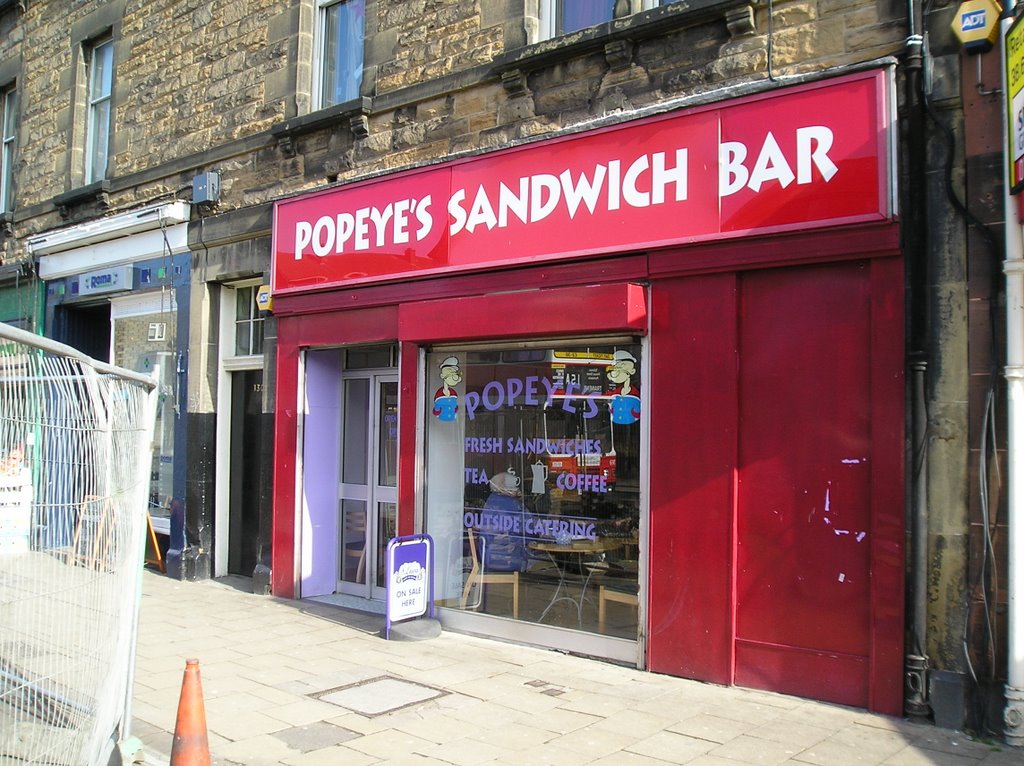
I've meant to post something about our trip to Scotland Mary and I took in March, but haven't gotten around to it until one of our publications at work needed a travel piece. There's lot more I could add and I include more material for this post. The first image is yours truly at Castle Doune. The second image is from Edinburgh. Frequent readers of this blog will understand why I took it! The third is the Wallace Memorial as seen from Stirling Castle.

It's a mid-March day in Edinburgh and the snow is blowing sideways on the windshield of our taxicab.

It's springtime in Scotland.

As our cabbie negotiated the medieval streets of the capitol of Scotland, there are signs that spring is actually here - there are flowers in bloom everywhere.

This is my second trip to Scotland - my wife was born in Glasgow and raised in Paisley - and we have the advantage of having generous and hospitable relatives to put us up and give us sight-seeing advice.

Even if we didn't have this wonderful resource, Scotland would still be a relaxing destination. Scots are friendly, the mass transit is abundant and easy to use and there are tourist information centers with plenty of information.

We crammed as much as we could in the period of 12 days. If you're planning a trip to the United Kingdom, give yourself a treat and spend some time in Scotland.

Edinburgh

The capitol of the nation is by far one of most tourist friendly spots I've ever visited. There is a tourist information center in the center of the city on Princes Street near the huge spire that is a memorial to Sir Walter Scott.

The biggest tourist spot is the Royal Mile, the street that begins on the top of a hill and the site of Edinburgh Castle and ends at the Holyrood House where the British royal family stays when they're passing through.

Undoubtedly the best known attraction in the city, Edinburgh Castle is a feast for any history, military or architecture buff. Expect to spend the better part of several hours at the castle.

Tourist Tip Number One: When at the castle, don't ask when the famed one'o'clock gun is fired.

Walking down the Royal Mile you see a wide variety of shops with their guns aimed squarely at tourists. Frankly I enjoy these kinds of shops, as they are the source for all of items you're going to bring home to family and friends.

Off the Royal Mile, on Chambers Street, are the Royal Museum and the Museum of Scotland, two museums in two joined buildings. Admission is free and the museums house wonderful exhibits on the history of the nation as well as decorative arts, archeology and the natural world.

There is a great cafe in the center of the two museums, which is an ideal place to relax after a day of walking. Keep your eyes peeled, here: Harry Potter author J.K. Rowling is a regular. Our friends who were traveling with us actually had a sighting!

Tourist Tip Number Two: Always keep a 20 pence coin or two 10 pence coins with you for the pay toilets.

Across from the museums is the Greyfriars Kirkyard and the resting place of Greyfriars Bobby, a Skye terrier who watch over his master's grave for 14 years and was adopted by the city of Edinburgh.

The Greyfriars Pub is outside the gate of the cemetery and features a haggis sampler. Go ahead and try it. The national dish of Scotland - actually just a mixture of mutton, oats and spices - has a bad reputation, but is quite good, specially when eaten with the traditional mashed potatoes and turnips or tatties and neeps.

Tourist Tip Number Three: When in a Scottish pub, don't order "Scotch." In Scotland it's just whiskey. And you might not find your brand there as much of what we drink here is only available for export.

Glasgow
Just a quick 45-minute train ride away is the largest city on the nation. If Edinburgh is like New York - a flashy tourist destination - then Glasgow is like Chicago. It's a great city with plenty to see and do that some folks just don't think about.

We arrived on a Saturday afternoon and spend most of it just walking through the bustling downtown. That's right. I did just write the word "bustling," "Saturday afternoon" and "downtown" together. In many American cities, down towns are dead on the weekend, but in Glasgow shopping malls haven't sucked the life out of urban areas.

Sauchiehall Street is a blast with great shops, restaurants and pubs. We walked into pub and found a six piece jazz band playing up a storm - something you'd never see on an afternoon in an American bar.

Tourist Tip Number Four: There is a substantial difference in language between Edinburgh and Glasgow, largely thanks to the "Glesgie patter," or slang. As long as they don't call you an "eejit" you're okay.

There are great museums in Glasgow - 13 in fact - ranging from Museum of Transport to the Burrell Collection of paintings, furniture, textile and sculpture to the magnificent Kelvingrove Art Gallery and Museum. Admission is free to the museums, which is helpful on a tight tourist budget.

Other sights

Stirling Castle, in the village of Stirling, is in Braveheart country. This is the second most important castle in the country and is well worth the scenic drive into the foothills of the Highlands.

Aberdeen is known as the "Granite City," and for a very good reason - most of the buildings are made from the native material. It's far from a "grey" town, though thanks to the large student population as well as a hustle and bustle from its large port.

If you love chocolate Scotland is the place to be. Here's words to look for: Cadbury's ( the real stuff...not what we get here) and Tunnock's. I'm in love with the Tunnock's line of wafers and tea cakes. Fabulous!

In Glasgow we found a non-touristy restuarant chain called Jake McPhees (pretty sure of thespellingg) where a slightly surly waitress reminded me that beans come on top of Scotch Pies. I told her I was not stranger to Glasgow and knew that. She seemed a little surprised and was then less surly! We also tried a fish and chip platter ( I know stereotypicall foods, but these you have to try in a foreign country) and it was, as the folks in Glasgow say, "magic."

We loved shopping at Govan market, an outdoors event in a very hard-core section of the city. The stalls sell everything from baked goods to carpeting and I loved watching the portable butcher shop conduct a television-style informerical– holding up various cuts of meat, describing it and talking about the price. The broken glass and dog shite on the sidewalk made me feel at home!

The underground in Glasgow is a dream for the tourist. Much cheaper than a cab, the subway line is a big cricle through the city. If you miss your station, don't worry, you'll get back to it eventually.

For film nuts such as myself, the best place to get DVDs is Fopp, a British chain that features a vast selection at the lowest prices I've seen. Get yourself an all-region player before you go to UK and then hunt down a Fopp.

For me, though, the best moment is when I could walk around Doune Castle, just minutes away from Stirling in the village of Doune. This is where Monty Python filmed much of their second film Monty Python and The Holy Grail. If you're quiet enough, you can still hear the clapping of coconut shells. We' re too late for a tour, so I walked around the castle and picked up a bit of masonry that had fallen on the pathway.

As always we are indebted to wife's Scottish relatives for their unlimited hospitality.

Tourist Tip Number Five: One trip to Scotland isn't enough.

© 2006 by Gordon Michael Dobbs. Yes, I used the word "shite." I take responsibility.

Wednesday, July 19, 2006

Sometimes what I write here helps me construct my column for the newspapers I edit. Here's an example.

You never know what is going to interest people.

In the new Superman film, the Man of Steel returns to Earth after a five-year search in space for his home world. He doesn't find it and comes back to resume his life here.

His return is met with general acceptance, but for Lois Lane the news isn't necessarily good.

You see Lois is hurt that the man she loved took off without an explanation, especially since there was a little complication: a son.

So I thought some folks would be enraged that Superman and Lois had pre-marital relations, but no one seems too upset about that.

Instead some conservative commentators have latched onto the scene in which Perry White, the editor of The Daily Planet, is talking to his staff. He wants to know everything about Superman and his return. He asks if Superman still stands for "truth, justice and all that stuff?"

Apparently the writers and the director wanted not to include the phrase "American way" because this film will play to audiences world-wide and this nation's policies are not uniformly popular.

Carol Platt Liebau writes on the web site for The American Spectator, "Certainly, Hollywood filmmakers want to distribute their films overseas. It's possible that someone felt that explicitly aligning Superman with American values and interests might alienate some foreign audiences. After all, these days, moviegoers abroad are used to seeing American films that depict the worst, rather than the best, of the American character.

"But if that were the case, the phrase 'the American way' could simply be dubbed out of the film's foreign versions, treated like other culturally inappropriate material when films are adapted for an overseas audience. As ridiculous as that arrangement would be, it could, at least, be defended as a business decision, albeit a repugnant one.

"But there's more to it than that. It's not only that the film's creators believe that non-Americans would find the phrase offensive - they themselves do, too.

"According to reports in the New York Post, the screenwriters of the film wanted to avoid 'outdated jingoism.' One of them commented, 'I don't think 'the American way' means what it meant in 1945.' The other noted, 'He's not just for Metropolis and not just for America.' Apparently, he's a new Superman for the global age."

It would be nice is Liebau actually knew something about the character and its history. The 1940s animated cartoons made by the Fleischer Studios used the phrase "truth and justice." There was no mention of the "American way" even in the cartoons produced after the start of WWII.
The early Superman was indeed a champion for the underdog as written by his co-creator Jerry Siegel. He fought mobsters, quacks and dictators and the police didn't like him very much. They considered him a vigilante.

By the time the 1950s rolled around and the production of the popular television series the character was far more establishment. In the light of the cold war, the phrase "American way" was added to the list.

I always thought the phrase was redundant - is truth and justice inherently supposed to be the American way?

This is the kind of subject that some talk show hosts love because it means nothing and yet gets some people very angry.
As a piece of pop culture I found the film to be a fun but thoughtful look on the burden a real Superman would have to carry in this world. The character is not one that would lend itself to a politically charged story.

Liebau doesn't bring up that Superman is the ultimate illegal alien. He was brought into the country illegally, given a fake identity as a child, adopted a second fake identity as an adult, carries no passport and files no flight plans with the FAA.

And we expect him to help us out and no one seems upset that he doesn't get just compensation for his labors.

Perhaps she doesn't want to consider that aspect of "the American way."

©2006 by Gordon Michael Dobbs. Sorry if I hurt your feelings. These are my words alone.

Tuesday, July 18, 2006


And Carlos was a nice guy!

The deputies of Reno 911! are back – on television and on DVD.

The fourth season of the popular comic police show has started on Comedy Central and the third season has just been released to DVD in a two-disc set.

If you’ve not seen the show, it’s a clever and raucous parody of FOX’s Cops. Set in Reno, Nevada, documentary cameras follow around a group of sheriff deputies during both their professional and personal lives.

Led by the hot pants-wearing Lt. Jim Dangle (Thomas Lennon), The Reno squad includes the in your face Deputy Raineesha Williams (Niecy Nash), the flack-vest wearing depute Travis Junior (Robert Ben Garant), the deeply disturbed Deputy Trudy Weigel (Kerri Kenny), the amorous Deputy Clementine Johnson and ladies’ man Deputy S. Jones (Cedric Yarbrough), the seasoned vet and bigot Deputy James Garcia (Carlos Alazraqui) and the rookie Deputy Cheresa Kimball (Mary Birdsong).

Very politically incorrect, Reno is a show that constantly surprises and sometimes shocks. Viewers are never quite sure how far a gag will be taken. On episode in the third season DVD, Dangle and Junior go undercover at a spa to follow a suspect there for a massage. The suspect takes off in his car and Dangle and Junior rush out of the door of the spa in hot pursuit with only their socks and shoes on. The spa locks its doors behind them and they have to make their way back eight miles to the station house.

The third season opens with episodes that show how the group got kicked off the force, served time in jail and then resumed their lives but as civilians. There is some funny stuff here, especially with Dangle trying out for American Idol and Jones and Garcia relishing their new lives as mall cops.

The third season set also features two groups of extended outtakes which shows how the cast crafts the scene through trial and error. The cast provides commentaries on several episodes, which give insights into the creative process.

***

Carlos Alazraqui

What makes Reno unique in American television is that it’s a sit-com that is almost all improvised and after four seasons cast member Carlos Alazraqui said in an interview with Reminder Publications that the cast is now a lot better at the acting challenge than during the show’s first season.

He attributed the early success of the show to “dumb luck.”

He explained how the show is shot. The cast is given a general description of a scene and then rehearses a short length of time developing some of the dialogue. If the director likes the lines, they start filming. Alazraqui estimated that the actors improvise 70 percent of the show.

The show is not shot in Reno, Alazraqui explained. It’s filmed in the greater Los Angeles area. The sheriff’s station is a real police station in Carson, Calif., and Alazraqui said the officers generally support the show.
“Ninety-five percent really love it,” Alazraqui said.

He added that one officer in particular makes an effort to help them out by telling them about real life incidents that could be used for the comedy. He has told the cast that some of their antics are reflections of what has happened to cops in real life.

Alazraqui’s character is frequently paired off with Yarbrough’s Jones and that was because the two actors hit it off in the pilot. Alazraqui said the producers liked the physical contrast between the men as well as the fact that Garcia was an unapologetic bigot.

Alazraqui added that “the whole staff is racially prejudiced.”

Alazraqui comes to the show from a stand-up comedy background and from a very active career as a voice artist in animation. If you’ve watched Nickelodeon in the past few years, you’ve heard him on shows such as The Fairly Odd Parents (as the evil Mr. Crocker), Camp Lazlo (Lazlo and Clem) and Rocko’s Modern Life (as Rocko).

Rocko was his first animated role and he is again working with Rocko creator Joe Murray on his new show Camp Lazlo.

“I’ve come full circle with Camp Lazlo,” he said.

You also heard him as the voice of the Taco Bell Chihuahua, a commercial campaign that is still remembered six years after it ended.

“That was a bizarre thing to land,” Alazraqui said.

He’s a cast member of the new animated film Happy Feet due for release in November and plays a Latino penguin named Nestor. The voice cast also includes Robin Williams.

That feature film release will be following in January 2007 with the premiere of Reno 911!: Miami. Alazraqui explained that in the movie the Reno deputies travel to Miami to attend a law enforcement convention in Miami. They lack the proper credentials and are not allowed in.

But when a biohazard forced the quarantine of the officer in the convention hall, the Reno deputies takes to the streets of Miami to keep the peace.

The film was shot in the same improv style, although Alazraqui said the cast had to pay much closer attention to creating dialogue and situation that matched the movie’s plot.

Alazraqui still performs stand-up and he said he favors no one aspect of his career.

“It’s so relative to the situation,” he explained. “There is nothing like the live response [to stand-up] when they love you. I get paid to do goofy voices. That’s another high.”

“The benefits of a multi-pronged career is that I get to do different jobs,” he said.

© Gordon Michael Dobbs 2006. My words alone.

Sunday, July 16, 2006

My wife and I have been on vacation this week and have been out of the state and away from computers for part of that time. Here are some observations from the road.

We were in Virginia to visit my mom and we hate taking I 95 all the way to the Richmond area. So, for years, we have been using US 301 for part of the trip to avoid the headaches of traffic around Washington DC. For a long time the route was a joy to drive: mostly small towns and farming areas.

Not any more.

It was astonishing to see just how built-up these one-time sleepy areas are now. Outside of Wilmington, Delaware, there are scores of new houses and big box stores to obviously fill the need of folks escaping from city life and waiting to create suburbs out of the country.

The traffic was horrendous in areas where it was once smooth-sailing.

Now I will admit that I generally despise the 'burbs. They have all of the disadvantages of living in a city (closeness to your neighbors,etc) and none of the fun of country life. The creation of more developments on one-time farmland is a mortal sin in my book.

I'd rather see our cities re-need than our rural areas taken away.

That's just me. But I would also like to see more mass transportation, the development of electric cars, more urban gardening projects and an emphasis on renovation of existing buildings.

***

Seen along the road: crabs fro $99 a bushel basket. You've got to be committed to seafood to pay a hundred bucks to some guy for a big basket of crabs that need to stay alive until you cook them.

***

We love Wa-Wa, a chain of uber-gas stations with a fantastic selection of food items for folks on the move and clean rest rooms.

***
A word on rest rooms: people can't be trusted.

Step into any public facility today and the odds are the toilets and urinals will flush themselves. The faucets and soap dispensers will be automatic as will the paper towels.

Obviously we can be trusted to flush things, turn off the water and tear off the right amount of towels.

Now I know these things are done in the name of cleanliness and thrift, but it goes to the heart of the matter that people are pigs when it comes to the use of public restrooms.

As someone who has had to maintain rest rooms for the public I will never understand the psychology of walking into someplace that will be used by another people and urinating all over it.

Is this our instinctive marking of territory manifesting itself?

Oh, well... Just know that in the South, Wa Wa has clean restrooms. Thank all that is holy!

©Gordon Michael Dobbs 2006. My words alone.

Tuesday, July 04, 2006


The Curse of Superman?

Believe it or not, some of the TV entertainment shows are bringing up the old chestnut that there is a curse assigned to playing Superman. Kirk Alyn lived to a ripe old age and Bud Collier seemed to do all right himself. I'm sorry about George Reeves and Christopher Reeve and this story belittles their lives.

More much ado about nothing; typical TV.

However there is a great lesson about Superman: creators need to own their creations.

Now I'm entering my close friend Steve Bissette's territory here. He's been talking and writing about this subject for years. Hell, even Mark Martin ( the great comix artist NOT the race car driver) even will write about creator rights. He's another close friend. So I guess I'm caving in to peer pressure!

The photo above is from that June 21, 1941 article on Superman. As you can see, Siegel and Shuster are shown as living now in relative luxury. We all know now that in just a few years they were screwed in ways by DC Comics that affected the rest of their lives.

Max Fleischer did not benefit from his experience with Superman. He didn't own the character. He didn't own his most popular character, Popeye, either. He did eventually own Betty Boop, but only after a court battle and wound up not owning a single one of the films he produced. His heirs, though, have greatly benefited from the court case and have made a ton of dough in merchandising. Too late for Max, though.

The writers of the Mutual radio series, which introduced us to kryptonite and Jimmy Olson and other conventions which the comic adopted, got paid for their efforts and that was that.

Over 60 years later, creators are still fighting this corporate battle and in a way you can't blame the corporations. Corporations that publish or produce want something in exchange for the risk they take. Anticipating a success, they want some sort of long-term participation in the property.

It is always a balancing act between the two parties. Creators must always know what they are willing to give up in order to get their product out to the public.

One of the great "geniuses" in comics (insert sarcastic tone here; in fact probably the only "genius") talked about how the Internet was going to liberate many creative types from corporate bondage by setting up a new economic model. You create something, put it on your web site and people will pay for it. You eliminate the middle man.

Perhaps with music, we've see the beginnings of that kind of commerce. You notice though that most of the attention is generated by big recording companies partnering with other big Internet companies. And that success has come about because of a device that allows you to download the music and carry it everywhere.

Considering that many people don't have high speed connections, downloading a comic book, a novel or a poster is out of the question. Many people would not want to print a 24 page color comic on their home printer.

The web is still years away from being that direct pipeline from creator to consumer when it comes to a viable economic model, despite what "geniuses" say.

Today many creative types can learn a lot from Siegel and Shuster. They can avoid some of the landmines in the creative process that these two stumbled upon. Most importantly, they should learn not to give up on their dreams.

©2006 by Gordon Michael Dobbs. You know the drill.

Sunday, July 02, 2006


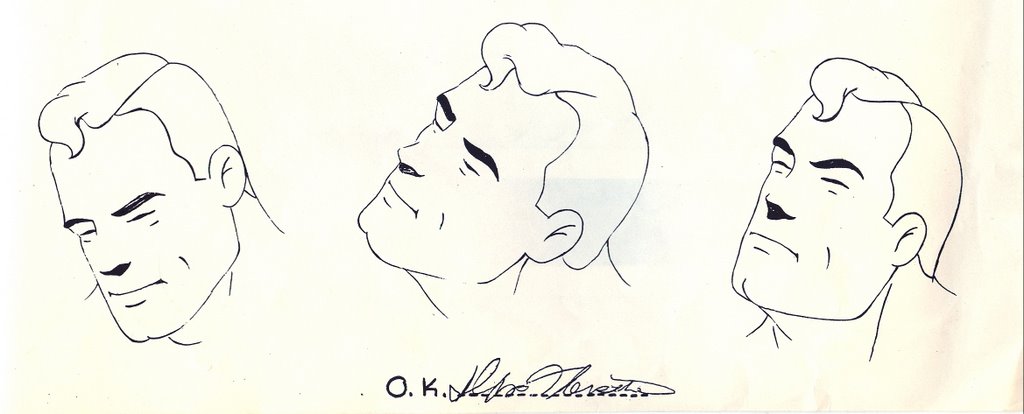
Here is a Superman model sheet to instruct artist how to draw his face ( in two images)

I think the thing people forget is just how much a departure the Superman shorts were to everything being produced in commercial animation at the time.

With the exeptions of Bob Clampett's attempt to bring Eedgar Rice Burrough's John Carter of Mars to the screen, no one had thought of using animation for non-humorous subjects.

And although the funny comic strips were raided for characters to bring to the big screen, no one thought of bringing the adventure strips to animation. If advenrure strips were adapted, it was always with live action.

Imagine some one bringing Terry and the Pirates or Flash Gordon to animation and preserving the style and tone of the strip?

And the Fleischers only did it because they were forced to by Paramount. Granted, they did a great job and the series is outstanding, however they obviously did not see animation as a vehicle for adventure, fantasy (except fairy tales) or science fiction.

Animation was worthy of humor and sentiment and that was about it.

I once had an exchange of critical letters with the late animation director Shamus Culhane. He charged the Superman shorts were failures because they didn't start a trend in the industry. Culhane was incorrect in his anaylsis.

The shorts made money and were popular. But they were expensive and a big risk. It was easier for the studios to take the easy path and keep producing humorous shorts.

© 2006 Gordon Michael Dobbs. These are my words alone.

Saturday, July 01, 2006

Marky Mark asked what I thought of the controversy over the deletion of the words "American way" from a description of what Superman stands for. I've not seen the movie yet but apparently Perry White says something like "truth, justice and all that stuff."

The Fleischer cartoons only had "truth and justice. There's a good piece at the New York Times site (http://www.nytimes.com/2006/06/30/opinion/30lundegaard.html?hp) about the history of the phrase.

Trivial pursuit is the name of the political game today. Major real issues from the cost of gas to the out-sourcing of jobs to how they hell we are going to get out of Iraq seem to get less political traction than something like this with too many people.

Now there is a debate over whether or not Superman is an American! Okay fan boys and girls, Superman is a classic illegal. He entered this country illegally and Pa and Ma Kent hid his real identity. He's suspect because he has two identities! But we are willing to overlook his illegal status because of the work he does for us! Think Superman has a passport? He comes in and out of this nation without papers. He doesn't go through customs. No one wands him at an airport. He doesn't file flight plans with the FAA. In effect he is a licensed pilot.

Hey picking fruit, watching our kids, sewing clothes and saving the planet: it's all the same!

I spent five years in talk radio and I understand this is exactly the kind of fluff issues that some talk show hosts love to present . It doesn't mean a damn thing, but it gets people angry and calling: Another example of the godless liberals who run Hollywood! They've taken Superman from us!

In the current press environment when the popular morning "news" show can feature hatemonger Ann Coulter spewing her filth and packaging it as "news," what can you expect about something nonsensical as this?

If Superman were actually real, don't you think he either be the dictator of the planet or the most apolitical person in the world? I figure for his own sanity he'd either have to one or the other.

More stuff on real things....the Fleischer Superman shorts tomorrow!

© 2006 by Gordon Michael Dobbs. My word alone here.

Thursday, June 29, 2006


Here's a model sheet from the Superman cartoon Terror on the Midway

Directed by Dan Gordon, Terror on the Midway boasts of some great non-typical cartoon editing and camera angles. The Superman cartoons were directed and laid out much more like live-action films than "typical" cartoons. I've always loved the sequence in which Superman and the ape are shown in tight cropped close-ups. It's such a radical scene for 1940s animation.

The model sheet is interesting as it shows the studio filmed a live gorilla for some rotoscope work. To the best of my knowledge they did not ever rotoscope Superman. The great animation is just that.

Fleischer animator and director Myron Waldman told me the Superman cartoons represented a challenge and a lot of work to the Fleischer crew. He noted how the characters, especially Superman, had to be animated to give the impression of weight and power.

More Fleischer Superman tomorrow.

© 2006 by Gordon Michael Dobbs. My words alone here.

Wednesday, June 28, 2006


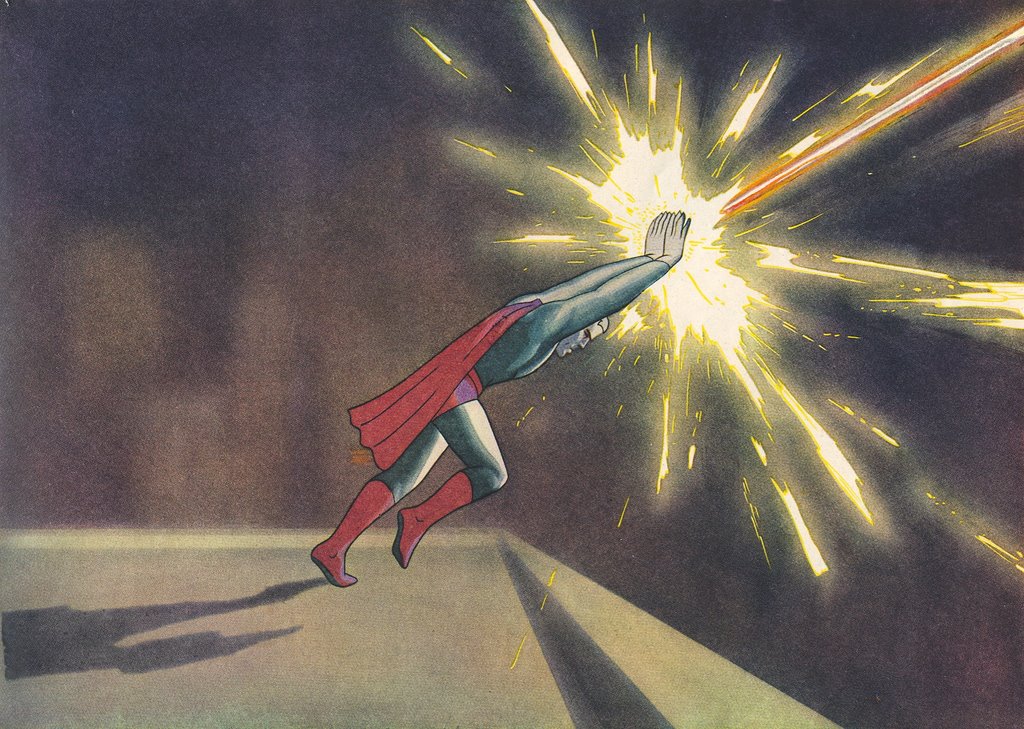
With the opening of the new Superman film, I thought it would be appropriate to post a number of items over the next few days from the first Superman cartoons: the Fleischer shorts from the early 1940s.

Here's a cel from the first Superman short that was published in an article about Superman creators Siegel and Shuster in the June 21 1941 edition of the Saturday Evening Post.

The article is quite interesting as it paints the two Cleveland guys as as babes in the woods when it comes to business; foreshadowing their years of struggle to come. I'm going to try to scan and post it.

More tomorrow!

© 2006 by Gordon Michael Dobbs. Now who could object to this post? Well, I'm to blame!

Thursday, June 22, 2006

Wisdom from Springer’s mouth to your eyes

There are not many definitive statements in life these days, but part of the conventional wisdom that floats in or collective subconscious is the idea that one wouldn’t expect profound statements from Jerry Springer.

Springer was one of the speakers at last week’s gathering of the radio talk show industry in New York City sponsored by Springfield-based Talkers Magazine.

Now I’m no hypocrite. I’ve watched plenty of Springer’s infamous television show and yes, I know it’s a very, very guilty pleasure.

The interesting thing about the former Ohio politician and television news anchor is that he has always been up front about the trash level of the program that bears his name.

He made one reference to the “ridiculously privileged life [he’s led] thanks to my stupid television show.”

It’s has been rumored that Springer has political ambitions and his current talk show on Air America (not heard in this area at this time) is an effort to rehabilitate his image so people would actually vote for him.

Now I think there are probably a whole bunch of people right now who would elect Springer to public office, but he believes he needs to be an issue-oriented media personality instead of someone who is introducing people who are their own grandpa.

I have heard his radio show and he is painfully sincere on it.

After admitting with a broad smile that he “has been everything people don’t respect,” Springer spoke about the difference between news and entertainment.

He said that the news is honest but doesn’t tell the truth, while entertainment is dishonest, but does tell the truth.

He explained that the news that is reported is the interpretation of a group of people and should not be considered the single absolute Truth.

“None of us know the truth,” Springer said. He added that news people should always be honest but should never pretend that they have “the truth.”

Entertainment is fictional, Springer, explained, but it can reveal some truth. When a work of entertainment is at its best, it can present true statements about the human condition.

Springer is right. Any one journalist who thinks he or she has a headlock on truth can be disappointed. That’s because truth is too many times a slippery entity that resists definition.

That is not to say we don’t show different sides to a story so that a reader can determine the truth for themselves, because we do that every day.

I’ve learned, though, that no matter how careful you are in constructing a story, some one is going to disagree with you and see the facts in a different light.

Go into a coffee shop and start talking politics. What is truth to you is not to others. Pick up several different publications with news colored by ideology and you’ll see the same thing.

And journalists who perch on a pedestal will more than likely get shoved off.

One more piece of advice from Springer: journalists need to take their work seriously, but not themselves.

That advice could be applied to a whole bunch of other folks as well.

©2006 by Gordon Michael Dobbs. My words alone; don't blame anyone else.

Sunday, June 18, 2006


Popeye on DVD at last!?
(seem here is the late, great Jack Mercer, the man who was Popeye's voice for almost 50 years)


The announcement that Warner Brothers has signed a deal with King Features to bring the Fleischer Popeyes to DVD is one that I've been waiting for years to read.

And I'm elated that there are clearly many Fleischer/Popeye fans who welcome the release as the many posts on the animation newsgroup would show.

I've detailed my association with researching the Fleischer Studios on this blog. I am renewing my efforts to put my research in print.

Because of the friendships I've made over the years while doing the research, I have to say that the Fleischer cartoons in general, but particularly the Popeye shorts are much more than my favorite things to watch. The cartoons have played an important role in my life and clearly the lives of many other fans.

One of the best evenings of my life was spent interviewing Jack Mercer in his New York City home. He was a gracious, modest guy and it was a treat to meet him.

Let's hope that the success of this release will spur Paramount to release the Betty Boops on DVD, as well as Universal to produce a best of Walter Lantz collection. And hey, there should be a Terrytoons collection as well.

© 2006 by Gordon Michael Dobbs. My words alone, so blame me.

Wednesday, June 14, 2006

Why is the hot dog neglected?

The sultan of sausage is loved by American young and old and yet aside form Nathan's there are no national hot dog chains (and Nathan's is not sea-to-sea).

Yes, and some KFC/A&W Root Beer combos do sell dogs, but it's a sideline.

The thought occurred to me last week when in NYC.

Now locally we do have two hot dog restaurants...White Hut and Nick's Nest. And Chicopee Provisions makes an excellent dog eaten far and wide.

But what is it about the lowly dog that keeps it from climbing the height the hamburger has risen?

Or is it the dog's fate to be the champion of the independent while the burger toils in the corporate vineyard? Is the hot dog the symbol of the entrepreneur?

Your opinions, please?

And White Hut beats Nick's by a mile.

Proudly ©2006 by Gordon Michael Dobbs who will suffer the slings and arrows of criticism all by himself.

Tuesday, June 13, 2006

A pirate double feature and a camp classic are in this week's DVD column.

Mommie Dearest: Hollywood Royalty Edition

The studios what release DVDs these days understand the value of packaging. We've seen a plethora of "special editions" and "director's cuts" of films as well as multiple releases of the same movie. Just how many versions of Napoleon Dynamite or the Evil Dead trilogy or Peter Jackson's King Kong do we need?

The release of Mommie Dearest in its "Hollywood Royalty edition" is a triumph of packing over content. Mommie Dearest is the film version of the 1978 best-selling book by Christina Crawford about her life and relationship with her mother, the superstar actress Joan Crawford.

High controversial when published - there were both defenders and opponents of Christina's side of the story - the book was a huge success and encouraged other children of celebrities to write about their miserable lives. As you know now, it's almost a genre onto itself.

The film was shot in 1981 and galvanized its audiences. It could either be seen as a tragedy or a story of survival or simply as over-blown camp. Since its release the film has achieved cult status. Most of us know what the phrase "No more wire hangers!" mean.

So this DVD capitalizes on the film's campiness with a commentary by director and writer John Waters and a feature on the enduring popularity of the film. Just like Joan herself, the DVD has a second face. While some of the extras celebrate the film as kitsch, the other extras feature producer and writer Frank Yablans and co-stars Diana Scarwid speaking about how good the film is and how serious it is.

Apparently star Faye Dunaway won't talk about the film, which is a bit of a mystery to Yablans.

I have to say that I'm not a fan of the film. In his commentary Waters describes the production as a bit of a horror film, and I think he's right. Dunaway's Crawford is an unstable bomb capable of going off any time for any reason - she's not an ideal parent by any stretch of the imagination. What we have is a feature-length film depicting years of child abuse, which isn't my definition for light entertainment.

However watching the film with the Waters commentary is the only way to get through it.

If you enjoyed the film before, you'll love it now. If you're like me, making fun of it is the only way to endure it.

Fortunes of Captain Blood/Captain Pirate

There are certain genres of films that were once staples, but have fallen out of favor. One of those is westerns, which were once ubiquitous, and another is the swashbuckler.

During the 1930s though the 1950s, movie goers could bet on seeing at least couple of films each year that involved guys in tights, duels, ships battling one another at sea, references to "doubloons" and "pieces of eight," dungeons, and casts full of rangy, dirty looking pirates.

Douglas Fairbanks, Junior, made a few of these films. Errol Flynn probably starred in the best ones. Louis Hayward, perhaps, made the most.

Hayward was a versatile actor who never made it to the top rung of the Hollywood ladder, but appeared in dozens of movies and television series from 1932 to 1978. Among his films were films such as The Son of Monte Cristo, The Man in the Iron Mask and this double feature in which he played pirate Captain Peter Blood.

Fortunes of Captain Blood from 1950 is a competently made, enjoyable film which Blood must free some of his men from slavery and woe the lovely Isabelita (Patricia Medina). The fast-moving story is told in expertly handled black and white.

The 1952 sequel to that film is the Technicolor Captain Pirate in which Hayward and Medina reprise their roles.

These are films from a simpler time when people simply closed their eyes and bloodlessly dropped to the ground when shot and no one questioned just why those hard-working pirates wore the exact same outfits over the course of the movie. Just learn to accept them!

If you're in the mood to sail the Spanish Main and say "Arrrrrr!" a lot, this double bill will shiver your timbers.

© 2006 by Gordon Michael Dobbs, Standard disclaimer applies.

Monday, June 12, 2006

For a second year, I had the pleasure of covering the New Media Seminar presented by Talkers Magazine. Having spent five very enjoyable years doing talk radio in the Springfield, MA, market, the seminar is an event that fires my imagination with plans to return to the medium. Alas there are no stations in this area that would even consider dropping some free show off the satellite to pay me to do a local show

But I can dream...


NEW YORK CITY - Is music on the radio an endangered species? That was just one of the issues discussed at the ninth annual New Media Seminar conducted in New York City over the weekend.

Sponsored by Springfield-based Talkers Magazine, the "bible" of the growing talk radio industry, the two-day event drew hundreds of radio hosts, programming executives and stations owners as well as some of the biggest names in the field.

Nationally syndicated hosts such as Alan Combes, Dr. Joy Browne, Jerry Doyle, Michael Medved, Jerry Springer, Mike Gallagher, Jim Bohannon, and Neal Boortz participated in the event.

The effects of ever-changing consumer electronic products and how to cope with them were also a dominant theme at the event.

Sean Hannity, the number two rated talk show host in the country, opened the conference with the prediction that talk radio "was positioned to save the AM and FM bands" of radio.

He said that talk radio was the only radio format with an upward tract.

He claimed that music radio was dying because consumers want to listen to the music they want to hear when they wanted to hear it. More and more consumers no longer want to listen to the musical selections made by program executives, Hannity maintained. Thanks to iPods, they can carry the music they love with them and listen to it any time.

Many music stations tend to play similar musical formats and lack the individuality of talk show hosts.

There is a greater exclusivity, he emphasized with the talk format. Looking at a stage filled with national and regional hosts, he said, "There is only one Jim Bohannon, only one Mike Gallagher."

Hannity told the audience that the 2008 election would be the "single biggest predictable news ratings boom in history" whether or not New York Senator Hillary Clinton runs for president.

"And she will not win," he said with a smile.

Hannity's co-star on their popular FOX television show, Alan Combes - a top-rated radio talk host as well - began his time at the podium with the statement, "And yes she will win."

Walter Sabo, an industry consultant, discussed the next technical challenge for radio. Sabo displayed a photo of big band leader Lawrence Welk taken in the mid-1950s. Welk was seen putting a record on a record player installed in his car. Sabo said that from 1955-57, Chrysler developed a record player that allowed consumers to turn their radios off and still listen to music.

And, he noted, the records would not skip due to bumps in the road.

Some people predicted the new record players would kill radio. They didn't catch on - Sabo said the players could only use specially designed records available only from the automaker. The special players became another in a long line of technological innovations that were suppose to fatally wound the medium.

He said that sound motion pictures, the eight-track player and CB radio all were supposed to phase out traditional broadcast radio. They didn't because radio adapted to the new technologies.

Sabo said the newest challenge to traditional radio would come from cell phones. He explained that cell phones offer consumers a growing array of entertainment options and that the radio industry should be working on producing programming specifically designed for the hand-held devices.

Podcasts - recordings of talk shows in a down-loadable MP3 format from web sites - and streaming radio shows on web sites were two of the technological advances that were discussed at this year's seminar. This year, Paul Duckworth, the program director at WMAL in Washington D.C. upped the technology ante by sharing that his reporters don't just attend news events with a microphone and recorder, but also with a digital movie camera.

Duckworth said his station posts digital video to accompany audio reports on their web site and gives their audience video they don't get from competing television stations.

Freedom of speech was also discussed by a number of panel members who debated just how far is too far and how to handle a bad situation created when a host makes an inappropriate remark on air.

The king of inappropriate speech was honored with this year's "Freedom of Speech Award" given by Talkers Magazine. Talkers publisher Michael Harrison said that freedom of speech was the "most misunderstood concept in our country," but is "the foundation of our country."

Harrison announced that self-proclaimed "King of All Media" Howard Stern was this year's recipient.
"Stern deserves this more than anyone in our industry," Harrison said.

Among Stern's accomplishments was pioneering the concept of talk on FM syndication in the morning and expanding "the envelope of artistic speech that could be performed on government regulated radio."

Stern did not attend the event, but one of his radio show's cast members, George Takei, accepted the award on Stern's behalf.

Takei described Stern as "an American of principal and courage."

© 2006 by Gordon Michael Dobbs. Smoke'em if you've got 'em. You know the drill: this is my stuff and I'm responsible.

Sunday, June 04, 2006

Just what the world needs...a new blog!

I've started another blog to discuss the issues that confront me and other "small town" journalists in the ever-changing world of mass media.

It's interesting to work in a medium, such as weekly newspapers, which media analysts like to to compare to the walking dead. The death of newspapers is discussed frequently and yet in New England supposedly 91 % of adults say they read some sort of newspaper.

It's a big fat mixed message and I wanted to create a blog on which media professionals and concerned consumers could discuss the issues that affect them.

For instance, I would love to know how many people really believe the myth of the "liberal" press? What the hell does "liberal," "centralist," and "conservative" mean these days and how do those terms relate to what one reads in a newspaper?

If you're interested, the link to the new blog, That's Thirty, is here on my links list.

Wednesday, May 31, 2006


A new Jackie Chan film, an old fashioned comic romance and an AIDS benefit are among this week's DVD offerings.

Red Hot + Blue
In 1990 attorney and art teacher John Carlin came up with an idea of having contemporary artists record their versions of Cole Porter songs for a CD that would both raise awareness and money for AIDS research and treatment.

At the time AIDS was still quite new to many people and the CD was accompanied by a television special designed to address issues about the disease.

Shout Factory has released a combination DVD and CD of Red Hot + Blue that has the original CD featuring artists such as U2, Sinead O'Connor, the Neville Brothers, Debbie Harry, Iggy Pop, Annie Lennox, and David Byrne as well as the television special, which features videos of many of these artists.

It's interesting to view this special now over a decade from its creation as some of the performances and videos still pack a punch, while others seem like artifacts from the late 1980s.

Annie Lennox had the pipes to do Cole Porter justice, as did Jody Watley and k.d. lang. Sinead O' Connor, on the other hand, seemed to be straining to fit into a non-rock tune and Kirsty MacColl & The Pogues murdered "Miss Otis Regrets/ Just One of Those Things."

Some of the artists were people whose names and careers have faded a bit since 1990 - who remembers Erasure, Les Negresses Vertes or Aztec Camera?

The videos themselves reflect their time. Some are gimmicky (Erasure's "Too Darn Hot") and some are playful ("Don't' Fence Me In" by David Byrne). The best focus on the performance as opposed to video effects.

Proceeds from the sale of this new collection will benefit AIDS programs.


Last Holiday

This re-make of a 1950 Alec Guinness comedy is a sweet old-fashioned romantic comedy. Queen Latifah stars as Georgia Byrd, a quiet hard-working department store clerk who leads a life of unfilled dreams. She catalogs them in a "possibilities" book, which includes photos of a co-worker with whom she's in love (LL Cool J) and places she would like to visit - including an Austrian resort where one of her favorite chefs works.

A trip to the doctor after an accident at work supposedly reveals she has three weeks to live. Her reaction? Take all of her savings and inheritance and, in her words, "Blow it!"

So, she takes off to Austria and the resort she has dreamed about. There her entrance - via helicopter - and her willingness to spend money catches the eyes of a crooked industrialist (Timothy Hutton) and a senator from her home state (Giancarlo Esposito).

The knowledge that she is going to die frees Byrd from her inhibitions.

Now, we know she isn't going to die. There is no suspense about her condition. Director Wayne Wang doesn't care about reality. He just wants his audience to have a good time with this love story.

Queen Latifah is in almost every scene in the film and she ably carries the film. The transformation from a timid shop clerk to a woman willing to jump off of a dam is one she makes with ease.

Aside from several muted sexual references, this film could have been made 50 years ago.

And that is not a bad thing.

Patton Oswalt: No Reason to Complain Uncensored

I've seen Patton Oswalt in acting gigs on sit-coms, but I had never seen his stand-up comedy until I watched this DVD. If you like the cynical urban musings of Dave Attell, then you'll probably enjoy Oswalt's brand of comedy.

Since I'm a huge Attell fan, I have to give a big "thumbs up" to Oswalt.

This DVD has the uncensored version of this Comedy Central special and the censored version that was on the cable channel. You can pick the one that is right for you. Like Attell, Oswalt has the ability of using some language that some might find funny, while others will find offensive.

The other special feature on this disc is a series of comedy shorts called Food for Thought. Oswalt co-stars as one of two over-night clerks in a 24-hour grocery store. I had never seen these before and I was reduced to tears by some of them.

The Myth

It's taken about two years for Jackie Chan's last film (New Police Story, 2004) to make its way to American video stores - it has been available in Asian video outlets for over a year. I imagine it might take an equally long time for Chan's newest film, The Myth, to get into your local Blockbuster or Hollywood Video.

Chan has made statements that he doesn't care as much about the American market as he once did largely because of how his Asian-made films have been re-cut and dubbed. Apparently that is why there was no theatrical release for New Police Story and probably won't be one for The Myth.

However, Chan's fans will have no problem securing a DVD of The Myth from online retailers that has English sub-titles.

Is it worth the effort? Absolutely.

Chan made his name with many audiences in two films in the 1980s in which he played a dashing archeologist. Here he reprises that kind of character in a much more serious way. He plays Jack Lee, an archeologist who won't raid tombs and won't take artifacts out of their country of origin - someone quite different than his character in The Armor of God and Operation Condor.

He is also plagued with vivid re-occurring dreams of a possible past life when he was a general in the Qin Dynasty. He is approached by a friend William (Tony Leung), a physicist, about searching for an anti-gravity artifact from the Qin Dynasty and Lee's past and present lives collide.

While there is a little of the patented Chan comic action, most of the film is played very straight and Chan does very well in the flashback sequences to ancient China. The action sequences are impressive, as are the epic war scenes.

It would seem that when one considers this film and New Police Story, it's not hard to imagine that the 52-year-old star is commenting on his past successes, not unlike what Clint Eastwood did with his definitive western The Unforgiven.

It's a fun film and one that fans of Asian cinema - and Jackie Chan - should enjoy.

© 2006 Gordon Michael Dobbs. You should know the drill by now: these are my words alone.

Tuesday, May 30, 2006


I'm going to start posting some of the interviews I've done with stand-up comics. So far the group has included Richard Lewis, David Alan Grier, Tommy Davidson, Jim Bruer, Dave Attell, Caroline Rhea, Brett Butler, Jay Mohr and Bob Nelson, among others. The over-whelming majority have ben fun interviews and almost none of them were "on."

However the latest, Judy Tenuta, was as on as any comic could be and it was a hoot.


I've interviewed a fair number of comedians who've appeared in our area, but I've never been serenaded by one before.

But then, I've never talked to Judy Tenuta before.

Tenuta will appear at the Hu Ke Lau for one show June 10 at 5:30 p.m.

Speaking from her California home at 8 a.m., Tenuta first told me that it wasn't too early for her to do an interview, because she has a lot of energy in the morning.

That proved to be an understatement.

After telling me that she was wearing her gold lamé leopard bikini, she told me to hang on while she fetched her accordion. Popping on her speakerphone, she launched into a song extolling the virtues of the Hu Ke Lau.

I discovered that I wasn't going to get many in-depth answers about the nature of comedy. Whether it's on stage or over a telephone, Tenuta is a total entertainer.

Tenuta is a veteran on the national comedy scene whose act is part political commentary, part audience participation and part religious and social satire.

The comic can also be very politically incorrect. Talking with her proved to be a wild ride.

Sometimes she describes herself as a "petite flower." Other times, she calls herself a goddess and preaches the faith she invented herself: "Judyism."

She said she loves appearing in Massachusetts - she will also be at the Comedy Connection at Faneuil Hall in Boston - and that it's been a while since she performed at the Hu Ke Lau.

"I love it. It's been five years since the last time and they were sweet enough to have two of the [Polynesian] dancers carry me on stage," she said. "I want them to do a fire dance around me."

She also likes the venue because the audience is "lit," by the time she arrives on stage, she said.
"We are all best friends by then," she added.

Tenuta is one of nine children of a Polish-Italian family from Chicago. She said her brothers were required to play musical instruments, but unlike them, she enjoyed the accordion.

When asked how much of her act is ad-libbed, Tenuta replied that she "makes it up right there."


"I do have certain things [planned] on a kind of mental outline, but you never know," she said.
Tenuta revealed she will be husband-hunting while in Chicopee and Boston and she does have her eye on one New England celebrity.

"Quarterback Tom Brady needs to meet the goddess now. I expect him to be at Faneuil Hall for the goddess!" she said.

She will be asking - or dragging - various men on stage to audition as potential husbands. Among her requirements are the candidates "have to complete a sentence and should have a wallet."

He should also be "pretty cute," as she said, "the goddess is pretty cute." Candidates also should bring presents and flowers to increase their attractiveness.

One last word: Tenuta warned that candidates have to have a job.

"The goddess will not be supporting a pig," she added.

©2006 by Gordon Michael Dobbs who takes full responsibility for what is published here.

Thursday, May 25, 2006

Here's a grumpy old man post. For added effect imagine me waving my cane in the air as I wrote this.

Is it my imagination or have using your indicators when driving just become a quaint memory from the past?

I must be getting old, as my powers of telepathy have definitely waned at a time when I'm supposed to divine what other drivers are going to do.

How about the use of ashtrays in cars? Do the new cars not come with them? Is that why people routinely flick their butts out the window? And while some older cars must come with ashtrays, parking lots must no longer have trashcans as I see little mounds of butts routinely on the asphalt.

We all know that it's required to listen to other drivers' choices of music, not our own. This applies not only when you're driving, but also when you're at home in your living room trying to watch television or listen to your music.

And four-way stops have become exercises in knowing when to stare someone down and when not to establish eye contact so you can sail through the intersection.

Are people behaving worse when behind the wheel? A recent study about road rage has our own capital city as one of the worst places in the nation to drive.

"Norwalk, Conn. - May 16, 2006 - The commute to work can be an unpleasant one for people across the country, and folks in Boston have one of the noisiest roads to travel.

"In a new road rage study, Boston was ranked first as likely to honk at other drivers, compared to 19 other major American metro areas.

"Boston was also tied for the No. 1 ranking for "more likely to curse another driver," along with Chicago. Overall, Boston was ranked the fifth least courteous city...

"The In The Driver's Seat 2006 AutoVantage Road Rage Survey, released today, was conducted to determine the driving habits and attitudes of commuters across the U.S. and to learn more about consumer views on the topic of road rage.

"Least Courteous Cities (Worst Road Rage): Miami; Phoenix; New York; Los Angeles; and Boston.

"Most Courteous Cities (Least Road Rage): Minneapolis; Nashville; St. Louis; Seattle; and Atlanta...

"American drivers also feel that stress, frustration, bad moods, and being generally aggressive contribute to the widespread phenomenon of road rage.

* 'People being stressed out.'

* 'People cut you off and do not signal.'

* 'They think the road belongs to them.'

"Behaviors by other drivers that cause stress for commuters, and which can lead to road rage, include:

* Driving too fast (57 percent observe this happening every day)

* Tailgating (50 percent see this every day)

* Cutting over without notice (44 percent see this every day)

" Commuters also reported that other drivers frequently:

*Talk on their cell phones (98 percent observe this at least once a week)

*Run red lights (59 percent observe this at least once a week)

*Slam on the brakes (54 percent see this happening at least once a week)

"As a reaction to rude or bad driving by others, people surveyed reported that they:

* Honked their horn at the offending driver (40 percent)

* Cursed at the other driver (32 percent)

* Waved their fist or arms (9 percent)

* Made an obscene gesture (8 percent)

* Called the police to report the driver (5 percent)."

So how would you evaluate where you live?

© 2006 by Gordon Michael Dobbs
I guess someone could possibly take offense at this posting, expecially if you're a bad driver who causes the rest of us to want to kill you. If that's the case, I take full responsibility for your anger.

Tuesday, May 23, 2006


Air Pirates!
I recently interviewed Gary Hallgren, one of the legendary underground artists who were sued by Walt Disney Studios back in the 1970s for copyright violation. He was a nice guy and it was a pleasure to speak with him.


A cartoonist and illustrator whose legal battle with the Walt Disney Studios helped define just how far parody could go is now making his home and career in the Pioneer Valley.

Gary Hallgren was one of the "Air Pirates," a group of underground cartoonists who produced a series of comic books in 1971 featuring Mickey Mouse and other Disney characters doing definitely non-Disney activities.

A prolonged lawsuit was eventually decided in Disney's favor, but the cartoonist and illustrator didn't allow the case to affect his career. He has been commissioned by publications such as The New York Times, Forbes, Men's Health, The Wall Street Journal, MAD Magazine and Entertainment Weekly, among others, for illustrations. He draws much of the syndicated comic strip Shylock Fox.

And he has even done freelance work for the Disney Studios.

Currently he is working on the illustrations for a series of five books on health. To this date, You, The Owner's Manuel and You, the Smart Patient have been published and Hallgren recently finished a series of illustrations for a third book.

Publishers Weekly noted Hallgren's illustrations in its review of You, The Owner's Manual, "The book has an entertaining feel: friendly elves guide readers through illustrations of the body and cartoons feature alien creatures that enter the body and cause illness. The humor is irreverent (e.g., muscle cells surrounding dead heart tissue "start fighting with each other, like Jerry Springer's guests, instead of supporting each other, like Oprah's."

Hallgren lives in Granby with his wife, a native of South Hadley, and daughter, and has his studio in Holyoke at Open Square.

Settling in Massachusetts to live was "coming home to roost, so to speak."

***
Studebakers and comics


His studio - which Hallgren described as the "best studio I've ever had" - reflects Hallgren's interests and career.

There is eye candy on every wall. A print of a cover of a comic by Robert Crumb hangs on one wall. Hallgren said that in the heady days of the early 1970s no one could have envisioned that artists such as Crumb would have become as popular as they have.

A poster heralding a concert by the rock band of which Hallgren was a member is near his computer as are vintage ads for Studebaker cars.

Hallgren is a life-long Studebaker fan - "always was and always will" - and has restored a Studebaker truck. He is currently working on restoring a Skyhawk.

Hallgren said that he was a fan of newspaper comic strips when growing up and published his first cartoon in his high school newspaper. He noted that some of the acknowledged masters of comic art, including George Herriman (Krazy Kat), George McManus (Bringing up Father) Chic Young (Blondie) and Carl Barks (Donald Duck comics), are among his influences.

A set of books shelves is loaded with art books and collections of comic strips and on the walls are paintings that are Hallgren's takes on vintage comic characters.

In one painting, Dagwood's dog Daisy is seen tearing a mouse apart. The caption reads, "Dagwood, come quick Daisy's caught a mouse."

The rodent in question resembles Mickey Mouse.

Another painting shows a close-up Dick Tracy and his assistant Sam Catchem with the words "Bulletin !! Bullet in!!"
The one Hallgren displays in the window of the studio shows Blondie and Dagwood in bed asleep. Blondie is dreaming of Mr. Beasley, the letter carrier, while Dagwood has Betty Boop on his mind.

These vintage characters may not be familiar to younger people today, but Hallgren said. "They have been in my brain since I was a little kid."

While copyright laws prohibit him from reproducing these canvases, he is allowed to create singular works.

He said that he enjoys playing with these icons of popular culture.

***
Re-constructing Mickey

He graduated from Washington State University where he studied painting and design. After graduation he trained as a sign painter.

Hallgren had his own sign painting business when he first met Dan O'Neill, then the creator of Odd Bodkins, a successful syndicated comic strip, at a rock concert in Washington in 1970.

Hallgren recalls that O'Neill was drawing comic strips about the rock concert from the media tent set up at the concert.

"I was impressed that an 'over-ground' artist was at the rock festival," he said.

O'Neill was impressed with the lettering Hallgren had done on a side of a van and wanted to meet the artist. Hallgren said that he had been thinking about trying to break into the undergrounds but had no idea where to start.

When O'Neill invited him to California to start up a studio and take on the Disney Studios, Hallgren said, "It sounded like a plan."

Artists Bobby London, Ted Richards and Shary Flenniken joined Hallgren and O'Neill.

And with the publication of three comic books that used Disney characters to lampoon their own image and contemporary politics, Hallgren said, "We did do what he [O'Neill] said. We were focused enough to make it a semi-reality."

The Disney Studios did sue them for copyright infringement and the case was not resolved until 1980. The court decision helped clarify the limits of parody and use of copyrighted characters.

Hallgren said, "Knowing what I know now, I would have handled things differently." And yet he added, "I would do it all again."

He is still in touch with Flenniken and with O'Neill and said there was an effort to put together a reunion project, but it proved not to be financially worthwhile.


***
Ren & Stimpy


Hallgren has long wanted to have a comic strip of his own, and has come close on several occasions to closing a syndication deal. He was in the running for taking over Nancy and had proposed a comic strip based on the Eloise series of children's books.

He was considered for both assignments based in part on his ability to copy the style of other artists.

In several illustrations for magazines such as Entertainment Weekly, he showed his skill at capturing various styles in illustrations on the animation industry.

Hallgren was interested in working in animation and was approached to come to Los Angeles to work at Games Animation, the studio then producing the Ren & Stimpy cartoons. Hallgren was hoping to become a background painter - he was a fan of the show - but instead he was seen fulfilling a role of "a minder," Hallgren said.

He was seen as an older artist who could be a role model to the younger ones and manage them to make sure they made their deadlines.

That wasn't for him, he explained.

***
Lifetime of work


When asked if he had a favorite project, Hallgren paused and then mentioned a magazine cover. When told this reporter hadn't seen it, he walked across the studio and brought back three leather art portfolios to a table.

Inside were hundreds of pieces of art, mostly by Hallgren but also original by O'Neill and others.

Hallgren never found the cover illustration, but a quick look through the pages of the portfolios was like taking a whirlwind tour of the artist's life with illustrations from major mainstream magazines, art for video boxes, and original pages from Hallgren's underground comics.

***
Web site


Hallgren has had a busy and successful career in illustration since 1979 and he is concerned about the future of illustration, as more and more art directors have turned to the use of stock photography to accompany articles, instead of commissioning original illustrations.

Unlike many other artists today, he still works in traditional artistic methods and does not use a computer to aid in drawing or coloring a project.

He isn't a Luddite, though, and he would like to "get a presence going" on the Internet.

He is considering launching a web site, though, to showcase his years of work. His plan is to post a new item each day.

"If I'm a cult figure at all, I'm a very tiny one," he said with a smile. "I'd like to get a little bigger one."

© 2006 Gordon Michael Dobbs.
This is my blog. Blame me.

Saturday, May 20, 2006


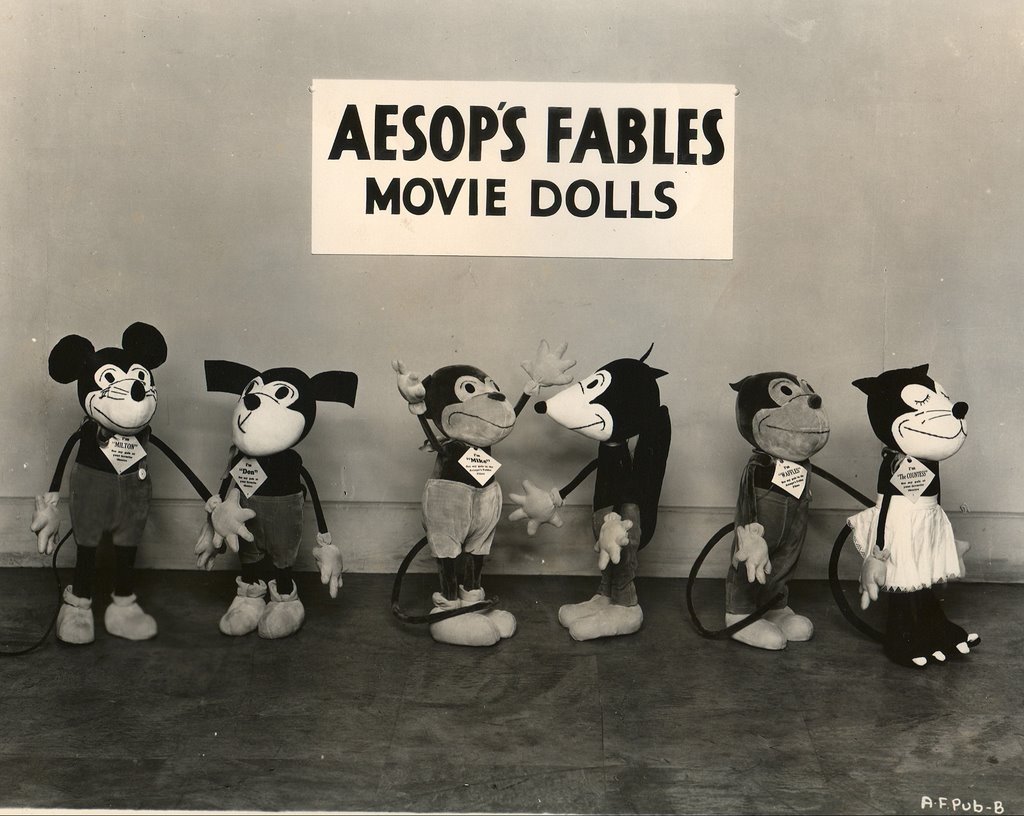
Here's a bit of a mystery for you animation fans.

I don't know recall buying this photo, but I must have picked it up at Cinefest, the annual film festival in Syracuse, NY, that has been my source for many of my additions to my still collection in the past 15 years.

There are no identifying numbers or codes on the still that would give me a more firm date, but I would hazard a guess somewhere from 1928 to 1930.

The reasoning behind my guess is the doll at the far left, "Milton," which closely resembles Mickey Mouse. Mickey parodies and steals popped up several places in animation at that time ( there are several Mickey appearances in Fleischer cartoons, for instance).

The dolls all wear a name tag that also reads "See my pals at your favorite theatre."

I'm no expert on the Aesop Fables series. Frankly, many of them just seem amazingly repetitive to me. They just seem to glom together into one big ball of mice running from someone.

What's your take?

© 2006 Gordon Michael Dobbs
This blog is mine alone. Blame me if you don't like it.