Tony Cignoli is one smart guy. A Springfield native who helps run campaigns in this and other country, he has an insider's view of politics and yet, he never seems jaded. I love talking shop with him. He sent me the following the night before the Inauguration:
"This Inaugural will be covered like no other before, given its historical significance and the internet age. There will be so much opinion, editorial, old and new media as well as citizen coverage that I thought it would be the best service to share a different perspective. It comes from the streets of Washington D.C. as well as from this city’s behind-the-scenes Beltway regulars.
"The excitement is nuclear – it is huge and everywhere. That is obvious from any report coming from the Capitol. Yesterday’s concert at the Lincoln Memorial naturally conjured up all the ghosts from the long journey to this moment: The most obvious of Lincoln and King. Beyond the electricity of performances by U 2, Bruce Springsteen, Stevie Wonder and Garth Brooks and despite the World’s Fair meets World’s Series combined with the Super Bowl feel of the celebration, there is no denying that there is something different being recognized on the streets of Washington and in the shadows of America’s monuments.
"As Obama said and Biden echoed when they took the steps of the Lincoln Memorial yesterday, this is all about so much more than the bricks, marble and mortar of the nations’ capitol. It is more than the Inaugural decorations and the stage erected behind the Capitol Building . Obama’s words yesterday may be as significant as the speech he gives tomorrow.
"There is an audacity by all here, the first-timers, the politicians, the incredible number of foreign visitors and even from the hardened and jaded Beltway wielders of influence, to collectively share the same hope. There is a need to hope and believe that in one moment, as one man, Obama, places his hand upon another man’s bible, Lincoln’s that this nation shall prevail, be restored and will carry on despite all challenges. There is a palpable hope that all we want for ourselves and our country might yet still be.
"Republicans, Democrats and that unique other 'Green' party - the folks who make grand livings lobbying and navigating this city’s back rooms and halls all seem to have a feeling that something new is taking place. It is more than what comes normally with the renewal of Presidential Inaugural and more than the historical aspect of the Inaugural of the nation’s first African-American President.
"Obama’s supporters are obviously ecstatic. The Democrats revel in a victory for their party. But Republicans here are positive and expressing hope for the nation as well. Many are not being cautious in a normal partisan sense by with-holding their thoughts that something new is about to happen in America . Perhaps it is polling that suggests that six out of ten Republicans are expressing a desire that Obama will address the nations’ challenges successfully. I think it is more though.
"The political consultants and advisors, the players behind the scenes in both parties seem to know that the rules will be changing. Obama’s campaign was ground-breaking and it revolutionized the arena we play in. It is believed, perhaps even secretly hoped for by the players who benefit from the old-Beltway ways, that this new President and his Administration may actually have the audacity to change the way this city works and to make it work for the citizen’s of America. Obama certainly has the political capitol and national will to do exactly this.
"Pundits will look for the big lines in tomorrow’s speech; the phrases that will be repeated in the discourse of politics like those provided the most memorably from Jefferson, Lincoln , FDR, Reagan and JFK who historians arguably maintain are the best Inaugural Address givers. All hope that Obama will exceed expectations as one of the most gifted orators of all Presidents and that his speech will be remembered and recited by school children decades from now. Whatever he says, the stage is set that there will be an underlying message in-between his lines that this day is about us, the nation and where we can dare hope to go. That is already what is whispered, said and shouted from the streets, in the 'smoke-filled' rooms and at the many parties and events of this Inaugural."

Monday, January 19, 2009

Saturday, January 17, 2009

You never know what's going to pop up on ebay, right?
(I've tried to add the link to the auction page, but blogspot doesn't seem to allow it!)
In high school and college I was bit by the fanzine bug and produced five or six editions of "Inertron," named for the element in the original 'Buck Rogers" strip that powered an anti-gravity rocket-pack device.
Horror, science fiction and comics were the main topics. My first movie star interview appeared there – Buster Crabbe, a very gracious man.
My father, who was teaching at the time, owned his own spirit duplicator machine and I used that as my printing press, going to outside offset printers for covers and photo pages. Eventually it was all offset printed.
I never made a dime off it as my costs always exceeded my revenues and my print runs were around 100 or so back in the period of 1971 to 1976. My last fanzine effort was a four-pager that I sent out to my subscribers in 1976.
I loved it. I loved working with contributors. The joy of holding a finished edition in your hands was incredible. I didn't care that what I did was something that no one else in my peer group would even think of doing – aside from a handful of people at the UMass Science Fiction Club, fellow geeks and fanboys and girls before those terms were used.
I still take so much satisfaction in getting something in print. I'm still a geek! When I was publishing the animation magazines, I took great pride in walking into bookstores and seeing it on a rack. I still get those feelings for the newspapers I edit, even though I don't own them. I'm just a hired hand.
Anyway, here is a copy on ebay with a starting bid of .99. I might bid on it myself!
© 2009 by Gordon Michael Dobbs
Thursday, January 15, 2009
This is one of the funniest bits of animation I've seen in a long time:
(Caution: perhaps not the best thing to play at the office)
http://superfad.com/player.php?project=251&item=566
I was very impressed with two recent animated releases:
For a number of years now I have received screeners of animated features at this time of year so I can vote in the annual Annie Awards presented by the Hollywood chapter of ASIFA, an international organization dedicated to the art of animation.
This past week I was sent two screeners and rather than discuss DVDs in this space, I'd like to call to your attention two animated films one that is currently in theaters here and another I hope will be seen here.
The first is the second animated feature ever to be produced in Israel, "Waltz with Bashir." Filmmaker Ari Folman served in the Israeli Army during the war in Lebanon in 1982. He was 19 and he witnessed the massacre of Muslim civilians by the Lebanese Christian Falangists who were seeking revenge for the murder of their president-elect Bashir Gemayel.
Although enlisted men such as Folman didn't participate in the massacre, other than light flares for what they thought was a different mission for the Falangists, the on-going debate in Israel has been how much did government leaders know and whether or not they allowed it to happen. Thousands of people were killed.
Folman himself has had both recurring dreams about the event and memory lapses and he decided to interview people who had served with him as well as one prominent Israeli reporter about the war and the massacre. He used these interviews as the basis of this outstanding film.
I've often written that what I want from an animated film is an effort to stretch and push the medium from the kiddy ghetto in which it has long been assigned. This film straddles a documentary and an exploration of a dream and frankly, while it could have been done in live action, it clearly works best as an animated film.
Like "Persepolis" last year, this film uses animation to tell a story, not as a pre-sold medium that indicates a particular kind of content. As a painter would chose the medium of his or her choice watercolors or oils, for example in which to convey a vision, Folman has used animation because it makes the most sense for his story.
The animation isn't as lush as some American audiences might expect, but I thought it worked perfectly for the subject matter.
So far this is the film I would pick as the best animated feature of the year, although I'm sure the Oscar race will be won by "Wall-E."

The other film I watched this weekend is the wonderful adventure fairy tale, "The Tale of Despereaux." I haven't read the book by Kate DiCamillo, so I don't know if the adaptation was true or not. The film stands on its own merits, though, and they are considerable.
I can't tell you how refreshing it is to watch a Hollywood mainstream animated family film that doesn't have a musical number, a stupid comic sidekick or any fart jokes. Instead we're offered a compelling story about a mouse who is seen as a misfit in his community, but a hero in ours, who saves a kingdom by adopting the ideas of truth, honor and bravery.
How often have we seen mainstream animation used a medium for a story about forgiveness and redemption? A film that doesn't preach a message, but gives audiences one nonetheless?
Although the film moves a bit slowly at first, I urge audiences to stay with it as I thought the story and characters quickly build momentum.
The voice cast does a great job with Matthew Broderick shining as an understated hero and Dustin Hoffman as a thoughtful and truly human acting rat.
This is a film that truly the whole family can enjoy, although I must say there are scenes that are too intense for younger children. Please leave any child under the age of five or six home with a babysitter.
Animation isn't just a means to sell toys, tell bad jokes or present musical numbers as these two outstanding films attest.
© 2009 by Gordon Michael Dobbs
(Caution: perhaps not the best thing to play at the office)
http://superfad.com/player.php?project=251&item=566
I was very impressed with two recent animated releases:
For a number of years now I have received screeners of animated features at this time of year so I can vote in the annual Annie Awards presented by the Hollywood chapter of ASIFA, an international organization dedicated to the art of animation.
This past week I was sent two screeners and rather than discuss DVDs in this space, I'd like to call to your attention two animated films one that is currently in theaters here and another I hope will be seen here.
The first is the second animated feature ever to be produced in Israel, "Waltz with Bashir." Filmmaker Ari Folman served in the Israeli Army during the war in Lebanon in 1982. He was 19 and he witnessed the massacre of Muslim civilians by the Lebanese Christian Falangists who were seeking revenge for the murder of their president-elect Bashir Gemayel.
Although enlisted men such as Folman didn't participate in the massacre, other than light flares for what they thought was a different mission for the Falangists, the on-going debate in Israel has been how much did government leaders know and whether or not they allowed it to happen. Thousands of people were killed.
Folman himself has had both recurring dreams about the event and memory lapses and he decided to interview people who had served with him as well as one prominent Israeli reporter about the war and the massacre. He used these interviews as the basis of this outstanding film.
I've often written that what I want from an animated film is an effort to stretch and push the medium from the kiddy ghetto in which it has long been assigned. This film straddles a documentary and an exploration of a dream and frankly, while it could have been done in live action, it clearly works best as an animated film.
Like "Persepolis" last year, this film uses animation to tell a story, not as a pre-sold medium that indicates a particular kind of content. As a painter would chose the medium of his or her choice watercolors or oils, for example in which to convey a vision, Folman has used animation because it makes the most sense for his story.
The animation isn't as lush as some American audiences might expect, but I thought it worked perfectly for the subject matter.
So far this is the film I would pick as the best animated feature of the year, although I'm sure the Oscar race will be won by "Wall-E."

The other film I watched this weekend is the wonderful adventure fairy tale, "The Tale of Despereaux." I haven't read the book by Kate DiCamillo, so I don't know if the adaptation was true or not. The film stands on its own merits, though, and they are considerable.
I can't tell you how refreshing it is to watch a Hollywood mainstream animated family film that doesn't have a musical number, a stupid comic sidekick or any fart jokes. Instead we're offered a compelling story about a mouse who is seen as a misfit in his community, but a hero in ours, who saves a kingdom by adopting the ideas of truth, honor and bravery.
How often have we seen mainstream animation used a medium for a story about forgiveness and redemption? A film that doesn't preach a message, but gives audiences one nonetheless?
Although the film moves a bit slowly at first, I urge audiences to stay with it as I thought the story and characters quickly build momentum.
The voice cast does a great job with Matthew Broderick shining as an understated hero and Dustin Hoffman as a thoughtful and truly human acting rat.
This is a film that truly the whole family can enjoy, although I must say there are scenes that are too intense for younger children. Please leave any child under the age of five or six home with a babysitter.
Animation isn't just a means to sell toys, tell bad jokes or present musical numbers as these two outstanding films attest.
© 2009 by Gordon Michael Dobbs
Wednesday, January 14, 2009
Sometimes having the coolest coat on the block might be a problem. From Sgt. John Delaney of the Springfield Police Department:
"At 12:29 P.M. officers were dispatched to Hampden Bank 115 State Street for a bank robbery. The employees of the bank stated when officers arrived that a black male about 5'10", dark skinned with pock marks on his face, medium build wearing a black coat with a hood and a silver design on the left chest area with silver buttons and a design on the back, dark pants and army type camo pants. The bank robber handed the teller a note that stated "Give me the money in the drawer". The bank robber then stated that he had a gun to the teller[although he didn't show it]. The teller handed over an undetermined amount of cash. The robber grabbed the money and fled in an unknown direction.
Detectives from the Criminal Investigation Unit under the direction of Lt. Thomas Kennedy are investigating this Bank Robbery. The investigation is ongoing. Anyone having any information on this individual please call 413-787-6355 the Springfield Police Department CIB."


"At 12:29 P.M. officers were dispatched to Hampden Bank 115 State Street for a bank robbery. The employees of the bank stated when officers arrived that a black male about 5'10", dark skinned with pock marks on his face, medium build wearing a black coat with a hood and a silver design on the left chest area with silver buttons and a design on the back, dark pants and army type camo pants. The bank robber handed the teller a note that stated "Give me the money in the drawer". The bank robber then stated that he had a gun to the teller[although he didn't show it]. The teller handed over an undetermined amount of cash. The robber grabbed the money and fled in an unknown direction.
Detectives from the Criminal Investigation Unit under the direction of Lt. Thomas Kennedy are investigating this Bank Robbery. The investigation is ongoing. Anyone having any information on this individual please call 413-787-6355 the Springfield Police Department CIB."


I wrote the following as the column for the newspapers I edit. I really believe that the melt-down of corporately-owned media, which has been coming for several years, along with the economic downturns has created a perfect storm that will eventually affect the nature of our democracy.
The business model media operates on now has not been changed by the Web at all. In fact, the Web is operating on the same business model of advertising to pay for free-to-the-consumer content. That model can not sustain a structure of professional journalists presenting the stories that need to be told. Many "citizen journalists" do a great job – I'm proud to be associated with several great ones in Pioneer Valley Central – but none of them can do that job as a paying gig right now.
I know there are of people who would disagree with this assessment because they think the Web and digital media on the brink of replacing all other mediums. Dream on.
Can you afford a Blu-Ray player and a HD TV right now? Most people can't. Do you want to buy a "kindle?" What do these futurists say when confronted with the poverty that we have in a city such as Springfield? Take away the free papers and the books in the library and expect people who are having a tough time finding food to trade up to the new digital age?
Bull.
We need to re-train our audience to pay more of their share for content – just like magazines have done for years now. We need market "real" news – not celebrity slop – as just as important to folks as who Madonna is currently with.
I'm just back from participating in a panel discussion at the sixth annual communication conference presented by Western New England College and the Valley Press Club and I'd like to thank all of the people who made a point of complimenting our coverage of their organizations. I passed your remarks onto my deserving staff.
Since the storm and the economy undoubtedly kept some people from attending this conference, which routinely offers real solutions and ideas to its attendees, I'd like to offer some suggestions on how businesses and organizations should cope with the ever-changing media landscape.
First a bit of a discussion of current affairs:
Newspapers in general have done an excellent job in detailing its own suicide a public death caused by incompetent and often greedy corporate management and an erosion of the advertising base brought on by the dominance of national and regional chains that don't feel the need to advertise.
The corporate model has been to sacrifice the reasons people pick up a newspaper meaningful original content to maintain some other status quo. The result has been ever-decreasing readership.
And yet just what medium is going to offer the kind of local news that many people need: Britney and Olsen Twins-free real stuff about where you live, work and shop?
Most local television stations focus on weather, crime, money and weather. Sorry if my colleagues in television view this as harsh, but they have admitted it themselves.
Commercial radio has largely given up local content. After your local morning guys, talk/news stations parade syndicated programming. You know, I'd like to see Bax and O'Brien do a music-free talk show. I think they would make great straight talk show hosts.
I'm glad Bill Dwight of WHMP is allowed to do an hour of local, although Hampshire County-centric, radio. Thank goodness we have two public radio stations covering events and WFCR is opening a new studio in Springfield that should boost its journalistic role here.
And I shouldn't overlook the contributions of John "Binky" Baibak of WHYN-AM.
"The Valley Advocate" still packs a punch with the investigative and news analysis pieces that are often missing from daily papers.
I'm no Luddite. I love the Web, but community newsgathering and dissemination is still in its infancy there. The issue remains how to pay for content on the Web and whether or not newly self-minted citizen journalists learn and maintain professional standards.
Right now, in this market, no medium can deliver as much local news as weekly community newspapers, especially if matched with a solid Web site. This combination truly supports readers looking for local stories and advertisers wishing to find a local audience.
And by "news" I mean more than just crime and politics, but the supposedly "little" stories that actually mean so much to so many people.
Yeah, I'm a partisan. I freely admit it. I just don't see other media fulfilling the local role that used to be the norm here.
And in order for this country to function we need to know things, besides whether or not the marriage of those chuckleheads on "The Hills" was legal.
So what can you do as someone wishing to spread your local news message? I'm afraid there's a little work involved. Here are some ideas:
First, think about whom you are trying to reach. Are age, gender or location criteria?
Then try to match your targeted market with a medium that reaches that market. This step might take a little research.
Get to know us! Contact that medium and find out how they wish to receive contributions: hard copy by mail, fax or e-mail? Who should receive the material? What are the deadlines? Here at Reminder Publications I prefer e-mail. Send me your release two weeks before an event at news@thereminder.com.
Do a Google Blog search to see if there are blogs that cover your topic. Drop them an e-mail. Locally, Pioneer Valley Central (http://pvcentral.net) is one such local news blog, but there are others.
Consider buying a digital camera and video recorder. We publish submitted photos and we are increasing the number videos (linked by YouTube) on our Web site. Call me (525-3247 ext. 103) or drop me an e-mail about a possible video submission.
And please shop at the local businesses that support publications such as this one.
There is no other locally owned and operated medium than community newspapers that is as invested in the future of an area. We are here to help restore and grow our circulation area by presenting as full a picture of it as possible.
Got a question? Ask me. And thanks for reading.
© 2009 by Gordon Michael Dobbs
The business model media operates on now has not been changed by the Web at all. In fact, the Web is operating on the same business model of advertising to pay for free-to-the-consumer content. That model can not sustain a structure of professional journalists presenting the stories that need to be told. Many "citizen journalists" do a great job – I'm proud to be associated with several great ones in Pioneer Valley Central – but none of them can do that job as a paying gig right now.
I know there are of people who would disagree with this assessment because they think the Web and digital media on the brink of replacing all other mediums. Dream on.
Can you afford a Blu-Ray player and a HD TV right now? Most people can't. Do you want to buy a "kindle?" What do these futurists say when confronted with the poverty that we have in a city such as Springfield? Take away the free papers and the books in the library and expect people who are having a tough time finding food to trade up to the new digital age?
Bull.
We need to re-train our audience to pay more of their share for content – just like magazines have done for years now. We need market "real" news – not celebrity slop – as just as important to folks as who Madonna is currently with.
I'm just back from participating in a panel discussion at the sixth annual communication conference presented by Western New England College and the Valley Press Club and I'd like to thank all of the people who made a point of complimenting our coverage of their organizations. I passed your remarks onto my deserving staff.
Since the storm and the economy undoubtedly kept some people from attending this conference, which routinely offers real solutions and ideas to its attendees, I'd like to offer some suggestions on how businesses and organizations should cope with the ever-changing media landscape.
First a bit of a discussion of current affairs:
Newspapers in general have done an excellent job in detailing its own suicide a public death caused by incompetent and often greedy corporate management and an erosion of the advertising base brought on by the dominance of national and regional chains that don't feel the need to advertise.
The corporate model has been to sacrifice the reasons people pick up a newspaper meaningful original content to maintain some other status quo. The result has been ever-decreasing readership.
And yet just what medium is going to offer the kind of local news that many people need: Britney and Olsen Twins-free real stuff about where you live, work and shop?
Most local television stations focus on weather, crime, money and weather. Sorry if my colleagues in television view this as harsh, but they have admitted it themselves.
Commercial radio has largely given up local content. After your local morning guys, talk/news stations parade syndicated programming. You know, I'd like to see Bax and O'Brien do a music-free talk show. I think they would make great straight talk show hosts.
I'm glad Bill Dwight of WHMP is allowed to do an hour of local, although Hampshire County-centric, radio. Thank goodness we have two public radio stations covering events and WFCR is opening a new studio in Springfield that should boost its journalistic role here.
And I shouldn't overlook the contributions of John "Binky" Baibak of WHYN-AM.
"The Valley Advocate" still packs a punch with the investigative and news analysis pieces that are often missing from daily papers.
I'm no Luddite. I love the Web, but community newsgathering and dissemination is still in its infancy there. The issue remains how to pay for content on the Web and whether or not newly self-minted citizen journalists learn and maintain professional standards.
Right now, in this market, no medium can deliver as much local news as weekly community newspapers, especially if matched with a solid Web site. This combination truly supports readers looking for local stories and advertisers wishing to find a local audience.
And by "news" I mean more than just crime and politics, but the supposedly "little" stories that actually mean so much to so many people.
Yeah, I'm a partisan. I freely admit it. I just don't see other media fulfilling the local role that used to be the norm here.
And in order for this country to function we need to know things, besides whether or not the marriage of those chuckleheads on "The Hills" was legal.
So what can you do as someone wishing to spread your local news message? I'm afraid there's a little work involved. Here are some ideas:
First, think about whom you are trying to reach. Are age, gender or location criteria?
Then try to match your targeted market with a medium that reaches that market. This step might take a little research.
Get to know us! Contact that medium and find out how they wish to receive contributions: hard copy by mail, fax or e-mail? Who should receive the material? What are the deadlines? Here at Reminder Publications I prefer e-mail. Send me your release two weeks before an event at news@thereminder.com.
Do a Google Blog search to see if there are blogs that cover your topic. Drop them an e-mail. Locally, Pioneer Valley Central (http://pvcentral.net) is one such local news blog, but there are others.
Consider buying a digital camera and video recorder. We publish submitted photos and we are increasing the number videos (linked by YouTube) on our Web site. Call me (525-3247 ext. 103) or drop me an e-mail about a possible video submission.
And please shop at the local businesses that support publications such as this one.
There is no other locally owned and operated medium than community newspapers that is as invested in the future of an area. We are here to help restore and grow our circulation area by presenting as full a picture of it as possible.
Got a question? Ask me. And thanks for reading.
© 2009 by Gordon Michael Dobbs
Monday, January 12, 2009
My buddy Mark "Not the Race Car Driver" Martin gave me a barn sale find a Christmas ago – an old ledger that was used by a Springfield area movie and sports fan as a scrap book.
The ads this person clipped and saved are primarily from Springfield, although there are some Boston venues included. Perhaps they too advertised locally for people who could afford to go to Boston for live theater.
The ads are from the early to mid-1920s, based on the release dates of the movies, and show a pretty vibrant town in terms of live entertainment and motion pictures. In fact, the downtown was filled with movie houses.
Something to remember: there were many factories downtown providing a ready and immediate market for theaters and restaurants. For a downtown to succeed people need to be there for a basic, primary reason, such as a job. With jobs leaving downtowns these kind of businesses move with them.
Here are four interesting ads:

Court Square Theater was a long-time "legitimate" stage featuring productions with local talent and road shows with some big names
Sidney Smith his comic strip creation "The Gumps" is all but forgotten today, but the long-running feature was popular enough to inspire live-action film adaptations. I think the double bill is interesting to say the least – Smith and the former Secretary of Commerce!
The Broadway Theater was on Bridge Street and featured vaudeville acts with its features. I've never seen "Yolanda" with Marion Davies, but Keaton's "The Navigator" is tremendous.
Before you get all misty eyed about the prices at The Mohican Market, also a Springfield institution for years, just remember people were working for $25 a week back then.
Here are two more:
The top one is The State Theatre, which was on Taylor Street near Main. The Goldstein brothers were regional theater magnates whose empire stretched up and down the Connecticut River Valley. My generation will remember The Bing, The Calvin, The Garden and The Rivoli, all Goldstein properties. I don't know when The State ended its run, but its featured live theater and – gasp – burlesque exactly the same it was seen in Times Square! Interesting that the Mardi Gras is on Taylor Street?
The Capitol was next to City Hall where the financial services building now is. I would have stood in line to see Hoot Gibson, one of the best movie cowboys known for his riding abilities – he was an actual champion rodeo performer – as well as his laid-back humorous approach to the genre. I've not yet seen a Gibson silent western, but he was very entertaining in the few sound films of his I've caught.

I'll post more of the material in the coming weeks.
The ads this person clipped and saved are primarily from Springfield, although there are some Boston venues included. Perhaps they too advertised locally for people who could afford to go to Boston for live theater.
The ads are from the early to mid-1920s, based on the release dates of the movies, and show a pretty vibrant town in terms of live entertainment and motion pictures. In fact, the downtown was filled with movie houses.
Something to remember: there were many factories downtown providing a ready and immediate market for theaters and restaurants. For a downtown to succeed people need to be there for a basic, primary reason, such as a job. With jobs leaving downtowns these kind of businesses move with them.
Here are four interesting ads:

Court Square Theater was a long-time "legitimate" stage featuring productions with local talent and road shows with some big names
Sidney Smith his comic strip creation "The Gumps" is all but forgotten today, but the long-running feature was popular enough to inspire live-action film adaptations. I think the double bill is interesting to say the least – Smith and the former Secretary of Commerce!
The Broadway Theater was on Bridge Street and featured vaudeville acts with its features. I've never seen "Yolanda" with Marion Davies, but Keaton's "The Navigator" is tremendous.
Before you get all misty eyed about the prices at The Mohican Market, also a Springfield institution for years, just remember people were working for $25 a week back then.
Here are two more:
The top one is The State Theatre, which was on Taylor Street near Main. The Goldstein brothers were regional theater magnates whose empire stretched up and down the Connecticut River Valley. My generation will remember The Bing, The Calvin, The Garden and The Rivoli, all Goldstein properties. I don't know when The State ended its run, but its featured live theater and – gasp – burlesque exactly the same it was seen in Times Square! Interesting that the Mardi Gras is on Taylor Street?
The Capitol was next to City Hall where the financial services building now is. I would have stood in line to see Hoot Gibson, one of the best movie cowboys known for his riding abilities – he was an actual champion rodeo performer – as well as his laid-back humorous approach to the genre. I've not yet seen a Gibson silent western, but he was very entertaining in the few sound films of his I've caught.

I'll post more of the material in the coming weeks.
Thursday, January 08, 2009
Don't you love mug shots? Why is this guy smiling? Oh, he must be drunk, still!
This came to me the other day from Sgt. John Delaney of the Springfield Police Force:
"At 1:15 A.M. this date officers Kim Brantley and Jose Diaz were on patrol in the area of 759 White Street when they came across an accident. The officers observed a white male standing next to his black pick-up that was just driven through a fence at that address. The officers then observed two parked cars in front of the address that had been smashed into. The officers questioned the driver and he wasn't responding very well because of all the Budweiser he had just consumed. There were empty beer cans all over the inside of his truck and frosty one that was half gone in the cup holder. The driver also admitted to having three white wines. He was placed under arrest for Driving While Intoxicated. Arrested was:
1) James O. Lord age 34 of 32 Bradford Street, Provincetown MA, charges;
a) Operating Under the Influence (second offense)"

Here's the damage to the fence.

Here's am even better one that came in before Christmas that I meant to post oveer the holidays:
"At 3:05 A.M. this morning Officers David Ramos and Selenia Cruz were dispatched to 418 Liberty Street for a large disturbance at a house party. The officers arrived and found 21 year old Jonathan Robinson of Springfield lying in the middle of Liberty Street suffering from stab wounds to his left side and the left side of his head. The victim received deep stab wounds and was losing a lot of blood. While he was lying in the street he was able to look up at a woman standing in front of 418 Liberty Street. He was able to point to this female and exclaim, "That is the person who stabbed me". The woman then entered the home while the officers provided first aid. The ambulance arrived and quickly brought Robinson to the Baystate Medical Center E.R. The victim is in 'serious but stable condition' and the wounds are not life threatening. The female then re-appeared and the officers arrested her for the assault. She fought with the police and was abusive in her remarks to the officers. The arresting officers had to use pepper spray to get her under control. They recovered a large kitchen knife. The officers observed blood all over the walls in the hallway. The fight started because Robinson made remarks as he was leaving. he commented on the weight and the sexual orientation of the female. She took offense to the remarks and grabbed a kitchen knife and stabbed Robinson in the side and the head as he was leaving.
Arrested was:
1) Christina Brown age 24 of 418 Liberty Street Springfield, charges;
a) A&B Dangerous Weapon (Knife)
b) Resisting Arrest
c) Possession of Electric Stun Gun...(officer found this weapon in her house)"

There's no crying while you're having your photo taken!
Ah, life in the big city! Gotta love it!
This came to me the other day from Sgt. John Delaney of the Springfield Police Force:
"At 1:15 A.M. this date officers Kim Brantley and Jose Diaz were on patrol in the area of 759 White Street when they came across an accident. The officers observed a white male standing next to his black pick-up that was just driven through a fence at that address. The officers then observed two parked cars in front of the address that had been smashed into. The officers questioned the driver and he wasn't responding very well because of all the Budweiser he had just consumed. There were empty beer cans all over the inside of his truck and frosty one that was half gone in the cup holder. The driver also admitted to having three white wines. He was placed under arrest for Driving While Intoxicated. Arrested was:
1) James O. Lord age 34 of 32 Bradford Street, Provincetown MA, charges;
a) Operating Under the Influence (second offense)"

Here's the damage to the fence.

Here's am even better one that came in before Christmas that I meant to post oveer the holidays:
"At 3:05 A.M. this morning Officers David Ramos and Selenia Cruz were dispatched to 418 Liberty Street for a large disturbance at a house party. The officers arrived and found 21 year old Jonathan Robinson of Springfield lying in the middle of Liberty Street suffering from stab wounds to his left side and the left side of his head. The victim received deep stab wounds and was losing a lot of blood. While he was lying in the street he was able to look up at a woman standing in front of 418 Liberty Street. He was able to point to this female and exclaim, "That is the person who stabbed me". The woman then entered the home while the officers provided first aid. The ambulance arrived and quickly brought Robinson to the Baystate Medical Center E.R. The victim is in 'serious but stable condition' and the wounds are not life threatening. The female then re-appeared and the officers arrested her for the assault. She fought with the police and was abusive in her remarks to the officers. The arresting officers had to use pepper spray to get her under control. They recovered a large kitchen knife. The officers observed blood all over the walls in the hallway. The fight started because Robinson made remarks as he was leaving. he commented on the weight and the sexual orientation of the female. She took offense to the remarks and grabbed a kitchen knife and stabbed Robinson in the side and the head as he was leaving.
Arrested was:
1) Christina Brown age 24 of 418 Liberty Street Springfield, charges;
a) A&B Dangerous Weapon (Knife)
b) Resisting Arrest
c) Possession of Electric Stun Gun...(officer found this weapon in her house)"

There's no crying while you're having your photo taken!
Ah, life in the big city! Gotta love it!
Tuesday, January 06, 2009

Another artifact from Springfield's past
I couldn't help but want to spend a buck on this item when I found it this summer. No it's not a cook book neither for the creation of food for pets or using pets as ingredients – wise guys – but a 1937 fundraiser item for the friends group of the MSPCA in Springfield.
As you can see members of the group submitted recipes, drawings and photos.


And the book was supported by local advertisers.

I haven't tried any of the recipes, but I love the fact they are much more intuitive than today's cooking instructions. There are phrases such as "a slow oven." There are recipes that instruct to bake something but give no idea at what temperature. I suppose cooks then simply knew such things. There's one page in which the previous owners penciled in his or her own amendments about temperature for ginger wafers with the warning "watch!"
Monday, January 05, 2009
I received a vertaible bounty of bad and marginal cinema this Christmas, thanks to my friends Steve and Dave. Steve's intentions, he told me, was to bathe me with movie cheese and boy did he with two collections of drive-in films from the last 1950s through the 1970s.
I've watched most of the films from a collection of stinkers released by the late Crown International outfit and boy, oh, boy I finally had the chance of seeing "Madmen of Mandoras," an amazing little opus in which Hitler's head is kept alive by a group of Nazis in a mythical South American country who are following his orders for a new attack on the world.
The Crown International collection also had an actually interesting voodoo thriller "The Devil's Hand," which starred Linda Christian.
Dave have me one of those 50 film collections – this time one of science fiction films – which included a damn near perfect print of "The Mesa of Lost Women," a totally bizarre film that is in a league with those made by director Ed Wood.
Yeah, I know, why bad movies. Shouldn't I be spending my time watching good movies? Well, I do plenty of that. I'm just fascinated by movies that were made by people who actually thought what they were producing would be entertaining to someone, perhaps only themselves.
I also think that quite often it's easy to get an understanding of an era through its throwaway popular culture as opposed to its "significant" culture.
And I love finding a low-budget throwaway movie that is really legitimately good – that happens more often than not.
Take for example this choice bit of fermented curd:


I picked up this press sheet at Cinefest one year just out of "what the heck is this thing?" And naturally I'd love to see it. Here's the trailer.
Now come on be honest, you'd spend 90 minutes watching this, wouldn't you?
I've watched most of the films from a collection of stinkers released by the late Crown International outfit and boy, oh, boy I finally had the chance of seeing "Madmen of Mandoras," an amazing little opus in which Hitler's head is kept alive by a group of Nazis in a mythical South American country who are following his orders for a new attack on the world.
The Crown International collection also had an actually interesting voodoo thriller "The Devil's Hand," which starred Linda Christian.
Dave have me one of those 50 film collections – this time one of science fiction films – which included a damn near perfect print of "The Mesa of Lost Women," a totally bizarre film that is in a league with those made by director Ed Wood.
Yeah, I know, why bad movies. Shouldn't I be spending my time watching good movies? Well, I do plenty of that. I'm just fascinated by movies that were made by people who actually thought what they were producing would be entertaining to someone, perhaps only themselves.
I also think that quite often it's easy to get an understanding of an era through its throwaway popular culture as opposed to its "significant" culture.
And I love finding a low-budget throwaway movie that is really legitimately good – that happens more often than not.
Take for example this choice bit of fermented curd:


I picked up this press sheet at Cinefest one year just out of "what the heck is this thing?" And naturally I'd love to see it. Here's the trailer.
Now come on be honest, you'd spend 90 minutes watching this, wouldn't you?
Sunday, January 04, 2009
Here's a couple of clippings from the Springfield Union – the morning daily paper before The Morning Union and the Union-News and now The Republican – showing a bit of the night life in Springfield circa 1937.

The "Hollywood Band Wagon" show at the Paramount – now the Hippodrome night club – was a live how starring Abbott – they left off a "t" – and Costello. At this point in their careers they had been burlesque and vaudeville stars, but hadn't yet made the splash on radio that would help propel them to national prominence. They were still a couple of years away from making their film debut.

Lord, just look at the number of movie theaters that was in this area! The Capitol was next to City Hall where the bank building is now standing.
The Poli was on Main Street and The Court Square theater was on Elm Street. Note the movie at the Court Square; Jimmy Cagney in "Great Guy." Cagney was in a contract battle at Warner Brothers and had stayed off screen for about a year. he made this film at First National, a small indie that was trying to improve its status. Cageny kissed and made up with WB and First National eventually withered away.
The Arcade was near the corner of State and Maple Streets. The Jefferson was on Main Street in the North End, where audience members could get "oven bak-ware" as a bonus. Much, much later it was the Jefferson Fine Arts Theater and was the city's porn theater, when there were porn theaters.
Double features, what a concept! Look at them all! When "Grindhouse" was released as a faux double feature, at the showing I attended people walked out after the first half because they didn't understand another film was coming.
© 2008 by Gordon Michael Dobbs

The "Hollywood Band Wagon" show at the Paramount – now the Hippodrome night club – was a live how starring Abbott – they left off a "t" – and Costello. At this point in their careers they had been burlesque and vaudeville stars, but hadn't yet made the splash on radio that would help propel them to national prominence. They were still a couple of years away from making their film debut.

Lord, just look at the number of movie theaters that was in this area! The Capitol was next to City Hall where the bank building is now standing.
The Poli was on Main Street and The Court Square theater was on Elm Street. Note the movie at the Court Square; Jimmy Cagney in "Great Guy." Cagney was in a contract battle at Warner Brothers and had stayed off screen for about a year. he made this film at First National, a small indie that was trying to improve its status. Cageny kissed and made up with WB and First National eventually withered away.
The Arcade was near the corner of State and Maple Streets. The Jefferson was on Main Street in the North End, where audience members could get "oven bak-ware" as a bonus. Much, much later it was the Jefferson Fine Arts Theater and was the city's porn theater, when there were porn theaters.
Double features, what a concept! Look at them all! When "Grindhouse" was released as a faux double feature, at the showing I attended people walked out after the first half because they didn't understand another film was coming.
© 2008 by Gordon Michael Dobbs
Thursday, January 01, 2009
Happy New Year!
There's no better way to start a New Year than to write about Springfield politics, right? Here's what I just wrote for the papers I edit:
I took the period between Christmas and New Year’s off and I was under strict orders to unplug and basically watch movies and relax. One of the things, I try to do for my staff, though, is not to burden them with trying to filling the hole meant for this column.
So on New year’s morning, I’m briefly plugging back in – while I’m on vacation typically don’t look at newspapers or watch much local news – and the task is easier because of the implications presented by the negotiated settlement between House Speaker Sal DiMasi and State Rep. Cheryl Coakley-Rivera.
Coakley-Rivera had placed the governor’s loan repayment bill for Springfield several amendments that stopped the bill’s legislative process dead in its tracks. So did State Rep Ben Swan, but obviously DiMasi didn’t recognize the merits of Swan’s arguments.
After discussions with House leadership, Coakley-Rivera removed several of the amendments, but two were allowed to go forward – one that would eliminate the trash fee and another that would require city residency for any new city employee and those receiving a promotion.
I have no doubt that Coakley-Rivera was simply doing her job as a state rep and responding to issues identified by her constituents. Her positions, at least on the trash fee, put her at odds with Mayor Domenic Sarno, once an ally on the issue, and the Finance Control Board, which, ironically, she also wanted to stay longer in the city.
Now here’s the rub in all of this: the state has now stepped into two issues that have historically been the role of the city to address. That’s an interesting and, perhaps to some, a dangerous precedent.
The question becomes who represents the city’s interests as a whole and how are we as a community suppose to set policy. If a state rep and mayor disagree over a controversial law or fee set by a city, should this be the way to settle the issue?
Over the years, residency requirements are fairly controversial, and although they were once pretty common, unions representing municipal employees have sought to eliminate them. So what are the legal implications here?
And the trash fee? From the press release dated Jan. 1: “Representative Coakley-Rivera’s amendment to eliminate the $90/barrel trash removal fee has been fast-tracked ending the fee per barrel one year earlier than she had originally proposed, now July 1, 2011.
“‘This is a major victory for the residents and businesses, helping them out in this tough economy and fighting our trash fee related problems of blight, flight, and illegal dumping,’ said Representative Coakley-Rivera.”
I live in a neighborhood where illegal dumping has taken place in the past and I have to say I’ve not seen an increase in the time in which the fee has been collected. The threat of illegal dumping, though, has never been the real issue here. Whether or not the city should be charging for a service that is already covered by our taxes is what bothered many people who made the claim that city residents don’t have an additional $90 a year to spend.
Although the city needs the $4 million it receives from the fee, I’m sure the logic is that it can afford to absorb it with a better re-payment plan in place, provided the Senate approves it. I hope so. With more cutbacks in state aid anticipated, perhaps we would need that $4 million past 2011.
Now some folks in other communities probably will read all of this and roll their eyes in the way I know they do about this latest turn in the soap opera that is Springfield politics. In this sub-plot, Coakley-Rivera has won by going over Mayor Domenic Sarno’s head – as those as well of the City Council and the Finance Control Board – and had the state dictate city policy.
But before anyone chuckles, consider it happening in your community. If you live in a city or town in which there is a controversy or two and a mayor or select board on the opposite sides of that issue with members of the local legislative delegation, this can happen to you.
And is that the way you wish to have your community governed?
© 2008 by Gordon Michael Dobbs
There's no better way to start a New Year than to write about Springfield politics, right? Here's what I just wrote for the papers I edit:
I took the period between Christmas and New Year’s off and I was under strict orders to unplug and basically watch movies and relax. One of the things, I try to do for my staff, though, is not to burden them with trying to filling the hole meant for this column.
So on New year’s morning, I’m briefly plugging back in – while I’m on vacation typically don’t look at newspapers or watch much local news – and the task is easier because of the implications presented by the negotiated settlement between House Speaker Sal DiMasi and State Rep. Cheryl Coakley-Rivera.
Coakley-Rivera had placed the governor’s loan repayment bill for Springfield several amendments that stopped the bill’s legislative process dead in its tracks. So did State Rep Ben Swan, but obviously DiMasi didn’t recognize the merits of Swan’s arguments.
After discussions with House leadership, Coakley-Rivera removed several of the amendments, but two were allowed to go forward – one that would eliminate the trash fee and another that would require city residency for any new city employee and those receiving a promotion.
I have no doubt that Coakley-Rivera was simply doing her job as a state rep and responding to issues identified by her constituents. Her positions, at least on the trash fee, put her at odds with Mayor Domenic Sarno, once an ally on the issue, and the Finance Control Board, which, ironically, she also wanted to stay longer in the city.
Now here’s the rub in all of this: the state has now stepped into two issues that have historically been the role of the city to address. That’s an interesting and, perhaps to some, a dangerous precedent.
The question becomes who represents the city’s interests as a whole and how are we as a community suppose to set policy. If a state rep and mayor disagree over a controversial law or fee set by a city, should this be the way to settle the issue?
Over the years, residency requirements are fairly controversial, and although they were once pretty common, unions representing municipal employees have sought to eliminate them. So what are the legal implications here?
And the trash fee? From the press release dated Jan. 1: “Representative Coakley-Rivera’s amendment to eliminate the $90/barrel trash removal fee has been fast-tracked ending the fee per barrel one year earlier than she had originally proposed, now July 1, 2011.
“‘This is a major victory for the residents and businesses, helping them out in this tough economy and fighting our trash fee related problems of blight, flight, and illegal dumping,’ said Representative Coakley-Rivera.”
I live in a neighborhood where illegal dumping has taken place in the past and I have to say I’ve not seen an increase in the time in which the fee has been collected. The threat of illegal dumping, though, has never been the real issue here. Whether or not the city should be charging for a service that is already covered by our taxes is what bothered many people who made the claim that city residents don’t have an additional $90 a year to spend.
Although the city needs the $4 million it receives from the fee, I’m sure the logic is that it can afford to absorb it with a better re-payment plan in place, provided the Senate approves it. I hope so. With more cutbacks in state aid anticipated, perhaps we would need that $4 million past 2011.
Now some folks in other communities probably will read all of this and roll their eyes in the way I know they do about this latest turn in the soap opera that is Springfield politics. In this sub-plot, Coakley-Rivera has won by going over Mayor Domenic Sarno’s head – as those as well of the City Council and the Finance Control Board – and had the state dictate city policy.
But before anyone chuckles, consider it happening in your community. If you live in a city or town in which there is a controversy or two and a mayor or select board on the opposite sides of that issue with members of the local legislative delegation, this can happen to you.
And is that the way you wish to have your community governed?
© 2008 by Gordon Michael Dobbs
Tuesday, December 30, 2008
Thirty years ago today, as I write this, I was at our wedding reception. It was quite a party with dramas that only a wedding reception could have. I won't go into them as to protect the guilty.
But there are some folks who should pay me hush money!
Today is our wedding anniversary and we've made it to the 30 year mark. Considering the state of the institution of marriage in this country, we've beat the odds so far.
When I met Mary she had no idea who Max Fleischer was. She had never milked any sort of animal or been much on a farm. She had no idea why someone would see value in, for example, the cinema of Ted V. Mikels.
I made the mistake of referring to her as a native of England (She's Scottish and raised in Glasgow). I had never heard of Billy Connolly. I didn't know haggis from bridies.
Over the years I learned from her and she from me. We moved into our home, got our first puppy and acquired a foster child all in the same month. We've seen friends come and go, seen business arrangements crumble and lost people close to us.
Such is life.
We're now grandparents to two wonderful girls. Our foster daughter – who is our daughter to us – is happily married. I have a nephew who seems to actually like my stuff – that's a relief to Mary. Our karma is being adjusted by Lucky the Wonder Bichon on a daily basis. We have six cats. And that's the limit. I'm putting my foot down.
Through it all she has put up with me. I'm sure it hasn't been easy.
We do have some rules. We've never gone to bed angry with each other – well, hardly ever. We always talk about big purchases or allocation of cash. We don't take each other for granted. We give each other some space.
I hope we make it to another 30. At least 20. We'd like to be invited to our granddaughters' weddings.
But there are some folks who should pay me hush money!
Today is our wedding anniversary and we've made it to the 30 year mark. Considering the state of the institution of marriage in this country, we've beat the odds so far.
When I met Mary she had no idea who Max Fleischer was. She had never milked any sort of animal or been much on a farm. She had no idea why someone would see value in, for example, the cinema of Ted V. Mikels.
I made the mistake of referring to her as a native of England (She's Scottish and raised in Glasgow). I had never heard of Billy Connolly. I didn't know haggis from bridies.
Over the years I learned from her and she from me. We moved into our home, got our first puppy and acquired a foster child all in the same month. We've seen friends come and go, seen business arrangements crumble and lost people close to us.
Such is life.
We're now grandparents to two wonderful girls. Our foster daughter – who is our daughter to us – is happily married. I have a nephew who seems to actually like my stuff – that's a relief to Mary. Our karma is being adjusted by Lucky the Wonder Bichon on a daily basis. We have six cats. And that's the limit. I'm putting my foot down.
Through it all she has put up with me. I'm sure it hasn't been easy.
We do have some rules. We've never gone to bed angry with each other – well, hardly ever. We always talk about big purchases or allocation of cash. We don't take each other for granted. We give each other some space.
I hope we make it to another 30. At least 20. We'd like to be invited to our granddaughters' weddings.
Monday, December 29, 2008

C. Bagley Beetle, the villain of the second Fleischer feature, "Mr. Bug Goes to Town."
About a week ago a writer from "the Villager" in NYC called me for an interview as he was writing a piece on Sammy Timberg, the composer of many of the tunes and scores heard in the classic Fleischer cartoons. It was a lay-out day, which meant as I was speaking with him, I was laying out pages for three of our four newspapers.
His story is here and please go take a look.
After he concluded his interview, he thanked me profusely but didn't reference me once in the story. Naturally. Note to the reporter: I've been in this business since 1975 and here's a good rule to follow – don't waste some one's time with an interview and then not reference the source in some way. It's rude.
Well, such is life. The reason for the story is the screening in NYC at the Film Forum is a 35mm print of Mr. Bug Goers to Town. I wish I could go as the film looks magnificent on the big screen.
Although the film has some flaws, I think it's a great animated feature that shows the evolution of the Fleischer style. Despite being in Florida, the hearts and minds of the Fleischer studios were definitely stuck in New York City and this feature shows it.
It carries on several key Fleischer elements: the urban setting, the use of pop music – several of the songs by Hoagy Carmichael were hits – the big versus little theme and a 3-D model. its use of rotoscoping to clearly identify the bug world from the human world is done much better than in "Gulliver's Travels."
Hoppity may be a bland hero, but the villains are a lot of fun as are the supporting characters.


There is one "fact" repeated in the story about Timberg referring to Mr. Bug's release and the sinking of the Fleischer Studios and that's the oft-quoted idea that Mr. Bug was released on Dec. 7, 1941, the day that Pearl Harbor was attacked.
First we have to understand how films were released at that time. The way a film is opened wide didn't exist then. The studios didn't make up thousands and thousands of prints and blanket the country at the same time. They were far more conservative with the number of prints and released a film in a far more gradual basis.
Films worked their way through cities and states. "Freaks," now considered a horror classic, for example, was released slowly throughout the country before it hit New York as MGM was fearful new York critics would hate the film. Their reviews could contribute to its premature box-office demise.
Take a look at this ad for Mr. Bug that appeared prior to the films release:

Look at the bottom where interested movie patrons were asked to inquire at their local theater about when the film was going to be playing.
Variety reviewed the film at a Dec. 4, 1941 trade screening and I have to wonder if the first public screenings came just three days later.
I wonder if there is a record of movie grosses at the time of the attack – did they drop across the board? I would imagine if there had been a trend it wouldn't have applied to just one movie.
I do know the New York Times didn't review the film until its Feb. 20, 1942 edition. Time magazine put in a review in its Feb. 23, 1942 issue.
A Christmas time release had definitely been originally planned as one Minneapolis department store its window display centered around the movie, Variety reported.
A February release couldn't capitalize on the school kids being out on Christmas break. Nor could a February release help sell the merchandise tie-ins as limited as they were.
Now whether or not Paramount sabotaged the film's release in order to tighten its hold on the Fleischer Studio and to fire Max and Dave was the reason for the delay in releasing the film – the NY Times and Time reviews would have come out to coincide with the film's general release – has often been the subject of speculation. It's interesting to note that Paramount brass would have been willing to lose its investment in the film just to make sure Max didn't stage some sort of financial recovery.
Remember there were no ancillary markets for motion pictures in 1941. You had a first run, a second run and then into the vault. If a truly successful film could warrant a re-release as RKO did with "King Kong" several times.
What saved Mr. Bug from oblivion was the sale Paramount made to the theatrical arm of NTA, the company that bought television rights to many of the Paramount shorts, including the Betty Boop cartoons. Paramount also sold rights to "Gulliver's Travels" to the company and both films were re-released to theaters.
Re-named "Hoppity Goes to Town," the film was in theaters in 1959. In the VHS era, NTA released the film on tape. The film, to my knowledge, has not received a legitimate DVD release. Amazon carries a version titled "Bugville."
If you're in the NYC area, catch a showing of this film.

© 2008 by Gordon Michael Dobbs
Monday, December 22, 2008
Just in time for the holidays is this screed from the folks who worship in the Church of Self. Read on:
By Leonard Peikoff
Christmas in America is an exuberant display of human ingenuity, capitalist productivity, and the enjoyment of life. Yet all of these are castigated as “materialistic”; the real meaning of the holiday, we are told, is assorted Nativity tales and altruist injunctions (e.g., love thy neighbor) that no one takes seriously. In fact, Christmas as we celebrate it today is a 19th-century American invention. The freedom and prosperity of post Civil War America created the happiest nation in history. The result was the desire to celebrate, to revel in the goods and pleasures of life on earth.
Christmas (which was not a federal holiday until 1870) became the leading American outlet for this feeling. Historically, people have always celebrated the winter solstice as the time when the days begin to lengthen, indicating the earth’s return to life. Ancient Romans feasted and reveled during the festival of Saturnalia. Early Christians condemned these Roman celebrations--they were waiting for the end of the world and had only scorn for earthly pleasures. By the fourth century the pagans were worshipping the god of the sun on December 25, and the Christians came to a decision: if you can’t stop ’em, join ’em. They claimed (contrary to known fact) that the date was Jesus’ birthday, and usurped the solstice holiday for their Church. Even after the Christians stole Christmas, they were ambivalent about it.
The holiday was inherently a pro-life festival of earthly renewal, but the Christians preached renunciation, sacrifice, and concern for the next world, not this one. As Cotton Mather, an 18th-century clergyman, put it: “Can you in your consciences think that our Holy Savior is honored by mirth? . . . Shall it be said that at the birth of our Savior . . . we take time . . . to do actions that have much more of hell than of heaven in them?” Then came the major developments of 19th-century capitalism: industrialization, urbanization, the triumph of science--all of it leading to easy transportation, efficient mail delivery, the widespread publishing of books and magazines, new inventions making life comfortable and exciting, and the rise of entrepreneurs who understood that the way to make a profit was to produce something good and sell it to a mass market. For the first time, the giving of gifts became a major feature of Christmas.
Early Christians denounced gift-giving as a Roman practice, and Puritans called it diabolical. But Americans were not to be deterred. Thanks to capitalism, there was enough wealth to make gifts possible, a great productive apparatus to advertise them and make them available cheaply, and a country so content that men wanted to reach out to their friends and express their enjoyment of life. The whole country took with glee to giving gifts on an unprecedented scale. Santa Claus is a thoroughly American invention.
There was a St. Nicholas long ago and a feeble holiday connected with him (on December 5). In 1822, an American named Clement Clarke Moore wrote a poem about a visit from St. Nick. It was Moore (and a few other New Yorkers) who invented St. Nick’s physical appearance and personality, came up with the idea that Santa travels on Christmas Eve in a sleigh pulled by reindeer, comes down the chimney, stuffs toys in the kids’ stockings, then goes back to the North Pole. Of course, the Puritans denounced Santa as the Anti-Christ, because he pushed Jesus to the background. Furthermore, Santa implicitly rejected the whole Christian ethics. He did not denounce the rich and demand that they give everything to the poor; on the contrary, he gave gifts to rich and poor children alike. Nor is Santa a champion of Christian mercy or unconditional love. On the contrary, he is for justice--Santa gives only to good children, not to bad ones.
All the best customs of Christmas, from carols to trees to spectacular decorations, have their root in pagan ideas and practices. These customs were greatly amplified by American culture, as the product of reason, science, business, worldliness, and egoism, i.e., the pursuit of happiness. America’s tragedy is that its intellectual leaders have typically tried to replace happiness with guilt by insisting that the spiritual meaning of Christmas is religion and self-sacrifice for Tiny Tim or his equivalent. But the spiritual must start with recognizing reality. Life requires reason, selfishness, capitalism; that is what Christmas should celebrate--and really, underneath all the pretense, that is what it does celebrate. It is time to take the Christ out of Christmas, and turn the holiday into a guiltlessly egoistic, pro-reason, this-worldly, commercial celebration.
Dr. Leonard Peikoff is the foremost authority on Objectivism, the philosophy of Ayn Rand. The Ayn Rand Center is a division of the Ayn Rand Institute and promotes the philosophy of Ayn Rand, author of “Atlas Shrugged” and “The Fountainhead.”
Now granted that few people in America have even heard of Ayn Rand, but they certainly have heard of "greed is good" and the trouble we find ourselves in today is a result of that "I've got mine, fuck you" attitude that has trickled down from the 1980s.
Although I defend his right to write this claptrap, I find it distressing that a celebration of selfishness is touted as a viable way to build a society.
© 2008 By Gordon Michael Dobbs
By Leonard Peikoff
Christmas in America is an exuberant display of human ingenuity, capitalist productivity, and the enjoyment of life. Yet all of these are castigated as “materialistic”; the real meaning of the holiday, we are told, is assorted Nativity tales and altruist injunctions (e.g., love thy neighbor) that no one takes seriously. In fact, Christmas as we celebrate it today is a 19th-century American invention. The freedom and prosperity of post Civil War America created the happiest nation in history. The result was the desire to celebrate, to revel in the goods and pleasures of life on earth.
Christmas (which was not a federal holiday until 1870) became the leading American outlet for this feeling. Historically, people have always celebrated the winter solstice as the time when the days begin to lengthen, indicating the earth’s return to life. Ancient Romans feasted and reveled during the festival of Saturnalia. Early Christians condemned these Roman celebrations--they were waiting for the end of the world and had only scorn for earthly pleasures. By the fourth century the pagans were worshipping the god of the sun on December 25, and the Christians came to a decision: if you can’t stop ’em, join ’em. They claimed (contrary to known fact) that the date was Jesus’ birthday, and usurped the solstice holiday for their Church. Even after the Christians stole Christmas, they were ambivalent about it.
The holiday was inherently a pro-life festival of earthly renewal, but the Christians preached renunciation, sacrifice, and concern for the next world, not this one. As Cotton Mather, an 18th-century clergyman, put it: “Can you in your consciences think that our Holy Savior is honored by mirth? . . . Shall it be said that at the birth of our Savior . . . we take time . . . to do actions that have much more of hell than of heaven in them?” Then came the major developments of 19th-century capitalism: industrialization, urbanization, the triumph of science--all of it leading to easy transportation, efficient mail delivery, the widespread publishing of books and magazines, new inventions making life comfortable and exciting, and the rise of entrepreneurs who understood that the way to make a profit was to produce something good and sell it to a mass market. For the first time, the giving of gifts became a major feature of Christmas.
Early Christians denounced gift-giving as a Roman practice, and Puritans called it diabolical. But Americans were not to be deterred. Thanks to capitalism, there was enough wealth to make gifts possible, a great productive apparatus to advertise them and make them available cheaply, and a country so content that men wanted to reach out to their friends and express their enjoyment of life. The whole country took with glee to giving gifts on an unprecedented scale. Santa Claus is a thoroughly American invention.
There was a St. Nicholas long ago and a feeble holiday connected with him (on December 5). In 1822, an American named Clement Clarke Moore wrote a poem about a visit from St. Nick. It was Moore (and a few other New Yorkers) who invented St. Nick’s physical appearance and personality, came up with the idea that Santa travels on Christmas Eve in a sleigh pulled by reindeer, comes down the chimney, stuffs toys in the kids’ stockings, then goes back to the North Pole. Of course, the Puritans denounced Santa as the Anti-Christ, because he pushed Jesus to the background. Furthermore, Santa implicitly rejected the whole Christian ethics. He did not denounce the rich and demand that they give everything to the poor; on the contrary, he gave gifts to rich and poor children alike. Nor is Santa a champion of Christian mercy or unconditional love. On the contrary, he is for justice--Santa gives only to good children, not to bad ones.
All the best customs of Christmas, from carols to trees to spectacular decorations, have their root in pagan ideas and practices. These customs were greatly amplified by American culture, as the product of reason, science, business, worldliness, and egoism, i.e., the pursuit of happiness. America’s tragedy is that its intellectual leaders have typically tried to replace happiness with guilt by insisting that the spiritual meaning of Christmas is religion and self-sacrifice for Tiny Tim or his equivalent. But the spiritual must start with recognizing reality. Life requires reason, selfishness, capitalism; that is what Christmas should celebrate--and really, underneath all the pretense, that is what it does celebrate. It is time to take the Christ out of Christmas, and turn the holiday into a guiltlessly egoistic, pro-reason, this-worldly, commercial celebration.
Dr. Leonard Peikoff is the foremost authority on Objectivism, the philosophy of Ayn Rand. The Ayn Rand Center is a division of the Ayn Rand Institute and promotes the philosophy of Ayn Rand, author of “Atlas Shrugged” and “The Fountainhead.”
Now granted that few people in America have even heard of Ayn Rand, but they certainly have heard of "greed is good" and the trouble we find ourselves in today is a result of that "I've got mine, fuck you" attitude that has trickled down from the 1980s.
Although I defend his right to write this claptrap, I find it distressing that a celebration of selfishness is touted as a viable way to build a society.
© 2008 By Gordon Michael Dobbs
Sunday, December 21, 2008
I started recording a "video rant" this week for our newspaper's Web site as my boss wants more original content for the site. At first it was suggested that I simply read my written editorial column, but that is exactly the opposite of what I hope to accomplish, which is to bring a camera out into the communities to provide footage for my comments.
I'm hoping as well in this age of "viral video" that my non-TV looks and delivery will be accepted. People who've lived in the Springfield area for a while might remember when the owners/general managers of the NBC and ABC stations actually delivered nightly commentaries in an idiosyncratic style.
The idea of plugging a community this way has been replaced in the local TV news format by endlessly telling us faulty weather forecasts, presenting us with every bit of crime news they can find and recycling bits from national sources.
Well, I shouldn't be too harsh as many local stations are under budget restraints and they are going to be attracted to the low-hanging, provocative, fruit. The stations are often run by corporations with no feel for a local market and are staffed by people who are seeking temporary employment there until they can get to a larger market. There are exceptions to this characterization, but I'm afraid they are becoming more difficult to find.
So anyway, with a face built for radio here I am....and yes, I should have combed my hair.
I'm hoping as well in this age of "viral video" that my non-TV looks and delivery will be accepted. People who've lived in the Springfield area for a while might remember when the owners/general managers of the NBC and ABC stations actually delivered nightly commentaries in an idiosyncratic style.
The idea of plugging a community this way has been replaced in the local TV news format by endlessly telling us faulty weather forecasts, presenting us with every bit of crime news they can find and recycling bits from national sources.
Well, I shouldn't be too harsh as many local stations are under budget restraints and they are going to be attracted to the low-hanging, provocative, fruit. The stations are often run by corporations with no feel for a local market and are staffed by people who are seeking temporary employment there until they can get to a larger market. There are exceptions to this characterization, but I'm afraid they are becoming more difficult to find.
So anyway, with a face built for radio here I am....and yes, I should have combed my hair.

I haven't posted DVD reviews for a while so here are some:
M Squad
I vaguely remember seeing "M Squad" when I was little -- the half-hour crime drama ran from 1957 through 1960 -- a time I was more concerned with cartoons and "Howdy Doody."
Now Timeless Media Group has brought out the entire 117 episodes in a 15 DVD set -- a pretty daring movie for a relatively obscure television show.
"M Squad" is a procedural police drama that spends more time showing the cops pounding the pavement and in the crime lab in order to solve a crime than firing their guns. The show is clearly a reaction to "Dragnet," Jack Webb's highly successful police show.
There are key differences here. One is that " M Squad" is centered in Chicago and exteriors were filmed there. Another is use of jazz for the score's show -- Count Basie wrote the theme music for the second season. The tone of the show is more film noir-ish and gritty than other police shows at the time.
And then there was the star, Lee Marvin. Marvin was coming into his own as actor and his portrayal of Lt. Frank Ballinger was far more interesting than Webb's straight-laced and straight faced Joe Friday.
Marvin plays his cop as both a committed public servant and someone who has seen it all. In the first episode, he is seen checking out a pretty girl while investigating a murder -- something most cop characters wouldn't have done at the time.
The half-hour shows move fast and I was surprised in this time of multiple "CSI" franchises to see just how much footage was devoted to forensic investigations.
Marvin's characterization probably will seem more modern and naturalistic to today's audience than those from other cop dramas of the same era. He walks an interesting line between appearing not to care and obviously caring very much.
For serious crime drama fans who don't mind dropping a chunk of change, this set from 51 years ago will provide some fresh material.
Harry Langdon: Three's a Crowd and The Chaser
Of all of the great silent comedians -- Charles Chaplin, Buster Keaton, Harold Lloyd and Harry Langdon -- it is Langdon who has had the hardest time establishing a new audience in the home video age.
Landon was a vaudeville star whose film persona was that of the "man-boy" a physically mature male who nonetheless has the emotional maturity of a seven-year-old. This type of character has certainly been a popular one in American film. Lou Costello, Huntz Hall, Jerry Lewis and Adam Sandler have all had their take on this shtick.
Langdon's character was often described as having the maturity of an infant. He seems almost incapable of dealing with the world. Made by the right hands, Langdon's films were highly popular, but Langdon himself directed the two films in this double feature and that was clearly a mistake.
Langdon's waif in "Three's a Crowd" is a mover's helper who finds a pregnant woman staggering about during the winter in the slum where he lives. He takes her in and cares for her only to see his heart broken when she reconciles with her husband.
In "The Chase," audiences are asked to accept Langdon as an errant husband chasing women and partying to his wife's disapproval. A judge makes Langdon stay at home for 30 days and take care of the house while wearing a dress. Many of the gags revolve around suicide.
I love silent films and am a huge fan of silent comedy, so I wanted to give Langdon another try, but I just couldn't understand why his character was so popular. I just want to shake him!
These two films from KINO on Video can boast of great scores by Lee Irwin and good-looking restored prints.
Mr. Bean: The Ultimate Collection
Okay, if you're a "Mr. Bean" fan this is your dream collection. The seven-disc collection has all of the television episodes originally aired on HBO, the animated series, and the two feature films.
That's a lot of beans.
If you're not familiar with Mr. Bean, you should know he is the first largely silent comic star developed since the advent of talking films. He can be an incredibly resourceful but also amazingly mischievous.
Rowan Atkinson was already a comedy star here and in his native Great Britain when he developed Mr. Bean with writers Richard Curtis and Robin Driscoll. In an informative documentary in the set, "The Story of Bean," Atkinson and his fellow writers describe how the character was developed, which partly came from Atkinson's youth.
The star described Bean as a nine-year-old boy who operates under the rules as long as they suit him.
I love the "Mr. Bean" series and I think the shorter productions are those in which the character is best suited. The animated cartoons are not my cup of tea and the first feature film "Bean: The Movie" was a mixed bag, I thought.
The extras here are a lot of fun with several Bean skits seen in the United States for the first time: "Torvill & Bean," in which Mr. Bean takes to the ice with the British skating star, was a hoot!
© 2008 by Gordon Michael Dobbs
Tuesday, December 16, 2008
Several weeks ago, I attended my 36th class reunion. No, the odd number didn't mean anything. The class reunion was part of a multi-class event covering the years 1970 to 1979 of Granby ( MA) Junior Senior High School.
I've attended every reunion we've had and have helped organize several of them. Aside from the first one, I've always found them to be very interesting and even fun.
I've told members of the staff and students I've taught that a reporter has to be, at his or her core, a gossip – a damn good gossip. Reporters want to hear dirt before anyone else and then tell other folks. I don't think more pious members of my profession would approve of this characterization, but screw 'em.
Perhaps that's why I enjoy going to the class reunions. It gives me plenty of opportunity to satisfy that "whatever happened to..." vibe that all reporters and gossips have.
What I also like is that going to a class reunion is the closest one can come to see a rift in time and space. Everyone who attends a reunion has changed in some way – either physically or emotionally or both. We know we've changed, but we see each other at least initially as we were in school.
That assessment usually wears off pretty quickly – it's hard to ignore grey hair, 50 extras pounds and other ravages of time. But for a few moments you're seen as you once were.
The fact that it does wear off in a matter of seconds is essential as I doubt that many of us actually want to be the person we were in high school.
Of course, in my case I was a geek – I published my own fanzine on horror films and comics – then and a geek now. Only my geek tendencies has helped pay my bills!
I'm always wary of the person who talks about high school as if that was the best time of his life. I'm equally concerned about people who say that college was the best time of their lives. Four years long ago being the pinnacle of an existence is sad.
The best moment of this reunion – as it has been for me at other reunions – is seeing someone whom I really want to see. I prepared for the reunion by looking through the year book and wondered almost aloud to myself about one guy who was a hippie iconoclast whom I liked even though I was sure he thought I was some sort of square, which of course I was.
I wondered if he was still alive.
When I saw him, He said with a big smile, "I bet you thought I was dead!" I confirmed that and we had a fun conversation.
I'm happy to report the members of the Class of '72 seemed like well-adjusted adults heading toward their AARP membership. Hey, just four more years to our 40th!

Sorry about the ikky color, but the print I scanned was not very well balanced.
© 2008 by Gordon Michael Dobbs
I've attended every reunion we've had and have helped organize several of them. Aside from the first one, I've always found them to be very interesting and even fun.
I've told members of the staff and students I've taught that a reporter has to be, at his or her core, a gossip – a damn good gossip. Reporters want to hear dirt before anyone else and then tell other folks. I don't think more pious members of my profession would approve of this characterization, but screw 'em.
Perhaps that's why I enjoy going to the class reunions. It gives me plenty of opportunity to satisfy that "whatever happened to..." vibe that all reporters and gossips have.
What I also like is that going to a class reunion is the closest one can come to see a rift in time and space. Everyone who attends a reunion has changed in some way – either physically or emotionally or both. We know we've changed, but we see each other at least initially as we were in school.
That assessment usually wears off pretty quickly – it's hard to ignore grey hair, 50 extras pounds and other ravages of time. But for a few moments you're seen as you once were.
The fact that it does wear off in a matter of seconds is essential as I doubt that many of us actually want to be the person we were in high school.
Of course, in my case I was a geek – I published my own fanzine on horror films and comics – then and a geek now. Only my geek tendencies has helped pay my bills!
I'm always wary of the person who talks about high school as if that was the best time of his life. I'm equally concerned about people who say that college was the best time of their lives. Four years long ago being the pinnacle of an existence is sad.
The best moment of this reunion – as it has been for me at other reunions – is seeing someone whom I really want to see. I prepared for the reunion by looking through the year book and wondered almost aloud to myself about one guy who was a hippie iconoclast whom I liked even though I was sure he thought I was some sort of square, which of course I was.
I wondered if he was still alive.
When I saw him, He said with a big smile, "I bet you thought I was dead!" I confirmed that and we had a fun conversation.
I'm happy to report the members of the Class of '72 seemed like well-adjusted adults heading toward their AARP membership. Hey, just four more years to our 40th!

Sorry about the ikky color, but the print I scanned was not very well balanced.
© 2008 by Gordon Michael Dobbs
Monday, December 15, 2008
During the Christmas season, one of the things I look forward to the most is hearing from people through Christmas cards and letters.
And my thoughts frequently turn to the people who were part of our lives but who are no longer with us.
I'm re-organizing my Fleischer material for yet another attempt to find a publisher and came across the holiday cards sent to us by Myron and Rosalie Waldman which featured original artwork by Myron.
I've posted three of them to give you a taste of the Waldman charm. Although these cards were quickly done, they are fun and heart-felt and show what a wonderful artist Myron was.
Enjoy!


And my thoughts frequently turn to the people who were part of our lives but who are no longer with us.
I'm re-organizing my Fleischer material for yet another attempt to find a publisher and came across the holiday cards sent to us by Myron and Rosalie Waldman which featured original artwork by Myron.
I've posted three of them to give you a taste of the Waldman charm. Although these cards were quickly done, they are fun and heart-felt and show what a wonderful artist Myron was.
Enjoy!


Sunday, December 14, 2008
My presentation at the Pine Point Library went very well as I had about 30 people crammed into the space and sold 14 books!
What was great is that members of the audience offered up information on the city's history that was new to me.
For those of you who missed it – the library folks would like me to do it again in a few months at a different library – here's part of what I did. I took images from my postcard history of Springfield and then paired then with contemporary views.
I also spoke of parts of the city's history that are now missing. For example, this famous marker erected in 1763 to denote the location of the road to Boston stood at the intersection of State and Federal Streets when I was a kid living in 16 Acres. Although it had been removed, it was not lost – nor did it turn up at the Brimfield Flea market for sale. Apparently one of the Masonic Lodges in town have it and I can only hope it will be part of the new Springfield History Museum that will be open in the fall of next year.
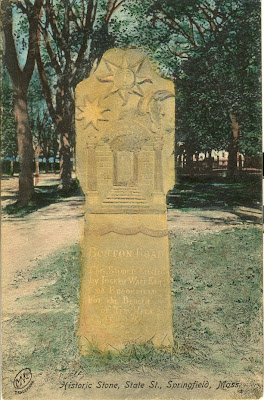

The corner of Sumner and Forest Park Avenues at the turn of the 20th century and today. I love that the house in the postcard is still standing.

Very close to our house is the other part of the U.S. Amory – commonly known as "The Water Shops." As a child growing up at 104 Navajo Rd. in 16 Acres, I never really knew the actual name of this body of water is Lake Massasoit. It was always Watershops Pond.
The building is filled with small businesses and the water stills flows through the complex although I'm know sure if it is generating power like many of the factory buildings are along the canals in Holyoke.


Here's the marker at Court Square denoting where Parsons or Washington Tavern once stood.
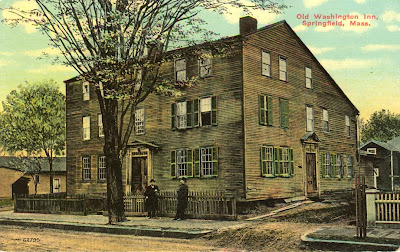
Here is a postcard of it but it is clearly not in Court Square. Local historian Jim Boone figured out the building had been moved to Water Street and then later demolished. In the 9130 and '40s the term "Washington slept here" as a historic designation became a joke as so many places were do described. It's a shame that Springfield's claim to having the "Father of the Country" rest here is long gone.
© 2008 by Gordon Michael Dobbs
What was great is that members of the audience offered up information on the city's history that was new to me.
For those of you who missed it – the library folks would like me to do it again in a few months at a different library – here's part of what I did. I took images from my postcard history of Springfield and then paired then with contemporary views.
I also spoke of parts of the city's history that are now missing. For example, this famous marker erected in 1763 to denote the location of the road to Boston stood at the intersection of State and Federal Streets when I was a kid living in 16 Acres. Although it had been removed, it was not lost – nor did it turn up at the Brimfield Flea market for sale. Apparently one of the Masonic Lodges in town have it and I can only hope it will be part of the new Springfield History Museum that will be open in the fall of next year.


The corner of Sumner and Forest Park Avenues at the turn of the 20th century and today. I love that the house in the postcard is still standing.

Very close to our house is the other part of the U.S. Amory – commonly known as "The Water Shops." As a child growing up at 104 Navajo Rd. in 16 Acres, I never really knew the actual name of this body of water is Lake Massasoit. It was always Watershops Pond.
The building is filled with small businesses and the water stills flows through the complex although I'm know sure if it is generating power like many of the factory buildings are along the canals in Holyoke.


Here's the marker at Court Square denoting where Parsons or Washington Tavern once stood.

Here is a postcard of it but it is clearly not in Court Square. Local historian Jim Boone figured out the building had been moved to Water Street and then later demolished. In the 9130 and '40s the term "Washington slept here" as a historic designation became a joke as so many places were do described. It's a shame that Springfield's claim to having the "Father of the Country" rest here is long gone.
© 2008 by Gordon Michael Dobbs
Tuesday, December 09, 2008

Take a look at this vintage postcard and tell me what's wrong.
Shameless plug time: I will be appearing at the Pine Point Library on Boston Road in Springfield Thursday Dec. 11 at 6:30 p.m. for a presentation called "Springfield Then and Now," as well as a signing for my book on Springfield history. I'll also bring a copy of two of my animation book as well just in case someone wants both of my highly Christmas-givable tomes.
Friday, December 05, 2008
I've been checking my work e-mail while on vacation – something I've never done before, but I get very paranoid about taking time off.
Years ago when I was an ad salesman at the Daily Hampshire Gazette I took my first vacation as an adult worker bee. I came back and found a guy sitting at my desk. He looked up at me and said, "You must be the guy who is going to train me."
My boss then whisked me into the conference room and informed me that my sales were down and I was fired. While on vacation they had hired this guy and I had a choice: I could walk out then or I could stay for two more weeks and get a severance package.
I stayed and I trained this guy as well as a salesmen who was being canned for lack for sales could. I saw him many years later at a Chamber of Commerce breakfast and we had a laugh about it.
The event marked me though and I get very nervous about taking time off. Of course I need to take time off, especially of late when my stress levels have been through the roof.
So I have been reading the e-mail just to be aware of some angry letter that would surprise me come Monday and I see the following from pollster John Zogby.
I like Zogby's attitude here. Despite now living in one of the worst periods in American history – a near depression coupled with a two-front war – Zogby has hope.
I do too. Do you?
Hey, maybe I won't find myself fired on Monday.
Here is his column:
The following column was previously published on Forbes.com.
I'm not naturally an optimist. And I'm saying that because my latest book, The Way We'll Be, is very optimistic. I guess having lived my entire life in upstate New York, where downturns have been so numerous, doesn't make you a natural-born optimist.
When I first thought of writing this book 10 years ago, I set out to write a completely different book, almost a dirge, focused on the tens of millions of Americans who had given up on the American Dream. That's because what I had been capturing since the late 1980s was the steady number of people I polled who were giving up eating meals for an entire day because of a lack of money to buy food; and also the growing phenomenon of Americans working at a job that pays less than their previous job.
From the early 1990s to the time I wrote the book, I saw that percentage climb from 14% to 20% by the late '90s, and to 27% in late 2007--and this is all prior to this recent official recession.
But instead, as I probed deeper, I found a renewed spirit, a survival instinct, a readjustment of life's expectations and a redefinition of the American dream. I have found for years now that more Americans say the American Dream has more to do with spiritual fulfillment and leading a genuine and honest life than with the attainment of material things.
To be sure, there are still about a third of us who do define our American Dream in material terms, like owning a home in the suburbs, going from rags to riches or having our dream job. But the simple fact is, in the last decade more than 40% of people consistently relate to the American Dream primarily in spiritual terms. I call them "Secular Spiritualists." We're already a religious nation, but this is something more.
What are the sources of this secular spiritualism? First, it's the 27% of Americans and growing who work for less, who have been downsized, outsourced, eliminated, thrown aside, who generally have been thrown lemons, but have learned to make lemonade. They are the new consumer and the new voter. With a shrinking dollar in their pocket, they are less apt to fall prey to pitches of fantasy and the abstract.
Don't try to sell them a truck just because it has an American flag, and don't try to pitch a product with a supermodel when consumers look like real women. These are people who trade down on a daily basis, and who populate the checkout lines at Wal-Mart, Costco, dollar stores and even Target. They want the best quality for the best buck.
The second source of this secular spiritualism can be found on the other end of the economic spectrum: the 9 to 10 million Americans who actually have made it and who are now saying, "I have too much, I don't need any more. In fact, I can do with a whole lot less."
There is an active and engaged simplification movement in this country that is very informal and is composed of people who say: "I don't really need the next iteration of the iPhone. The one I bought six months ago did not make me a better person. I don't need to put an addition onto my humongous home. I already have too much."
Baby boomers are the third source of secular spiritualism--I call us "Woodstockers." We are a group that peaked in our late teens and twenties. Too much was made of us--we feel we changed the world but now, later in life, we're in need of a second act.
Give or take a few years either way, add all of us together and we will be the first age cohort to have 1 million of us achieve age 100, which means that as we contemplate retirement many of us will have 25 to 35 more years of healthy living ahead of us.
This leads to a very important question--now what are we supposed to do? With that group of Americans just older than us, the group I call the "Privates," we will redefine old age. We will be working and heavily engaged in what historian Robert Fogel calls "volwork,"--meaning we want to teach, mentor, coach, travel and learn in pursuit of more fulfillment.
And the fourth source of this secular spiritualism is a confluence of technologies and events. More Americans are ready to make sacrifices to live in a world of limits, and more are ready to be aware that we are not the only people on this earth. I have noted this phenomenon over and over again, that Americans' greatest moments and victories have come when we've sacrificed together. Winning World War I and World War II are the most obvious, but we also need to be reminded that in the 1970s two different presidents, Richard Nixon and Jimmy Carter, asked us to save energy, wear sweaters and turn down the thermostat--and we did.
The earliest work I did as a pollster in the 1980s revolved around local communities, recycling, restricting smoking and littering. In every case I was warned by local government officials that Americans were selfish. But in every case Americans told me that if there is leadership that requires change, a cause that has a higher purpose and the pain is shared by everyone, then they are ready to serve.
So today we all recycle, we don't litter our streets and highways, and if you want an idea of how little we smoke, travel to Europe. Americans just made history. We elected an African-American who defeated a woman and a septuagenarian. Great changes lie ahead, perhaps more to do with the transformation of the American Dream and character than we have experienced in the last decade.
John Zogby is president and CEO of Zogby International and the author of The Way We'll Be: The Zogby Report on the Transformation of the American Dream.
Years ago when I was an ad salesman at the Daily Hampshire Gazette I took my first vacation as an adult worker bee. I came back and found a guy sitting at my desk. He looked up at me and said, "You must be the guy who is going to train me."
My boss then whisked me into the conference room and informed me that my sales were down and I was fired. While on vacation they had hired this guy and I had a choice: I could walk out then or I could stay for two more weeks and get a severance package.
I stayed and I trained this guy as well as a salesmen who was being canned for lack for sales could. I saw him many years later at a Chamber of Commerce breakfast and we had a laugh about it.
The event marked me though and I get very nervous about taking time off. Of course I need to take time off, especially of late when my stress levels have been through the roof.
So I have been reading the e-mail just to be aware of some angry letter that would surprise me come Monday and I see the following from pollster John Zogby.
I like Zogby's attitude here. Despite now living in one of the worst periods in American history – a near depression coupled with a two-front war – Zogby has hope.
I do too. Do you?
Hey, maybe I won't find myself fired on Monday.
Here is his column:
The following column was previously published on Forbes.com.
I'm not naturally an optimist. And I'm saying that because my latest book, The Way We'll Be, is very optimistic. I guess having lived my entire life in upstate New York, where downturns have been so numerous, doesn't make you a natural-born optimist.
When I first thought of writing this book 10 years ago, I set out to write a completely different book, almost a dirge, focused on the tens of millions of Americans who had given up on the American Dream. That's because what I had been capturing since the late 1980s was the steady number of people I polled who were giving up eating meals for an entire day because of a lack of money to buy food; and also the growing phenomenon of Americans working at a job that pays less than their previous job.
From the early 1990s to the time I wrote the book, I saw that percentage climb from 14% to 20% by the late '90s, and to 27% in late 2007--and this is all prior to this recent official recession.
But instead, as I probed deeper, I found a renewed spirit, a survival instinct, a readjustment of life's expectations and a redefinition of the American dream. I have found for years now that more Americans say the American Dream has more to do with spiritual fulfillment and leading a genuine and honest life than with the attainment of material things.
To be sure, there are still about a third of us who do define our American Dream in material terms, like owning a home in the suburbs, going from rags to riches or having our dream job. But the simple fact is, in the last decade more than 40% of people consistently relate to the American Dream primarily in spiritual terms. I call them "Secular Spiritualists." We're already a religious nation, but this is something more.
What are the sources of this secular spiritualism? First, it's the 27% of Americans and growing who work for less, who have been downsized, outsourced, eliminated, thrown aside, who generally have been thrown lemons, but have learned to make lemonade. They are the new consumer and the new voter. With a shrinking dollar in their pocket, they are less apt to fall prey to pitches of fantasy and the abstract.
Don't try to sell them a truck just because it has an American flag, and don't try to pitch a product with a supermodel when consumers look like real women. These are people who trade down on a daily basis, and who populate the checkout lines at Wal-Mart, Costco, dollar stores and even Target. They want the best quality for the best buck.
The second source of this secular spiritualism can be found on the other end of the economic spectrum: the 9 to 10 million Americans who actually have made it and who are now saying, "I have too much, I don't need any more. In fact, I can do with a whole lot less."
There is an active and engaged simplification movement in this country that is very informal and is composed of people who say: "I don't really need the next iteration of the iPhone. The one I bought six months ago did not make me a better person. I don't need to put an addition onto my humongous home. I already have too much."
Baby boomers are the third source of secular spiritualism--I call us "Woodstockers." We are a group that peaked in our late teens and twenties. Too much was made of us--we feel we changed the world but now, later in life, we're in need of a second act.
Give or take a few years either way, add all of us together and we will be the first age cohort to have 1 million of us achieve age 100, which means that as we contemplate retirement many of us will have 25 to 35 more years of healthy living ahead of us.
This leads to a very important question--now what are we supposed to do? With that group of Americans just older than us, the group I call the "Privates," we will redefine old age. We will be working and heavily engaged in what historian Robert Fogel calls "volwork,"--meaning we want to teach, mentor, coach, travel and learn in pursuit of more fulfillment.
And the fourth source of this secular spiritualism is a confluence of technologies and events. More Americans are ready to make sacrifices to live in a world of limits, and more are ready to be aware that we are not the only people on this earth. I have noted this phenomenon over and over again, that Americans' greatest moments and victories have come when we've sacrificed together. Winning World War I and World War II are the most obvious, but we also need to be reminded that in the 1970s two different presidents, Richard Nixon and Jimmy Carter, asked us to save energy, wear sweaters and turn down the thermostat--and we did.
The earliest work I did as a pollster in the 1980s revolved around local communities, recycling, restricting smoking and littering. In every case I was warned by local government officials that Americans were selfish. But in every case Americans told me that if there is leadership that requires change, a cause that has a higher purpose and the pain is shared by everyone, then they are ready to serve.
So today we all recycle, we don't litter our streets and highways, and if you want an idea of how little we smoke, travel to Europe. Americans just made history. We elected an African-American who defeated a woman and a septuagenarian. Great changes lie ahead, perhaps more to do with the transformation of the American Dream and character than we have experienced in the last decade.
John Zogby is president and CEO of Zogby International and the author of The Way We'll Be: The Zogby Report on the Transformation of the American Dream.
Thursday, December 04, 2008
My wife and I have lived in the Maple High -Six Corners section of Springfield since April 1990. It is an inner city neighborhood with working class and working poor residents that has, frankly, clearly bothered some of our friends and relatives.
It hasn't bothered us, though.
The threat of crime has remained largely a threat. We feel pretty safe here. We've had a basketball hoop stolen off the garage and a plant off the porch, but other than that, nothing.
Our biggest worry is abandoned houses as they usually fall prey to vandalism and fire.
That's why when I groggily turned on the television the other morning I couldn't really connect to what I was seeing on the tube – the news that cops had cornered a guy on the roof of a nearby house took a while to sink in.
"That's just up the street," I eventually realized.
Here are the details from Sgt. John Delaney:
"At 6:50 A.M. the Springfield Police Fugitive Apprehension Unit (FAU) led by Officers Robert Bohl and John Leonard went after a fugitive from justice at 98 Florence Street. The unit was attempting to arrest a...
Barry Luther Rowe age 20 of 144 Catherine Street.
Mr. Rowe had outstanding warrants for ...
1) Armed Robbery
2) A&B Dangerous Weapon
3) Assault With a dangerous Weapon
4) Discharging a Firearm with 500 Ft. of a dwelling
5) Carrying a Firearm
6) Poss. of Ammo Without FID
The FAU obtained information that Mr. Rowe was staying at his girlfriend's house at 98 Florence Street third floor. The team of officers entered the dwelling and Rowe ran out the rear door and climbed up onto the roof. Mr. Rowe was observed having a firearm in his waistband of his pants. Mr. Rowe refused to come down and threatened the officers. He would not answer to commands and was verbally abusive to all the officers. Mr. Rowe put himself in great danger. Lt. Charest called for the TRU and the hostage negotiators in to assist in taking Mr. Rowe down safely. Until that team was able to arrive Detective Dennis Prior engaged him in a conversation and was able calm him down. Mr.Rowe did not have shoes and was jumping around the roof almost falling several times. The roof was three stories high and a steep pitch. It's amazing he did not fall according to officers on the scene. The officers talked him down and placed him into custody without injury to anyone. The officers on scene did an outstanding job in the recovery and arrest. Lt. Kevin Wood who was in charge at the scene went into the cellar and recovered a .380 automatic handgun that Rowe was observed to have dumped down the chimney.
Rowe has been charged with the above warrants along with...
7) Carrying a Firearm Without Permit
8) Resisting Arrest
9) Carrying Firearm in Commission of Felony
Mr. Rowe will be arraigned in Springfield District Court this morning."
Lucky the Wonder Bichon and I watched the last part of the drama as we took our morning walk. The Springfield Fire Department was on the scene with a ladder truck to examine the chimney to make sure a weapon hadn't been placed there. WWLP was the only news crew on the scene.
In our neighborhood, the things that drive us nuts are the quality of life issues. The blare and boom from car sound systems, the callous but apparently legal treatment of dogs – keeping them chained outside 24/7 with no exercise and little shelter – the collection of dead cars on property, litter – God, I'm tried of picking up trash in front of the house – and other issues brought on by absentee landlords and people who don't seem to care.
If we were to move it would be due to those reasons and not the idea that we weren't safe.
© 2008 by Gordon Michael Dobbs
It hasn't bothered us, though.
The threat of crime has remained largely a threat. We feel pretty safe here. We've had a basketball hoop stolen off the garage and a plant off the porch, but other than that, nothing.
Our biggest worry is abandoned houses as they usually fall prey to vandalism and fire.
That's why when I groggily turned on the television the other morning I couldn't really connect to what I was seeing on the tube – the news that cops had cornered a guy on the roof of a nearby house took a while to sink in.
"That's just up the street," I eventually realized.
Here are the details from Sgt. John Delaney:
"At 6:50 A.M. the Springfield Police Fugitive Apprehension Unit (FAU) led by Officers Robert Bohl and John Leonard went after a fugitive from justice at 98 Florence Street. The unit was attempting to arrest a...
Barry Luther Rowe age 20 of 144 Catherine Street.
Mr. Rowe had outstanding warrants for ...
1) Armed Robbery
2) A&B Dangerous Weapon
3) Assault With a dangerous Weapon
4) Discharging a Firearm with 500 Ft. of a dwelling
5) Carrying a Firearm
6) Poss. of Ammo Without FID
The FAU obtained information that Mr. Rowe was staying at his girlfriend's house at 98 Florence Street third floor. The team of officers entered the dwelling and Rowe ran out the rear door and climbed up onto the roof. Mr. Rowe was observed having a firearm in his waistband of his pants. Mr. Rowe refused to come down and threatened the officers. He would not answer to commands and was verbally abusive to all the officers. Mr. Rowe put himself in great danger. Lt. Charest called for the TRU and the hostage negotiators in to assist in taking Mr. Rowe down safely. Until that team was able to arrive Detective Dennis Prior engaged him in a conversation and was able calm him down. Mr.Rowe did not have shoes and was jumping around the roof almost falling several times. The roof was three stories high and a steep pitch. It's amazing he did not fall according to officers on the scene. The officers talked him down and placed him into custody without injury to anyone. The officers on scene did an outstanding job in the recovery and arrest. Lt. Kevin Wood who was in charge at the scene went into the cellar and recovered a .380 automatic handgun that Rowe was observed to have dumped down the chimney.
Rowe has been charged with the above warrants along with...
7) Carrying a Firearm Without Permit
8) Resisting Arrest
9) Carrying Firearm in Commission of Felony
Mr. Rowe will be arraigned in Springfield District Court this morning."
Lucky the Wonder Bichon and I watched the last part of the drama as we took our morning walk. The Springfield Fire Department was on the scene with a ladder truck to examine the chimney to make sure a weapon hadn't been placed there. WWLP was the only news crew on the scene.
In our neighborhood, the things that drive us nuts are the quality of life issues. The blare and boom from car sound systems, the callous but apparently legal treatment of dogs – keeping them chained outside 24/7 with no exercise and little shelter – the collection of dead cars on property, litter – God, I'm tried of picking up trash in front of the house – and other issues brought on by absentee landlords and people who don't seem to care.
If we were to move it would be due to those reasons and not the idea that we weren't safe.
© 2008 by Gordon Michael Dobbs
Wednesday, December 03, 2008
I'm keeping my fingers crossed this week.
In my newspaper column this week I wrote the following:
Now the bulk of religious Americans believe in only one God, but sometimes I think we divide our deity of choice into subsets.
Certainly as students we sent prayers to the subset in charge of final exams, SATs and prom date answers. As adults we cluster our requests around getting a warning from the cop who stopped us instead of a ticket; making sure that drink we had at lunch doesn't put us asleep at 3 p.m.; and hoping the IRS doesn't realize we're sending our taxes a day late.
Well, I send prayers to the part of the Almighty who is charge of garbage pickup in the city of Springfield. Granted, that must be a very small part of the Supreme Being's attention, but for my wife and I it is a very important part.
My wife is the world's great recycler. She actively looks for refuse to sort into one of the four bins we have on the back porch. She carefully washes the cans and jars so the two opossums who like to forage in our back yard aren't tempted to go through the cans. She checks the bottom of plastic containers to make sure it is the type of plastic that can be recycled.
But getting rid of this stuff hasn't always been easy. And that leads me to believe perhaps we aren't praying hard enough.
We have no problem with the priests of the other trash deities. The acolytes of the Being That Is The Big Green Can take our offerings regularly and on time. Their colleagues serving the Bulk Pickup God always take our dead sofas, broken tables and cat-clawed chairs as long as we make the right monetary donation to their cause.
It is Those Who Serve Recycling with whom we have problems.
For a while we couldn't get them to pick up our stuff, even though they were picking up the cans, bottles and paper from the few other neighbors who were recycling as well. I made an inquiry and was told we weren't separating the trash properly. I was puzzled how we were to separate items in a single container and decided it had to be a Divine Mystery.
Instead of pondering that riddle, we acquired containers for each class of recyclable and every other week we bring out our bounty of offerings.
Only this past time, we were passed over.
Our neighbors with their single boxes were collected and my wife and I wondered just who we had offended: the Recycling Deity or his servants.
We brought our offerings back from the curb after waiting two days for a special pick-up but it was useless. In order to hold the next two week's quantity I bought more containers, each in the proper blue color with the holy triangle on them.
So my question to the Springfield Church of the DPW is what have we done wrong? We sort. We have separate bins and yet our offering was rejected.
I pray for answers.
Now this time I've once again carefully separated the trash I can recycle into its own bin. In fact we bought a new bin to handle the four week's worth of items.
Now we wait.
For those of you who don't live in Springfield, you need to understand that you can be fined if you don't recycle. The DPW trash police slaps a sticker on your big green can proclaiming your violation. Mayor Domenic Sarno wants to the city to increase its paltry eight percent recycling rate. I'm all in favor of getting that participation up as it's good green policy and it can make the city some money.
However if I don't get my stuff picked up this week I will either have to buy more containers or throw the stuff into the trash. Well, at the very least I will be calling to the DPW and screaming at someone.
I'll keep you posted.
© 2008 by Gordon Michael Dobbs
In my newspaper column this week I wrote the following:
Now the bulk of religious Americans believe in only one God, but sometimes I think we divide our deity of choice into subsets.
Certainly as students we sent prayers to the subset in charge of final exams, SATs and prom date answers. As adults we cluster our requests around getting a warning from the cop who stopped us instead of a ticket; making sure that drink we had at lunch doesn't put us asleep at 3 p.m.; and hoping the IRS doesn't realize we're sending our taxes a day late.
Well, I send prayers to the part of the Almighty who is charge of garbage pickup in the city of Springfield. Granted, that must be a very small part of the Supreme Being's attention, but for my wife and I it is a very important part.
My wife is the world's great recycler. She actively looks for refuse to sort into one of the four bins we have on the back porch. She carefully washes the cans and jars so the two opossums who like to forage in our back yard aren't tempted to go through the cans. She checks the bottom of plastic containers to make sure it is the type of plastic that can be recycled.
But getting rid of this stuff hasn't always been easy. And that leads me to believe perhaps we aren't praying hard enough.
We have no problem with the priests of the other trash deities. The acolytes of the Being That Is The Big Green Can take our offerings regularly and on time. Their colleagues serving the Bulk Pickup God always take our dead sofas, broken tables and cat-clawed chairs as long as we make the right monetary donation to their cause.
It is Those Who Serve Recycling with whom we have problems.
For a while we couldn't get them to pick up our stuff, even though they were picking up the cans, bottles and paper from the few other neighbors who were recycling as well. I made an inquiry and was told we weren't separating the trash properly. I was puzzled how we were to separate items in a single container and decided it had to be a Divine Mystery.
Instead of pondering that riddle, we acquired containers for each class of recyclable and every other week we bring out our bounty of offerings.
Only this past time, we were passed over.
Our neighbors with their single boxes were collected and my wife and I wondered just who we had offended: the Recycling Deity or his servants.
We brought our offerings back from the curb after waiting two days for a special pick-up but it was useless. In order to hold the next two week's quantity I bought more containers, each in the proper blue color with the holy triangle on them.
So my question to the Springfield Church of the DPW is what have we done wrong? We sort. We have separate bins and yet our offering was rejected.
I pray for answers.
Now this time I've once again carefully separated the trash I can recycle into its own bin. In fact we bought a new bin to handle the four week's worth of items.
Now we wait.
For those of you who don't live in Springfield, you need to understand that you can be fined if you don't recycle. The DPW trash police slaps a sticker on your big green can proclaiming your violation. Mayor Domenic Sarno wants to the city to increase its paltry eight percent recycling rate. I'm all in favor of getting that participation up as it's good green policy and it can make the city some money.
However if I don't get my stuff picked up this week I will either have to buy more containers or throw the stuff into the trash. Well, at the very least I will be calling to the DPW and screaming at someone.
I'll keep you posted.
© 2008 by Gordon Michael Dobbs
Tuesday, December 02, 2008
Well, the cooperative blogging effort of which I'm proudly a part received a nice piece in the Valley Advocate this week. Go read it and come back.
The goal of Pioneer Valley Central is to try to create a blogging center for local voices that will hopefully make us a little money in the future. Like any publishing effort all of us expect it to take time and to be the subject of constant adjustments.
I'm concerned the Web will devolve into yet another corporate controlled medium. Corporate ownership of television, radio and newspapers has literally sucked the life out of local news and commentary and frankly I can't imagine why the Web won't eventually become the same. Anyone who believes the inherent democratic nature of the Web won't be the subject of corruption and control isn't much of a student of media history – especially of the last 40 years.
In my mind the only way to help prevent that is to build sites that foster local issues. I do some of that here, but more is done over at Pioneer Valley Central.
If you're blogging in the Pioneer Valley and would like more info on how to become part of the group, drop me a line at mdobbs at crocker.com.
The goal of Pioneer Valley Central is to try to create a blogging center for local voices that will hopefully make us a little money in the future. Like any publishing effort all of us expect it to take time and to be the subject of constant adjustments.
I'm concerned the Web will devolve into yet another corporate controlled medium. Corporate ownership of television, radio and newspapers has literally sucked the life out of local news and commentary and frankly I can't imagine why the Web won't eventually become the same. Anyone who believes the inherent democratic nature of the Web won't be the subject of corruption and control isn't much of a student of media history – especially of the last 40 years.
In my mind the only way to help prevent that is to build sites that foster local issues. I do some of that here, but more is done over at Pioneer Valley Central.
If you're blogging in the Pioneer Valley and would like more info on how to become part of the group, drop me a line at mdobbs at crocker.com.
Subscribe to:
Posts (Atom)