Peter Bergman RIP
For some reason, the death of Peter Bergman hit me harder than I thought. Perhaps it was because ideas of mortality were rattling around in my head as we had attended the memorial service of a person we knew who died unexpectedly and was just a few years older than I am.
Or perhaps it was just another reminder that someone who played a prominent role in my youth was gone.
What Bergman's death means is there will never again be a Firesign Theater production that features the entire cast. Perhaps there never would have been another recording or video or tour, but now the possibility of any of that has been determined.
Explaining the impact of The Firesign Theater on me is like talking about the impact of the Marx Brothers or Monty Python. For me, each of these comedy groups had an anti-establishment tone and attitude – very appealing to me – and a certainly density of material. I can watch the films all three of these groups produced over and over. They never fail to entertain.
Of the three, The Firesigners had the least amount of mainstream media attention. They were truly an underground act with just enough success to keep them in the marketplace for 40 years. They were also the ones who produced the work that truly demanded your engagement.
I've been trying to remember when I first heard them and recalled being at a high school party where their first album was played. I didn't get it, but then again I'm sure my attention was focused on whatever girls were there. In college and beyond is when my interest in them really flowered.
One of the true privileges of being a journalist is being able to find reasons to interview people whose work you love. The Firesigners were no exception. I pursued them whenever I could.
I had the pleasure of interviewing Peter Bergman and Phil Proctor 1986 when "Eat or be Eaten" first came out. I'm looking for both the recording of the interview and the printed version to post here. The amazing thing about that discussion was how the Firesigners were working on a very early CD video game based on the TV special and subsequent album.
I attended a performance of their 25th anniversary tour and it was a great evening. I met the guys in person afterwards and David Ossman said he recognized my name from a publication to which we were both contributors. That made my night.
In 2001, I interviewed David Ossman with the DVD release of "Weirdly Cool." Great guy and a fun discussion with me flying my not-so-inner fanboy proudly.
In Nov. 2002, I interviewed Peter Bergman and Phil Proctor again on the release of "J Men Forever," their delirious re-dubbing and editing of Republic serials into a rock and rock reefer comedy. When the film was first released in 1979, I went the theater twice where it was playing as I was so amazed by it. The DVD is one of the my standard "go to" discs when I need a laugh.
I wonder who will replace them – a group who is funny and smart, willing to do challenging material, but not above a cheap laugh as well. The Kids in the Hall come closest, but they don;t have the multi-media edge that made The Firesign Theater what is was.
Here is a great and little seen Firesign bit that was broadcast as part of the syndicated show "A Night at the Improv." Enjoy and thank you Peter Bergman.
Tuesday, March 13, 2012
Thursday, March 08, 2012
I've been watching a bunch of DVDs of late. Here are some!
J. Edgar
Director Clint Eastwood's low-key biopic of J. Edgar Hoover, the founder of the Federal Bureau of Investigation (FBI), probably surprised some people. Some audiences may have thought Eastwood — known for his more conservative politics — might have presented a whitewashed vision of the man who held onto power by having private files on Washington players.
Instead, Eastwood presents story of a very conflicted person and does so in a non-exploitative way. Perhaps this approach wasn't also satisfying to people who see Hoover as a villain.
What I liked about the film is that Eastwood and screenwriter Dustin Lance Black succeed in showing a portrait of an undeniable patriot and an uncontrollable paranoid; a man who was concerned about his image, more than his accomplishments; and a man who fought to create a federal policing agency, but also abused it.
Ultimately, "J. Edgar" is about a man who fights against many personal odds to achieve a goal, but the very nature of how he achieved those goals destroyed the legacy he so desperately wanted to have.
From capturing bank robbers in the 1930s to fighting Nazi spies in the 1940s, Hoover found himself unable to change with the law enforcement challenges of the last 20 years of his career. He fought acknowledging the existence of organized crime and looked for communist ties in anyone whom he believed was questioning the status quo.
Leonardo DiCaprio is amazing in the role. Although he looks nothing like Hoover, DiCaprio, with the help of minimal makeup, transforms himself into the stubby bulldog.
DiCaprio's performance is matched by Dame Judi Dench, who plays Hoover's controlling mother and Armie Hammer as Clyde Tolson, Hoover's second in command at the FBI and his lover.
Eastwood doesn't shy away from the issue of Hoover's homosexuality, but nor does he allow it to become the central theme of the movie. He effectively conveys the irony that Hoover sought to find out secrets about potential political opponents in order to protect his own secret.
The film has a washed-out look, which adds a certain documentary feel to it. Eastwood effectively hops back and forth to different times in Hoover's life, but manages to keep the narrative from becoming confusing.
It's a shame the Academy ignored the film. DiCaprio certainly deserved a nomination, as did Eastman. It's a fascinating drama, especially for those of us who remember J. Edgar.
Bounty Hunters
If I was teaching a class in film as I did for years at Western New England University, I would be tempted to screen this new release as an example of how to make a low budget action exploitation film.
"Bounty Hunters" is a modest Canadian production starring former wrestling star Trish Stratus. Rule number one: have at least one person in the cast with some sort of name value who would appeal to the intended demographic.
The story is straight forward: a team of bounty hunters must decide if they are going to accept a bribe of $1 million to return a gangster to the local crime boss who wants to kill him so he can't testify against him. Rule number two: keep the story simple.
Rule three: give the audience what they want to see. Stratus can convincingly say a line and is quite beautiful, but she also can deliver the goods in the numerous fight scenes. That's what the audience of this film wants to see.
So is there violence, is there some gratuitous nudity? The filmmakers respect the expectations of the audience, as there is a brief scene in a strip club. Stratus, though, keeps her clothes on.
Rule five: keep it brief. This film keeps rolling straight ahead and doesn't try to add more exposition than need be. Again, they know their audience.
Rule six: will it rent at the Red Box? Oh, yes. Stratus will sell.
Is the film watchable? I didn't hit the fast forward button once. Would I ever watch it again? No. Is it groundbreaking in some way? Oh, no, but that is not the intent.
This film is all about watching a former WWE star kick some backside and shoot some guns. If that's your standard in entertainment, then rent this one today.
London Boulevard
Generally, I like the recent spate of British crime films — such as the Guy Ritchie movies and "Layer Cake," to name several — and I had high hopes for "London Boulevard."
The film marks the directorial debut of William Monahan, the writer of "The Departed," and is based on a well-received crime novel.
Colin Farrell plays Mitchel, a man who has just been released from prison after a three-year term. We're not sure what he did to get into prison except it was violent, but we do know that he doesn't ever want to go back. Despite a reunion party for being a stand-up guy, Mitchel simply wants to live his own life outside of organized crime.
That isn't going to be easy as Gant (played with intensity by Ray Winstone), a local crime boss, sees potential in Mitchel and wants him to lead a loan shark operation.
As Mitchel tries to keep Gant at bay, he struggles to deal with his sister, a multi-level addict, and a new job he has fallen into: helping Charlotte, a reclusive movie star (played by Keira Knightley) with odd jobs and keeping the paparazzi away.
The conflict with Gant and a growing love affair with the actress come to their respective heads and Mitchel puts forth a violent plan to rid himself of the crime boss permanently to start his new life.
As a director, Monahan gets a lot of things right, but there are details that color the story that are obscured, such as Gant's sexual identity and if Mitchel was raped in prison. Part of the reason American audiences may not fully understand such plot points is due to the English accents and colloquialisms. I had a hard time following the dialogue in some scenes.
The irony about Knightley's character is that Charlotte complains she has been receiving movie roles in which she is there simply to tell more of the hero's story and that is exactly what happens in this film. There is not much of an opportunity for Knightley to develop her character and instead Charlotte comes off as self-indulgent and wacky, instead of sympathetic.
Farrell carries the film, though. At his core, his character is an essentially decent man who wants to take care of his sister and protect Charlotte and Farrell reveals his character's intentions in an effective, low-keyed manner.
So despite the flaws, I was enjoying the film until the end, which was very unsatisfying. There is a difference between a movie with film noir aspirations and a clunky bummer, but Monahan apparently doesn't understand the difference.
"London Boulevard" is an interesting film, but not a successfully told story.
Devil's Rock
OK, the trailer looked pretty damn intriguing and I was in the mood for a solid horror film. Alas, the budget limitations kept this New Zealand horror film from being a satisfying guilty pleasure.
The premise, in true exploitation film tradition, is a riff off a successful film property — in this case, "Hellboy." In the "Hellboy" films, Ron Perlman plays a demon who had been summoned by the Nazis during World War II but was rescued by the Allies and fights evil.
In this film though, two New Zealand commandos accidentally discover that Nazis have conjured up a demon they intend to use as weapon against the Allied invasion. The only problem is that our two heroes find it's not going so well for the Nazis.
The demon, who appears as the woman a person loves, has killed and eaten the unit with the exception of its commander.
The film takes place primarily on two sets and quickly becomes a three-character enterprise: a commando, the Nazi and the demon. Although there are some good performances, the movie's thin budget shows through by a lack of action and special effects.
It is also another film that ends in a way that is scarcely satisfying.
With a larger budget, the film might have gone places far more interesting. Director Paul Campion, who also co-wrote the script, shows some ingenuity in his staging of the film, but the cheap claustrophobic nature of the production ultimately defeated him.
The Ides of March
With Americans finding themselves knee-deep in this year's presidential race, George Clooney's latest effort as a director certainly hits home with a powerful look at how campaigns are run and the morality of those who run them.
Clooney plays a sitting governor, Mike Morris, who's running for the Democratic nomination. He is facing a tough race in the pivotal state of Ohio. If he can win that state, he will be the frontrunner and an almost cinch for the nomination.
What we start to learn is that it doesn't matter what ideas Morris presents to voters, but how his campaign manager Paul Zara (played with a realistic combination of competitiveness and fatigue by Philip Seymour Hoffman) and his second in command, Stephen Meyers, (Ryan Gosling) do behind the scenes.
Where Zara is the seasoned hand, Meyers is still the idealist, who declares he wouldn't work for Morris if he weren't ethical and moral. Morris shows early on a willingness to buck conventional wisdom to stick to his philosophical guns.
Something happens, though, and I'm reluctant to provide too many details — so I won't — that causes Meyers to question his own beliefs and descend to a level to which he never thought he would go.
Clooney is not the central character in the film. It is Gosling's picture and he does well portraying a guy whose life and livelihood is very much hanging in the balance. Like Clooney, much has been made about Gosling's looks, but also like Clooney, he can carry a film well.
"Ides of March" features a tight script, co-written by Clooney, as well as effective direction. There is a ring of truth throughout the film including the central theme: should you support a flawed man who would do the right thing as president?
Although I though the ending of the film was premature — there was the potential for more of the story — I did think this was one of the finer political films I've seen in a long time.
Dr. Who: The Doctor, the Widow and the Wardrobe
Dr. Who: The William Hartnell Years
Dr. Who: The Peter Davison Years
BBC Home Video has recently released not only the most current Christmas special for the venerable British science fiction series but also two other DVD collections of two of the other 11 actors who have played the time lord.
If you're not familiar with Dr. Who, summing up more than 40 years of programs, movies and specials will be a somewhat difficult task, but I'll do my best. The Doctor is the last of his kind, an alien from a destroyed world who can travel through time and space in a vessel known as the Tardis, but looks like a British policeman's box.
Always eccentric in his dress and demeanor, he is accompanied by at least one human companion and is often at odds with a number of reoccurring villains, perhaps the most notable are the Daleks, creatures who live inside robotic bodies and bent on universal domination.
"Dr. Who" has the most original and handy plot device to explain the change of the actor in the lead role. The Doctor changes into a new person — with residual memories — every time he dies.
Although originally designed for children, since the series revival in 2005, the emphasis has been on more adult stories resulting in a new audience, some of whom were fans as children and some who have discovered the show recently.
"Dr. Who: The Doctor, the Widow and the Wardrobe" is the latest Who production, broadcast this past Christmas. Matt Smith plays The Doctor with a lot of humor, but at the same time, the ability to express anger as well. In this show, set in the midst of World War II, he attempts to make the Christmas of a widow and her two children as happy as he can by constructing a time and space portal to a world where the snow-covered trees look like an image from a Christmas card.
The curious little boy opens the package early and The Doctor finds out more is happening on this planet than meets the eye.
Like any great pop culture property — Tarzan, Sherlock Holmes, and the Lone Ranger — there is no effort to explain who is The Doctor, which might put off some new viewers, but this production is well worth the time of neophytes.
Although I'm not a great "Dr. Who" fan, I do enjoy many of the episodes I've seen and this one was first-rate with an interesting premise and some heart-felt emotion.
The other two collections feature the first Doctor, played by William Hartnell, and the fifth Doctor, Peter Davison are for dedicated fans. The slow-moving black and white Hartnell shows are short on action and on budget, while the show selected for the Davison collection shows a marked improvement in budget and technology, but is a little confusing.
Nostalgia probably helps the viewing of these collections.
Wake Wood
Years and years ago, it was possible to make a very good guess what studio made a particular film just by watching it and looking at the credits — no peeking allowed at the studio logo.
Hints were in the form of the cast and crew, the look of the film and its subject matter. Fans of 1930s movies can tell you what the difference was between a film from Paramount and Warner Brothers, for instance. In the 1960s, it was easy to spot many films released by American International Pictures.
Hammer Films from Great Britain certainly had identifying markers. The studio excelled in period horror films from the late 1950s to its demise in the late 1970s. It launched the career of Sir Christopher Lee in roles such as Dracula and furthered the stardom of Sir Peter Cushing, who came to the studio as a significant television star.
Not every Hammer film was a gem, but it produced enduring classics such as “The Horror of Dracula,” “Kiss of the Vampires” and “The Devil’s Bride,” just to name three.
The art direction always made full use of its budget and the studio had talented, if under-appreciated, directors such as Terence Fisher. Hammer films were noted as well for their lush musical scores and a repertory company of character actors.
Hammer was one of the last studios to establish and maintain a style and one wonders if the new Hammer is going to do the same. Film fans around the world recognized the old Hammer brand.
I was one of those fans who knew that a film made by Hammer had a good chance of at least being an enjoyable throwaway film, if not something I’d want to see again.
A newly reconstituted Hammer — not unlike one of the creations Cushing labored over in his “Frankenstein” series — has reemerged and in the last two years has released several films with its newest production, “The Woman in Black,” starring Daniel Radcliffe about to hit American movie screens.
I certainly intend to see “The Woman in Black” next month and I recently received the DVD release of one of the studio’s new films, “Wake Wood.”
“Wake Wood,” would have broken the old Hammer mold if the previous studio bosses had considered making it. It’s a contemporary film set in Ireland with an appropriate use of bloody scenes but no sexual tease. It doesn’t star anyone associated with the horror genre, although the superb character actor Timothy Spall, who had a reoccurring role in the “Harry Potter” series, is prominent in the cast.
Nor is the film directed by someone with experience in the horror genre.
“Wake Wood” is the story of a married couple, Patrick (Aiden Gillen) and Louise (Eva Birthistle), a veterinarian and a pharmacist, whose daughter is killed in a dog attack.
The couple is overwhelmed by grief and leave their urban home for the small bucolic village of Wake Wood to start over.
By accident they discover a secret: Wake Wood is the home of a group of pagans who perform a ritual that allows a dead family member to return to the living for three days. It is used to allow the grieving to say a final goodbye and find some peace.
Louise is desperate to see her daughter again and the couple agrees to take part in the ritual, but when their daughter Alice returns, there is something dreadfully wrong.
The script is, at least initially, pretty formulaic. Director David Keating tells the story in a competent straightforward manner with a sure hand on the shock sequences, but the story itself is predictable. It only starts to change gears a bit in the last third.
The conclusion is a surprise, although it violates the logic of the story.
A fairly effective film, especially if you’ve never read or heard of the story “The Monkey’s Paw,” “Wake Wood” falls into the category of enjoyable timewaster, rather than classic.
It will be interesting to see how this new Hammer builds its brand and if such a thing is possible in the motion picture industry of today.
Brighton Rock
The British gangster film has been defined by director Guy Ritchie in the last few years with movies such as “Lock, Stock and Two Smoking Barrels,” and “Snatch,” but this adaptation of Graham Greene’s 1938 novel is more old school.
You won’t find flashy editing or grimly humorous characters in “Brighton Rock.” This film owes more to the British social dramas of the 1960s and American film noir.
At its heart, the film is about whether or not the central character of Pinkie, an ambitious thug willing to ignite a gang war in the English resort community of Brighton, is beyond redemption.
Many classic gangster films are about the rise — and fall — of a powerful criminal, such as “Little Cesar,” “Public Enemy” or either version of “Scarface.” This film follows that format to a certain degree, but Pinkie never makes it to the heights of the title characters in those films.
Pinkie is the junior member of a threadbare gang who kills, instead of scares, a rival gang member. His situation is complicated by the fact there is a material witness to the crime, Rose, a very innocent waitress working in a restaurant on the Brighton pier. He knows that he has to keep her quiet somehow and decides to woo her.
Ida, Rose’s boss, knew the murdered man and she starts to realize who Pinkie is and that Rose plays a role in the affair.
As events and the rival gang boss start to close in on him, the question is whether or not Pinkie sees Rose’s love as his redemption or if he plans to just kill her.
This is the first feature film for director and writer Rowan Joffe and it’s an auspicious start. Although it is a period film, it’s not set in 1938, but moved to 1964 when the clash between British youth groups were at their height.
Sam Riley gives an award-worthy performance as Pinkie, a kid who is trying to prove himself, while Helen Mirren shines as Ida. Andrea Riseborough strikes the right notes as Rose.
If film noir and crime films are of interest to you, check out “Brighton Rock.”
Don’t be Afraid of the Dark
I think the best horror films are those that strip any adult logic from you and return you to a child-like state in which simple noises and shadows can cause gooseflesh, much less ideas and images.
This film does pretty well in making its audiences remember what it was to be a kid and scared of things that logic and common sense should discount.
It does so without a big serving of gore but with a fairly sympathetic central character and a really good monster — or monsters.
Alex (Guy Pearce) is an architect who has moved into his new project — renovating the home long closed that once belonged to a distinguished artist. All is going well until his daughter, Sally, shows up. It seems her mom has other priorities and has dumped her on her ex.
The only person who welcomes Sally’s arrival is Kim (Katie Holmes), Alex’s girlfriend and designer. Sally (Bailee Madison) rejects her attention and retreats to her room where she hears voices telling her things she wants to hear.
Although there is a sizable logic problem that happens during a key section of the film, first time feature film director Troy Nixey did an admirable job with a script by Guillermo del Toro and Matthew Robbins, which is based on the original film of the same name made for television in 1973.
For horror fans who like their films moist with blood, this film might be weak tea, but for those of us who like a little more subtlety, “Don’t be Afraid of the Dark” is quite good.
© 2012 by Gordon Michael Dobbs
Monday, March 05, 2012
A modest proposal
My close friend Steve Bissette has launched a campaign to raise awareness about a particular creator's rights issue involving the estate of the late comic book superstar Jack Kirby.
The Kirby estate recently lost a court case in which they unsuccessfully argued that Kirby's family should receive some share of the use of characters that he created or co-created. With the new "Avengers" movie scheduled to be released this summer, the case was very timely.
Read Steve's blog here to see his full argument. I'll wait.
While my experience working comics has been limited, my experience with dealing with creator's rights is not. Right now, as the managing editor of Reminder Publications, any freelance article or photo we "buy," we purchase only first-publications rights. Any other use of a story or photo is up to the freelancer.
Ironically, the only comic book scripts I've written have been on a work for hire basis. I went into it knowing that no matter what I did I had no rights. They were the first work for hire assignments I had in years, but I knew the drill.
That's the point of course: I knew the drill. The question about Jack Kirby is what was said to him many years ago and if it was actually applied to his work years later.
I know a fair amount about the animation industry and a creator rights atmosphere did not exist in any of them. Most any other corporation in which there was something creative or innovative going on have had the rule that if you create something while doing your job – and in some cases even when you're off the clock – the company owns it. Unless, of course, you have a legal document defining your rights.
While the heirs of Max Fleischer have benefited from the ownership of Betty Boop, the families of Dave, Charlie and Joe Fleischer apparently have not.
Animator Grim Natwick never received a dime for his role in creating Betty Boop and Myron Waldman, who created Betty's dog Pudgey, also was never given any additional money, even though he was on good terms with Ruth Kneitel, Max's daughter, for many years after the studio closed and the merchandising money was beginning to roll in.
What happened at Fleischer was pretty typical. Disney didn't grant anyone rights to characters. No one did.
Kirby's widow did receive a pension that Marvel Comics execs felt forced to give her following the publicity of Kirby's death. When she died, the pension ended.
Steve would like to see a boycott of Marvel comics and products that feature characters Kirby created or co-created in order to send a message to Marvel. For this to be successful it has to be very widespread and must involve younger fans for whom Kirby may be just a name in the history books.
Stan Lee, the Marvel editor and writer who has long been a face for the company, is right in step with the company line. Lee, of course, receives a handsome stipend from Marvel to be "Stan Lee." Now in his late 80s, he continues to receive the kind of love and respect that few people in popular culture historically have received from multi-generational audiences.
Steve and others have sought to make their point without attacking Stan Lee as hard as certainly a guy like me would. Lee is a seminal figure in comics and a charismatic guy to boot.
But a boycott of Marvel will go nowhere in this media climate unless several things happen. First you have to have a whole bunch of name-brand people, like Steve, to stand as one demanding that Marvel do the right moral thing, since the law is probably on their side. A boycott Marvel website could be created – with the URL of "boycottMarvel" with an on-line petition. A blitz of press releases needs to be sent out to the national and regional press before the release of the "Avengers."
And the focus of the effort has to be to get Stan Lee to say Marvel is in the wrong. Forgive me, the website should't be about Marvel. It should be about Stan. How about www.tellthetruthStan or www.beamanStan?
This is now a publicity war and it needs to be fought hard and dirty. I'm not writing this from the perspective of a comics fan or as a comics professional, but rather has someone who understands how the media works.
Remember how DC decided to treat Siegel and Shuster when the first Christopher Reeve Superman movie came out? DC and Warner Brothers came to realize the story of these two improvised old men certainly would do their movie any good.
The advantage for Superman's creators is they were alive at the time of the decision to help them. Kirby and his wife have passed. Frankly that takes a lot of wind out of the sails of public sentiment. If either of them were still alive, there could be have some satisfaction.
The only way to get the faceless Disney/Marvel execs to see things differently is to put a lot of heat on Stan Lee. Yes, I know he's an old guy. Yes, I know he's beloved. So what? He knows what happened. He knows right from wrong.
If Lee truly respected Kirby, he would do the right thing now and help set a moral precedent. The trouble of course is that moral precedent could be the basis for creators working now in the industry to forge contracts to protect their rights.
So if you want to get the Kirby family some money, then someone has to organize an effort to put the heat on the one asset Marvel has that isn't printed in four colors: Stan Lee.
©2012 by Gordon Michael Dobbs
My close friend Steve Bissette has launched a campaign to raise awareness about a particular creator's rights issue involving the estate of the late comic book superstar Jack Kirby.
The Kirby estate recently lost a court case in which they unsuccessfully argued that Kirby's family should receive some share of the use of characters that he created or co-created. With the new "Avengers" movie scheduled to be released this summer, the case was very timely.
Read Steve's blog here to see his full argument. I'll wait.
While my experience working comics has been limited, my experience with dealing with creator's rights is not. Right now, as the managing editor of Reminder Publications, any freelance article or photo we "buy," we purchase only first-publications rights. Any other use of a story or photo is up to the freelancer.
Ironically, the only comic book scripts I've written have been on a work for hire basis. I went into it knowing that no matter what I did I had no rights. They were the first work for hire assignments I had in years, but I knew the drill.
That's the point of course: I knew the drill. The question about Jack Kirby is what was said to him many years ago and if it was actually applied to his work years later.
I know a fair amount about the animation industry and a creator rights atmosphere did not exist in any of them. Most any other corporation in which there was something creative or innovative going on have had the rule that if you create something while doing your job – and in some cases even when you're off the clock – the company owns it. Unless, of course, you have a legal document defining your rights.
While the heirs of Max Fleischer have benefited from the ownership of Betty Boop, the families of Dave, Charlie and Joe Fleischer apparently have not.
Animator Grim Natwick never received a dime for his role in creating Betty Boop and Myron Waldman, who created Betty's dog Pudgey, also was never given any additional money, even though he was on good terms with Ruth Kneitel, Max's daughter, for many years after the studio closed and the merchandising money was beginning to roll in.
What happened at Fleischer was pretty typical. Disney didn't grant anyone rights to characters. No one did.
Kirby's widow did receive a pension that Marvel Comics execs felt forced to give her following the publicity of Kirby's death. When she died, the pension ended.
Steve would like to see a boycott of Marvel comics and products that feature characters Kirby created or co-created in order to send a message to Marvel. For this to be successful it has to be very widespread and must involve younger fans for whom Kirby may be just a name in the history books.
Stan Lee, the Marvel editor and writer who has long been a face for the company, is right in step with the company line. Lee, of course, receives a handsome stipend from Marvel to be "Stan Lee." Now in his late 80s, he continues to receive the kind of love and respect that few people in popular culture historically have received from multi-generational audiences.
Steve and others have sought to make their point without attacking Stan Lee as hard as certainly a guy like me would. Lee is a seminal figure in comics and a charismatic guy to boot.
But a boycott of Marvel will go nowhere in this media climate unless several things happen. First you have to have a whole bunch of name-brand people, like Steve, to stand as one demanding that Marvel do the right moral thing, since the law is probably on their side. A boycott Marvel website could be created – with the URL of "boycottMarvel" with an on-line petition. A blitz of press releases needs to be sent out to the national and regional press before the release of the "Avengers."
And the focus of the effort has to be to get Stan Lee to say Marvel is in the wrong. Forgive me, the website should't be about Marvel. It should be about Stan. How about www.tellthetruthStan or www.beamanStan?
This is now a publicity war and it needs to be fought hard and dirty. I'm not writing this from the perspective of a comics fan or as a comics professional, but rather has someone who understands how the media works.
Remember how DC decided to treat Siegel and Shuster when the first Christopher Reeve Superman movie came out? DC and Warner Brothers came to realize the story of these two improvised old men certainly would do their movie any good.
The advantage for Superman's creators is they were alive at the time of the decision to help them. Kirby and his wife have passed. Frankly that takes a lot of wind out of the sails of public sentiment. If either of them were still alive, there could be have some satisfaction.
The only way to get the faceless Disney/Marvel execs to see things differently is to put a lot of heat on Stan Lee. Yes, I know he's an old guy. Yes, I know he's beloved. So what? He knows what happened. He knows right from wrong.
If Lee truly respected Kirby, he would do the right thing now and help set a moral precedent. The trouble of course is that moral precedent could be the basis for creators working now in the industry to forge contracts to protect their rights.
So if you want to get the Kirby family some money, then someone has to organize an effort to put the heat on the one asset Marvel has that isn't printed in four colors: Stan Lee.
©2012 by Gordon Michael Dobbs
Sunday, February 26, 2012
The two faces of Mike at the 2012 Toy Fair.
For the better par of ten years, I've been covering Toy Fair in new York for the newspapers I edit. Western Massachusetts has a number of jobs and connections to the toy industry.
The following is what I wrote for the 'paper. Stay with me there's more.
NEW YORK CITY — From games played with a handful of dice to toys that require the use of an iPhone or iPod, the 109th American International Toy Fair showed once again the wide diversity of play.
An estimated 34,000 visitors from around the world converged on the Jacob J. Javits Convention Center, as well as showrooms around the city, to see new offerings from manufacturers and to place orders. The Toy Industry Association, the sponsors of the trade show, reported the toy industry is an $83 billion global business.
Three companies represented Western Massachusetts at the event this year: Hasbro, whose games division is located in East Longmeadow, Janlynn from Chicopee and The Haywire Group of Springfield.
Hasbro
Hasbro is continuing its program of developing its properties into multi-platform entertainment vehicles with its toys being the center of major motion pictures and shows on its cable television channel The Hub.
This summer will be marked with the release of a movie loosely based on the venerable game Battleship, according to publicist Donetta Allen. The film will be accompanied by several new versions of the board game as well as a card game and several of the company's Kree-O building sets.
Battleship will also be among the Hasbro games that get "zAPPed" — the company's phrase indicating a game that uses an iPad, iPhone or iPod Touch as an essential part of the play. Besides Battleship, there are new versions of The Game of Life and Monopoly that require the use of the devices. Players download free software that interacts with the actions on a traditional game board.
The use of an iPhone or iPod Touch is also essential to the new Lazar Tag set. Players use their device as the heart of the game utilizing free software.
The company will be rebranding all of its word games under the Scrabble game and will be introducing Scrabble Race, a new faster-paced version of the game played without the traditional board.
Hasbro updates many of its traditional favorites every year. There are new versions of My Little Pony and The Littlest Pet Shop and Twister. Twister Dance is aimed at tween girls who follow dance steps shown by a console. The game features a special remix of the Britney Spears hit "Till The World Ends."
The company is continuing its licenses with Disney and Marvel, with significant tie-ins with the new Spiderman movie as well as the new Avengers film.
G.I. Joe is also the subject of a new film, "G.I. Joe: Retaliation," which will star Dwayne "The Rock" Johnson and Bruce Willis. A line of new toys will accompany the release of that film.
"Star Wars" also continues to be a huge part of the Hasbro line-up and this year among the new items is Star Wars Fighter Pods, more than 100 miniature figurines for fans to collect.
Janlynn
The Chicopee-based company made its mark in the craft industry with its line of needlecraft kits, but at last year's Toy Fair what took off was a line of charms for tween girls.
Thomas Lonergan, executive vice president of the company, explained the success of the new line was a pleasant surprise and this year the company doubled the space for Charmtastic.
He said the market for tween girls is still an important one and the line's affordable price — a bracelet is $5 and charms are $2.99 — make it an affordable item in this time of continuing economic challenge.
Lonergan said the company is moving away from licensing — it had many Disney items for years — and is building their own brand. Many of the craft kits for children are selling well without a tie-in to a Disney movie or character, he added.
"Stitchery is coming back this year," Lonergan said. Although the company never had abandoned its core business, he noted Janlynn would have a full eight-foot shelf section of its needlecraft crafts kits and accessories in about half of the nation's Walmarts starting in the middle of April.
He said the company undertook a considerable research effort to show to Walmart the reasons to carry the products.
"We're pretty excited," he said.
Much of the needlecraft kits are made in Chicopee and the sale to Walmart has allowed Janlynn to hire back several people to its staff.
The Haywire Group
Based in the Indian Orchard Mills, the Haywire Group has been creating games since 2005, Davis Blanchard, director of sales of marketing for the company, explained.
The small company has received some big attention as its Flickin' Chicken game was a nominee at last year's Toy Fair for Toy of the Year. Flickin' Chicken is a game that can be played inside or outside. The goal is to throw a rubber chicken at a target placed on the floor or the ground. Blanchard said players can score the game like golf, keeping track as of many attempts it takes to get the chicken to land on the bull's eye.
This year, the company introduced seven new game titles at Toy Fair and as technologically laden the new Hasbro games might be, the Haywire games are simple in design. They also cost less — they retail for less than $20 — and Blanchard noted sales are up 15 percent this year over last year.
Among the new games is Chupacabra: Survive the Night, a dice game based on the legendary and mysterious beast that attacks farm animals. The players can charge the dice in light to make them glow in the dark. Depending what dice a player rolls, the goal of the game is to be the last farm animal standing.
Robbin Eggs is a memory and math game that Blanchard noted was tested in a school in Wilbraham. A set of robin blue eggs all have numerical values on the bottom. A player rolls the dice to determine a number, while also drawing a playing card that determines the number of eggs he or she can turn over to match that number.
Addition and subtraction skills are necessary for the game that is aimed age children starting at age 7.
Local connections
Toys based on the works of two prominent authors and artists also represented Western Massachusetts. Wonder Forge featured a group of Dr. Seuss games and puzzles, while Zoobies was selling several plush toys based on Eric Carle's book, "The Very Hungry Caterpillar." One of the toys was a "Book Buddy." The plush toy opened up to reveal a book inside.
The Pioneer Valley was known for years by comic book fans as the home of Mirage Studios, the creators of the Teenage Mutant Ninja Turtles (TMNT). In 2009, Peter Laird, co-creator of the wildly successful comic book, television and movie characters, sold the rights to the TMNT to Nickelodeon for a reported $60 million.
This year, Playmates Toys, the company that had created the original TMNT action figures, was displaying its new line of toys with the design reflecting how the Turtles will look in the new animated series that is currently in production for Nickelodeon.
Sarah Hoffman, a spokesperson for the company, explained the new animated series will debut in September and a new film is planned for release either in 2013 or 2014 with Michael Bay, director of the three Transformers movies, slated to produce it.
She said the original designs of the TMNT had the turtles too much alike and the new designs provide additional details to make each of the turtles stand out. Besides the standard action figures there will be deluxe versions complete with sounds and phrases spoken by the voice actors from the new cartoons.
Cool stuff
One of the true joys covering Toy Fair is finding items that are surprising, cool or perplexing.
Locker Lookz may be cool to some or perplexing to others. The company makes accessories that girls can add to their school lockers everything from patterned wallpapers, mirrors and a chandelier.
The QBA Maze 2.0 is the most different building set I've ever seen. Martin Smith from the company Mindware explained that people can build mazes that allow a steel ball bearing to drop step by step from the top of the structure to the bottom.
Ed O'Brien, the owner of Brand 44, has a mission to get kids and adults up from the couch and outside. He reported a "fabulous" response at Toy Fair for his Slackline product. The two heavy nylon lines — one for the hands and one for the feet — are installed between trees in a person's back yard. Then people can learn practice this form of tightrope walking.
O'Brien also was selling a kit that creates a 75 foot long zipline.
Finally, even though I'm writer, I've never liked word games. At this year's Toy Fair I did see a word game I wouldn't mind trying.
You've Been Sentenced is a card game in which a player receives a hand of cards that all have various words on them. The goal is to create a sentence using as many of the words as you can and your fellow players must vote that the sentence actually makes sense.
It's not unlike writing under deadline.
***
Okay, naturally while I'm walking around as a reporter I'm also walking around as a fanboy. I'm also curious to see what movies, television shows and the pop culture properties are begin transformed into toys.
The interesting thing to note is that years ago, licensing was huge in the toy industry. Manufacturers wanted to have a toy that tied into a hit movie or television show. That really isn't the case today.
More and more manufacturers are reluctant to roll the dice that a film or television show is going to inspire the kind of success that translates into the purchase of merchandise. That's easy to see walking around Toy Fair over the past five years.
Not even Disney properties are sure things as the additional cost of a license – one person told me it adds thousands of dollars to the production process – can eat up part of the profit margin on an item that could sell almost as well without a Disney character adorning it.
So this year I noticed that nearly all of the licensed material was placed in one area. Diamond Distribution, Necco, Funco, Underground and McFarlane were all in the same area with toys that were clearly aimed at fans.
It was like a fanboy ghetto.
McFarlane featured a bunch of "Walking Dead" items, Funco had a new selection of bobble heads, including ones from "The Big Bang Theory" and Underground featured "Dr. Who" and "Star Wars" stuffed toys.
There was a smattering of Betty Boop items, but I saw no Popeye toys and no Warner Brothers items. Perhaps I missed them. Despite a big movie splash, non Tin-Tin toys and Hasbro seems to have the lock on the new Spiderman and Avengers movies.
I really expected to see more "Big Bang" items. The show is a big hit and from t-shirts to recordings of choice Sheldon-isms, the possibilities of "Big Bang" tie-ins I would think are pretty big.
It would seem that many people have decided the market for such merchandise is a relatively small one and is aimed at collectors who are seeking the next anal retentive item. Diamond had a bumper crop of such oddities. One of the hallmarks of Bill Gaines, the publisher of MAD was that he could't abide with merchandising. Of course, Gaines has been dead for years and MAD now carries advertising, something else Gaines wouldn't allow.
At the Diamond area, there were truly bizarre items such as Alfred E. Neuman figures dressed as superheroes, a huge Spy vs. Spy figurine set – which I would love but could never afford – and an intricate set featuring Boris Karloff from "Abbott and Costello meets Dr. Jekyll and Mr. Hyde."
Really, who the hell is going to buy that? Only the most dedicated Karloff collector would consider such as thing. The "Mad Monster Party" items were also displaying had more sales potential, I think.
I just thought it was an interesting disconnect: while mainstream pop culture is thought by many as being more welcoming for the kind of fanboy interests that were practically underground while I was a kid, there was little evidence of that here at this year's Toy Fair.
© 2012 by Gordon Michael Dobbs
Sunday, February 12, 2012
Sunday, February 05, 2012
This is the introduction to my proposed book "15 Minutes With," a collection of interviews I've conducted since 1972. It is one of four books I'm planning to get into print – physical or digital – before I turn 60. That's my mid-life – or at this point – old guy's crisis.
I will be posting a sample chapter from this book shortly as well and then posting revised material for books on Max Fleischer, Tom Tyler and a graphic novel collaboration with an exotic dancer about moments from her life on the road.
Let me know what you think, if you can.
Perhaps the first question any journalist has when they land an interview is “How much time do I have?”
Chances are you will have 10 to 20 minutes to speak with someone well known. That’s not much time and it requires writers not only to prepare to use those few minutes wisely but also to be able to improvise.
Many actors will tell you the secret to a performance is listening and reacting. The same holds true to interviewing.
I would guess that 95 percent of every reporter working right now hasn’t had the opportunity of doing what was long considered the gold standard of interviews: those found in the front of Playboy. Those writers traditionally were given lengthy access to their subjects over a period of several meetings and then carefully edited the interview together in such a way to present a well-rounded look at a person.
Over the years, being profiled in Playboy became prestigious.
In a professional writing career that started in 1975, I’ve had one opportunity to do multiple interviews with someone that lasted more than 15 minutes and that was with William Gaines, the publisher of the much respected EC line of comics in the 1950s and the publisher of MAD magazine.
This is the original artwork for the first interview I conducted with William Gaines in my fanzine "Inertron," drawn by my college friends Michael Moyle.
The opportunities to do intense sit-downs don’t come very often.
Most of the time when a journalist has some time with someone famous there is a purpose attached to that interview and invariably that subject has something to sell. A book, television show, a movie, a new record or a political objective are probably the most common reasons for anyone mildly famous to want to speak with a reporter.
Otherwise, why submit yourself to something you can’t control? Perhaps the only time a celebrity would allow himself or herself to be intensively grilled is if it panders to their ego. If a major magazine, for instance, selects a particular person for a lengthy profile, there is certainly an unmistakable element of ego buffing.
The key to a good interview is to allow the subject to get his or her plug into the story, but to try to find the time to ask something that make your few minutes with this person and your story different.
One of my journalism professors, a former Chicago newspaper reporter, said all of the best interviews he conducted were in bars. Somehow that sounded sort of romantic to me when I attended college in the 1970s. That was hardcore – a reporter in a cheap suit getting some elected official to spill the beans through a liberal application of booze with one eye on his watch and the other on his notebook.
The scene has the ring of being from “The Front Page,” or my favorite newspaper movie “Five Star Final” – catch it the next time it’s on Turner Classic Movies.
I’ve interviewed hundreds of people. Most were not famous. Some – many of which are in this book – were. Only two of those interviews were conducted in a bar – once with a Penthouse magazine centerfold and once with an exotic dancer who was staging a retro burlesque show.
So much for the romance from the era when reporters wore fedoras with a press pass stuck in the band, drank their Scotch neat and called into a newspaper to speak with a re-write man.
The fact is most interviews are done at the convenience and schedule of the subject and the more famous a person is – or the hotter he or she might happen to be at the time – the probability grows that a writer will have to jump through many hoops to get what he or she needs.
If a star has a new movie out and you get on the list to speak with him or her for 10 minutes then you call at the appointed time, ask your questions and say goodbye. You don’t meet her at her hotel room when she is in town or at a high-end restaurant for an extended sit-down, if you are a working class writer such as myself.
Instead you work with a publicist in securing the time and you find out if there are restrictions to what you can ask. Sometimes those restrictions are for legal reasons; sometimes it’s about ego.
If you are working on a story about an outstanding investigation, the district attorney may speak with you but won’t comment – at least on the record – on anything unresolved.
I spent five years as a local radio talk show host and one of my first interviews was with a state senator – later a member of Congress – who told me off the air at the beginning of my program that he wouldn’t talk about some particular issue. I acquiesced to his demand, although I hated doing so.
Why? I wanted to preserve my access to him in the future. This is the game you have to play with news sources, many times elected officials. If you embarrass them, they are not going to speak at all with you in the future.
A reporter has to walk a line between doing the story that needs to be done and understanding reality. Some times idealism wins at this game and some times reality wins.
Interviewing can have its dangers, such as a good-natured throttling from the late wrestling great Killer Kowalski. This shot was taken after I did a quick interview with him at Mountain Park in Holyoke, Mass. in the mid-1980s.
If you decide to bash someone, make sure you don’t wound the person. Instead, kill him, because if they can hurt you in the future, they will.
With people from show business, violating restrictions might mean a publicist won’t cooperate with you in the future or it might result in a celebrity ending the interview much earlier than you hoped. Of course that can also make for a good story.
It’s always wise to negotiate about restrictions, to make sure that perhaps some of that forbidden information can be discussed.
With celebrity interviews, I’ve seldom encountered the problems of someone speaking off the record, as it is usually politicians you want to do that. Essentially, someone speaking off the record wants you to know something, but you cannot attribute any of that material to that person directly. That’s when you see phrases such as “according to a source close to the governor” being used, chances are that source was the governor.
Many of the interviews one sees on television are the end result of both negotiations and pre-interviewing. A producer will go over questions or subjects to make sure everyone is happy with the direction of the interview.
Some of the interviews in this book had some restrictions, but there were no pre-arranged questions and answers.
When I was on talk radio in the 1980s, I jumped at the chance of having Cassandra Peterson on my show. She is better known as Elvira, Mistress of the Dark. The publicist came on the telephone prior to the live interview and told me that I wasn’t interviewing Peterson, but instead Elvira.
The idea of interviewing a character was not what I had in mind. The segment was lame. I stank trying to set up improvised comedy bits.
In 2011, I had the chance to interview Peterson again. This time it went well as I spoke to Peterson and not her alter ego. At the end of the interview I told what had happened years before. Peterson, who was a member of the famed comedy troupe The Groundlings, was a friend of Paul Ruebens also known as Pee-wee Herman.
She said that back in the 1980s she was impressed that Ruebens never broke character even in interviews and she wanted to do that herself. We had a good laugh about it.
Some interviewers believe strongly in doing a minimal amount of research because they believe they are representing an average reader or viewer who is fairly ignorant on the subject. This approach worked well for Larry King, but then he was as famous, if not more, than his subjects. I watched a few interviews conducted by King in which his approach actually wasted time. I wanted him to get on with a meaty question instead of the soft ones he was throwing.
A regular working reporter doesn’t have the luxury of assuming an interview subject will be gracious when asked questions that reveal the reporter’s ignorance.
I believe in doing research because it has been my experience that if you actually prove to a subject you know something about them, they will favorably respond.
Also doing research may change whatever prejudice or perspective you might have about the subject.
An example of this was when I interviewed Clayton Moore, the actor who played the Lone Ranger in the long-running television series. I made a point of not talking about the Lone Ranger until about mid-way through the interview. I spoke with him about his entry into show business and roles he had that didn’t involve wearing a mask.
My reward was Moore saying warmly to me, “You really know something about my career.”
At the end of the interview, he said “Adios amigo!” I teared up. After all this was a childhood hero of mine. Thank goodness, I was on radio.
Being a fan can work in your favor in an interview if you don’t fixate on questions that seem obsessive and if you show that you actually do appreciate the person’s work and you’re not just blowing smoke.
I interviewed actor and director Leonard Nimoy about an exhibit of his photos in a local gallery. I didn’t say a word about “Star Trek,” despite being a fan. It wouldn’t have made sense within the context of the conversation.
If I’m a fan of someone, I will admit it as I’ve learned over the years that it is one way to break the ice and to relieve my own nervousness. When I told Bill Cosby I loved his work for years – my family listened to his comedy albums over and over when I was a kid – he said, “Good. That will make this a lot easier.”
We spoke for 45 minutes and I got a great interview.
Revealing that you actually like someone’s work provides a bit of humanity to a process that can be very repetitive to celebrities. I had the opportunity to speak to actress Maureen O’Hara and told her the truth: I had had a crush on her since I was about 12 and I thought she was a very under-rated actress.
Both are true statements. She looked at me and said she agreed with me – she had been under-rated. The interview went well.
On the other hand, sometimes you meet someone who you admire and find out the worse. I loved the music of Don McLean and when I interviewed him the encounter was so negative it put me off listening to his recordings for years.
People frequently make assumptions when speaking with a reporter that they share knowledge on a subject. For me, interviews are about learning and if I do not understand something, I slow things down and make sure I’m keeping up.
When I’ve not done my homework I’ve paid for it. When first interviewing comic Jim Breuer I was under the impression he was still on “Saturday Night Live.” That was a mistake and Breuer – whom I’ve interviewed three times – let me have it in a good-natured way.
Having a list of questions is also invaluable, although one has to go with the flow of the conversation. I had exactly 10 minutes with rock legend Alice Cooper and every minute had to count. Cooper was courteous, highly professional, sharp and expected me not to waste his time. I didn’t.
How did I get into writing, much less interviewing? When I was a young teen, I became seriously interested in movies – especially horror, science fiction and fantasy – and there was no one at my small town high school who shared my interests.
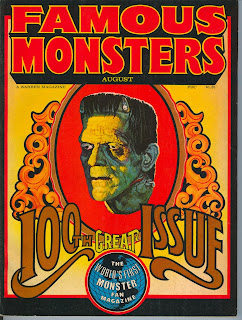
Listen, getting excited about the new issue of “Famous Monsters of Filmland” was something I learned not to speak about at Granby Junior Senior High School in the somewhat rural town of Granby, Mass. It’s little wonder I didn’t date until I was a senior.
Through “FM,” though, I learned of the world of fanzines – amateur magazines published by geeks like me. Interesting enough, there were no words like “nerd” or “geek” then. We were just fans.
I was thrilled to find fellow fans and decided to publish my own’ zine as a means to communicate, if nothing else. I didn’t want to make money. Luckily for me, my father, who was an industrial arts teacher not only had his own spirit duplicator machine at home – so I had a printing press – but he also taught me how to silk screen.
And so I launched my fanzine “Inertron.” The name came from the substance that enabled comic strip hero Buck Rogers to defy gravity in the 25th Century.
My interests undoubtedly mystified my parents, but my dad kept his remarks to a minimum and my mom helped me by being the typist for the magazine.
My ‘zine never had more than 100 readers, but it was the reason I became a journalist. I was hooked on writing.
I quickly learned that what drew people to fanzines were interviews with the stars and authors of our type of entertainment. And so, I decided to seek out someone who would draw attention to my little ‘sine.
I was elated when I received proof that Buster Crabbe had received my letter.
My legs were literally shaking when I called Buster Crabbe in 1972. I sat in the kitchen of our home with a microphone stuck with a suction cup on the receiver asking questions to the first movie star I had the opportunity to interview.
And not just any movie star – it was Flash Gordon.
I had found out that Crabbe lived in Rye, New York, and had written him. He very graciously replied with his telephone number and a time and date to call.
At that time, Crabbe was riding a wave of nostalgia that brought attention again to performers such as Buffalo Bob Smith of “Howdy Doody” fame and Clayton Moore, the Lone Ranger himself.
It was the first time that the childhood heroes of the Baby Boomers saw they had a second or third career as college students rediscovered them.
Clarence Linden “Buster” Crabbe came to prominence in the 1932 Los Angeles Olympics as a gold-medal winning swimmer. His athletic fame was translated into a contract with Paramount Pictures.
Crabbe was a utility player at Paramount. He was handsome and had a great physique, something which was played up in his first starring role as a Tarzan-like hero in “King of the Jungle” in 1933. He was never deemed by Paramount brass, though, as anyone who was “A” film material.
Instead Crabbe found himself as a supporting player or as the lead in program pictures. Perhaps his most prominent role for many people was in the W.C. Fields comedy, “You’re Telling Me.”
His place, though, in cinema history was assured with the success of the three “Flash Gordon” serial in which Crabbe played the comic strip hero. Serials were deemed as entertainment for children and other not so demanding audiences, but the Flash Gordon serials received a prominence that few serials reached.
After his contract with Paramount ran out in 1940, he found a new home at PRC, the lowest of the low budget studios where Crabbe made westerns and jungle adventure films.
In the 1950s, Crabbe made numerous appearances on television and had his own successful series, “Capt. Gallant of the Foreign Legion.”
Acting took a back seat starting in the 1950s, when Crabbe became involved with several profitable businesses – a swimming camp, an affiliation with a pool company and work as a stockbroker.
Crabbe had made his final film, a comedy titled “The Comeback Trail,” in which he played a retired cowboy. He was clearly enthusiastic about the film, which received scant theatrical release and has yet to appear on home video.
Crabbe died in 1983.
One thing I learned at the tender age I conducted this interview is just because a statement about an actor or director is made in a book by a film historian that doesn’t mean it’s true. Crabbe refuted two “facts” that were stated about him.
Also in my ignorance, I sort of had an idea that if you worked in a genre of film – such a serials or low budget Westerns – you knew other people who worked in similar films. That wasn’t necessarily the case.
This interview originally appeared in my fanzine “Inertron” in 1972.
Since you were an Olympic champion I was wondering what your opinions were of this year’s Olympics [1972 in Munich, Germany].
“Well, I think it was very poorly handled, much to be desired management wise. I certainly didn’t agree with taking the Gold Medal away from the youngster Demanche who won the 400 meters, he’s the one who had the asthmatic condition with the pill. I think it’s inexcusable that two boys were sleeping when they were supposed to be up for the preliminaries and that began with, I feel, the coach’s and management’s fault, not the athletes’.
“The basketball was certainly an all fouled-up affair and if I had anything to do with the Montreal Olympics in 1976 I certainly would take a wary eye at what might happen before they spent a lot of money preparing for the 1976 Olympic Games.”
There is a new book out entitled “Heroes, Heavies and Sagebrush” that claims your first movie was “Island of Lost Souls” with Charles Laughton. Is that true?
“No, I was not in that film at all. My first was ‘King of the Jungle,’ a Tarzan-like picture Paramount made and released in 1933. I don’t know where that ‘Island of Lost Souls’ came from."
I was wondering if that had been any rivalry between you and Johnny Weissmuller?
“Sure there was.”
When you were both Tarzan?
“Well, no. I never considered myself a Tarzan. I thought you were talking about the competitive days. You know he’s older than I am and I started off as a kid racing him. After the ’28 [Olympic] games he retired from swimming and started in the movies in 1930.”
Did you make up your own Tarzan yell?
“No. The Tarzan yell, which was learned by a lot of kids – the original Tarzan yell, the one Weissmuller did – was the brainwork of my wife’s father, a fellow named Tom Held, who was a cutter at MGM. They didn’t know what kid of yell they were going to do and believe it or not, it turned out to be not one voice. The original Tarzan yell was three – a baritone, a tenor and a hog caller. Then Weissmuller learned it and every kid in the neighborhood learned the Tarzan call, too. So they used it ever since, but originally it was three voices, three separate voices all melted together.”
I know that you worked with W.C. Fields on a picture.
“Oh yes, I worked on two.”
Do you have any stories of him?
“He was just as he was on the screen. As a matter of fact, this nostalgic thing has been a plus for his films. Box office-wise his films drew, but he wasn’t a big tremendous box office star. I would hazard this: that the Fields pictures are doing better now than when they were first released 30 or 40 years ago.”
Do you ever get tired of being recognized as Flash Gordon?
“Well, no. You know, you didn’t have the coverage in the old days in the middle ‘30s and early ‘40s, you didn’t have the coverage you do now with television. Not that many people recognized me. More people recognize me now even though I’m older, as having played Flash Gordon than in the ‘30s and ‘40s, I think. They run the things on television and let’s say it plays to two million people. A serial that played to two million people might have taken two years to do it.”
You were one of the top Western stars. Who were your favorite cowboy stars?
“Well, Tom Mix. I used to see him as a kid. I thought he was really tops – Col. Tim McCoy, too. I liked [Wild Bill] Elliot very much in fact. You know, nothing fancy in dress and what not."
I was just reading Jim Harmon and Don Glut’s new book, “the Great Serial Heroes,” that you were offered the role of Superman first in the serial which eventually starred Kirk Alyn. Is this true?
“No, that’s not true.”
I heard that you’ve finished a new movie with Chuck McCann in it.
In this clip from "The Comeback Trail," Crabbe's character is the narrator. The Western footage features Tom Tyler from his first sound serial, "The Phantom of the West."
“Well it’s a thing called 'Comeback Trail,' and the deal is that it is supposed to be previewed now. It was made a year and a half ago, but they have been stalling on the cutting. However, I think that it’s going to be a very funny Western, a semblance to a Western, take it or leave it – it’s in a Western locale.
[Note: 'The Comeback Trail' never received a wide theatrical release and is not readily available on home video.]
"The plot is about a couple of fellows, Chuck McCann and Bob Staats, who are producers of skin flicks, horrible skin flicks and they have to do something to make some money because they owe a lot of money.
"In checking over the bills they owe they come across an item of insurance and Chuck wants to know what this $12,000 worth of insurance is about. Bob explains that when you make a film, you’ve got to insure it in case anything happens, you know, if the negative film is destroyed by fire or some such thing.
"The wheels begin to roll and they decide to make a Western film and instead of taking a young fellow whom they could develop into a Western star, they pick an old fellow for a reason.
"They’re going to make him do all of his own stunts, all his own falls off of horses ad infinitum, hoping to bring on a heart attack and have him drop dead on the set so they can collect the insurance.
"They insure the film for $2 million and go about finding the fellow and it turns out to be me.
"All during the film we go along telling our story, you see it’s a film within a film – you see us actually getting ready to shoot the scenes for the film – it bounces back and they never do succeed in putting me away, so to speak.
"That’s the story. It’s a funny picture, a real funny picture. These fellows are good; they work well together like a Laurel and Hardy team. I think that after the film is shown and I’ve only seen a couple of days work and some cuts – I’ve never seen even a rough cut of it – but watching the fellow work together and whatnot I really think that they have a chance of getting to be a comedy team a la Laurel and Hardy.”
Other than your Flash Gordon role, which role is your favorite?
“Well, I like the 'Captain Gallant of the Foreign Legion' – that was 65 films we made for television in 1954 and ‘56– because my son was in it. I enjoyed making that series. He was with me all the time and that was kind of fun.”
Speaking of that series, some people would condemn it today because its supposed excess of violence would be detrimental to Saturday morning viewers.
“Oh that is so very wrong! Take a look at what they have on the screen now! This is tame compared to what’s going on now! Look at cowboy pictures that they make now. Look at pictures Clint Eastwood and people like that make! Blood and thunder! This, they looked down upon 25 and 30 years ago. No, we don’t even hold a candle to what’s going on, Too much violence? That’s asinine."
Well, it was bothering me because I was raised on your Foreign Legion show and the old Lone Ranger series.
Sure, they were a lot of fun. If they try tried to shoot you and they weren’t successful you shot them, you know, it was one of those things. But violence wise we don’t even compare.”
Which role have you enjoyed most in life: that of an athlete, movie star or a businessman?
"I never really considered myself a movie star. One of the reasons for that is that I never had a top grade triple A script and a top grade triple A director and producer. I never had the chance to work with a real big director in the business. The result is that I made action pictures, which turned out to be fortunate for me. The Billy the Kid Westerns, all the Westerns I did for Paramount, the serials I made and the other action things stood me in good stead because when television came along they sort of resurrected me, so to speak.
"But I always considered myself, when I was a college student and before that, as a fair to middling swimmer and I go for the physical fitness type of thing, That’s why I’m involved in the Masters Swimming program now =, which is for guys and gals who aren’t so young anymore.
I was reading a book by William K. Everson who said that your career, like that of W.C. Fields’s Paramount career, was mismanaged by the studio.
"I think that they could have really done something with it had they put on their thinking caps and brought me along. They took me dripping wet of out of a swimming pool.’
"Now don’t misunderstand me, I had a year in law school and wasn’t a dummy who came out of left field or anything like that. I think with a little bit of grooming and the right kind of coaching then I might have been able to do something, but that’s over the hill now.
"I was there a long time at Paramount and I did what I was told – you know body and soul belonging to Paramount Studios. The type of comedy that Fields did, I don’t think they appreciated. I think that they could have done a better job promoting him – tours and things. Maybe he turned them down, I don’t know, maybe he said the hell with them – “I don’t want to go on the road “ – but I kind of doubt this because he came off vaudeville back east here. I think the man has a point particularly in regard to W.C. Fields."
Well, he mentioned in the book that they gave you a fairly good starting picture, “King of the Jungle.”
“King of the Jungle” was fine, but it was the “Me Tarzan, you Jane” type of thing. The word got out around the studio that regardless of my background – you know, college and a year of law school – that “he looks fine if you’ve got a life guard part, you strip him down and put him in a G-string, he’s okay, don’t give him any dialogue.” This is what I had to live down the first two or three years there."
Crabbe as he appeared in his first feature film, "King of the Jungle."
Would you like to do more films after this last one?
"Oh yeah, sure, I’d like to work in a movie. Of course, I’d have to be a character [actor] now. I love to play heavies. I had more fun playing the heavy than the lead by far. Love to play the real nasty guy."
Crabbe played a heavy in "The Bounty Killer."
Thank you Mr. Crabbe for allowing me to ask you these questions.
"No bother at all, Mike."
Interviews for my fanzine that followed included James Pierce, a college football star in the 1920s who played Tarzan in “Tarzan and the Golden Lion,” among other roles, and the publisher of MAD magazine, William Gaines.
I sold a version of the Gaines interview to a local alternative weekly, “The Valley Advocate,” which also bought the first interview I conducted that wasn’t a fanboy subject.
Veteran NBC reporter and commentator Edwin Newman was appearing at the Eastern States Exposition promoting his book “Strictly Speaking: Will America be the Death of English?” in 1975. I had heard about it and managed to arrange to speak to him at the sales table. The book was a New York Times bestseller and Newman, whom I had grown up watching on television, was a gentleman, which undoubtedly soothed my nerves.
The only reason a local or regional publication would have a chance at a celebrity is because he or she is coming to town for a purpose. I learned through my five years on local radio as a talk show host that celebrities viewed the electronic medium differently.
During my tenure, I discovered I didn’t require having a local hook for an actor or writer to be interested in speaking with me. People appearing on television shows were happy to speak to me if their show was in my market. Authors wanted the exposure for their books.
Politicians were, for the most part, overjoyed to get onto radio.
My time on the air was 1982 to1987 at a time when stations still hired local talent and the Fairness Doctrine, which required stations to present both sides of a controversial issue, was still in force. When the Fairness Doctrine was revoked, the rise of syndicated program espousing one political point of view began and stations started getting rid of local hosts, whom they had to pay, and replacing them with syndicated shows that were for free. All the local stations were given time in those shows to sell ads.
Local hosts were supposed to be jacks-of-all-trades, talking about many subjects. Their shows would change from hour to hour, depending upon the guests
.
A show also reflected the interests of a host and as soon as I realized that station management didn’t care what I did, I decided to care just about my interests and those of my audience.
If there was someone of note coming into the area, I tried to book him or her to appear either by phone or in person. When I look over the list of people I was able to interview on a 500-watt daytime AM station, I feel a little pride.
The first “celeb” was a personal favorite of mine, music historian Dr. Demento. Soon after, a science fiction convention in town gave me the chance of having actors Barry Morse and Sarah Douglas in the studio. Douglas was dressed in a black leather outfit that closely resembled her costume on the Christopher Reeve “Superman” films. I was a little intimidated, but she and Morse were wonderful.
It’s one thing for a journalist to sputter and pause while he or she is asking questions for a newspaper story, but an interview that is broadcast live is quite another matter. You really don’t want to sound like an idiot and stumble around. On the other hand, you don’t want to ask questions that all sound pre-scripted. The best way was to simply try to have a conversation with the subject.
If you’re subject is in the studio, you had to balance between speaking with the guest, running the controls and watching the clock. Keeping your finger on the seven-second-delay button was also a good idea if your guest was accepting calls from your listeners.
A partial list of people, some of whom are in this book, would include two Playboy playmates – Terry Nihen and Debbie Johnson – actors such as James B. Sikking, Lucie Arnez, Richard Crenna, Keye Luke, William Benedict, Virginia Christine, Rick Moranis, Dave Thomas Antonio Fargas, Mark Metcalf; authors Gerri Hirshey, Sidney Sheldon and Cleveland Amory; directors George Romero and Larry Cohen, abortion rights pioneer Bill Baird; Myra Lewis, the former wife of seminal rocker Jerry Lee Lewis; former Attorney General Eliot Richardson, Sen. George McGovern, Massachusetts Gov. Michael Dukakis, Rev. Ivan Stang of the Church of the Sub-Genius, Mel Taylor of the legendary instrumental guitar group the Ventures, folk artists Tom Rush and Aztec Two-Step, Larry “Bozo the Clown” Harmon, Phil Proctor and Peter Bergman of Firesign Theater, Jack Benny co-star Dennis Day, comedians Lois Bromfield, Emo Philips, Yacov Smirnoff , “Weird” Al Yankovic and cartoonist B. Kliban.
Two memorable interviews were with Clarence Nash, the voice of Donald Duck and Andriana Caselotti, the voice of Snow White.
I even interviewed Dick Wilson, who was Mr. Whipple, the slightly twisted grocer in love with Charmin toilet paper. He was fun, cracking toilet paper jokes.
The easiest two hours of my five years on air was with wrestling superstar Bob Backlund. For the life of me I cannot recall how Backlund decided to come on my show. I had interviewed him once at a local match and I thought he was going to slug me when I asked him how did he respond to people who claimed wrestling was fake.
But somehow, Backlund called me and wanted to come on my show on Aug. 14, 1984, ten days after his last match with the WWF and less than a year after he lost his championship title. I wish I had a tape of that show, as Backlund was highly critical of Vince McMahon, the owner of the WWF.
The phones simply didn’t stop ringing for the two hours.
The next day, I received one of the oddest phone calls in my career. Vince McMahon called me completely unexpectedly and said he had heard I had interviewed Backlund and wanted to know if I was interested in writing for his new wrestling magazine.
I was gob smacked and mumbled some ambiguous reply. I was startled by the call – how did he know in the pre-Internet days of the 1980s that I had spoken with Backlund? How did he know I was a writer?
I never followed up on it. Perhaps I should have.
Other great moments were interviews with the first lady of American cinema Lillian Gish and my personal hero Vincent Price. Gish had recently re-issued her autobiography and her publisher wasn’t cooperative. Undaunted, I contacted her agent and Gish agreed to an interview. She was very sharp and it was a pleasure speaking with her.
Gish liked her interview with me. I liked the unicorn stationary.
Price was appearing at the University of Massachusetts at Amherst with a one-man show titled “The Villain Stills Pursues Me.” My wife and I had front row seats for what was a fantastic evening. The next day Price conducted a press conference and a fellow writer and I attended it. We asked most of the questions and Price walked out of the building with us, continuing his remarks.
With some of these interviews I was able to take some of the conversation and turn it into a written piece that I sold to various publications. My best sale at this time was USA Today, which bought an interview I did with attorney and author Alan Dershowitz who spoke to me about his book “The Best Defense.”
I always advise people to only sell first publications rights and try, if they can, to structure an interview so it can have multiple uses or sales.
My next group of interviews revolved around Animato! The Animation Fan’s magazine, which I co-owned and edited from 1992 to 1997. Many of those interviews were collected in my book “Escape! How Animation Went Mainstream in the 1990s.”
As the managing editor of a group of weekly newspapers, I use interviews with celebrities as a way to change readers’ conceptions about what a community newspaper should cover. People have said to me they didn’t expect to see an interview with Leonard Nimoy or Dave Attell or any number of other people in a “small” weekly.
That’s the power of getting a good interview.
© 2012 by Gordon Michael Dobbs
I will be posting a sample chapter from this book shortly as well and then posting revised material for books on Max Fleischer, Tom Tyler and a graphic novel collaboration with an exotic dancer about moments from her life on the road.
Let me know what you think, if you can.
Perhaps the first question any journalist has when they land an interview is “How much time do I have?”
Chances are you will have 10 to 20 minutes to speak with someone well known. That’s not much time and it requires writers not only to prepare to use those few minutes wisely but also to be able to improvise.
Many actors will tell you the secret to a performance is listening and reacting. The same holds true to interviewing.
I would guess that 95 percent of every reporter working right now hasn’t had the opportunity of doing what was long considered the gold standard of interviews: those found in the front of Playboy. Those writers traditionally were given lengthy access to their subjects over a period of several meetings and then carefully edited the interview together in such a way to present a well-rounded look at a person.
Over the years, being profiled in Playboy became prestigious.
In a professional writing career that started in 1975, I’ve had one opportunity to do multiple interviews with someone that lasted more than 15 minutes and that was with William Gaines, the publisher of the much respected EC line of comics in the 1950s and the publisher of MAD magazine.
This is the original artwork for the first interview I conducted with William Gaines in my fanzine "Inertron," drawn by my college friends Michael Moyle.
The opportunities to do intense sit-downs don’t come very often.
Most of the time when a journalist has some time with someone famous there is a purpose attached to that interview and invariably that subject has something to sell. A book, television show, a movie, a new record or a political objective are probably the most common reasons for anyone mildly famous to want to speak with a reporter.
Otherwise, why submit yourself to something you can’t control? Perhaps the only time a celebrity would allow himself or herself to be intensively grilled is if it panders to their ego. If a major magazine, for instance, selects a particular person for a lengthy profile, there is certainly an unmistakable element of ego buffing.
The key to a good interview is to allow the subject to get his or her plug into the story, but to try to find the time to ask something that make your few minutes with this person and your story different.
One of my journalism professors, a former Chicago newspaper reporter, said all of the best interviews he conducted were in bars. Somehow that sounded sort of romantic to me when I attended college in the 1970s. That was hardcore – a reporter in a cheap suit getting some elected official to spill the beans through a liberal application of booze with one eye on his watch and the other on his notebook.
The scene has the ring of being from “The Front Page,” or my favorite newspaper movie “Five Star Final” – catch it the next time it’s on Turner Classic Movies.
I’ve interviewed hundreds of people. Most were not famous. Some – many of which are in this book – were. Only two of those interviews were conducted in a bar – once with a Penthouse magazine centerfold and once with an exotic dancer who was staging a retro burlesque show.
So much for the romance from the era when reporters wore fedoras with a press pass stuck in the band, drank their Scotch neat and called into a newspaper to speak with a re-write man.
The fact is most interviews are done at the convenience and schedule of the subject and the more famous a person is – or the hotter he or she might happen to be at the time – the probability grows that a writer will have to jump through many hoops to get what he or she needs.
If a star has a new movie out and you get on the list to speak with him or her for 10 minutes then you call at the appointed time, ask your questions and say goodbye. You don’t meet her at her hotel room when she is in town or at a high-end restaurant for an extended sit-down, if you are a working class writer such as myself.
Instead you work with a publicist in securing the time and you find out if there are restrictions to what you can ask. Sometimes those restrictions are for legal reasons; sometimes it’s about ego.
If you are working on a story about an outstanding investigation, the district attorney may speak with you but won’t comment – at least on the record – on anything unresolved.
I spent five years as a local radio talk show host and one of my first interviews was with a state senator – later a member of Congress – who told me off the air at the beginning of my program that he wouldn’t talk about some particular issue. I acquiesced to his demand, although I hated doing so.
Why? I wanted to preserve my access to him in the future. This is the game you have to play with news sources, many times elected officials. If you embarrass them, they are not going to speak at all with you in the future.
A reporter has to walk a line between doing the story that needs to be done and understanding reality. Some times idealism wins at this game and some times reality wins.
Interviewing can have its dangers, such as a good-natured throttling from the late wrestling great Killer Kowalski. This shot was taken after I did a quick interview with him at Mountain Park in Holyoke, Mass. in the mid-1980s.
If you decide to bash someone, make sure you don’t wound the person. Instead, kill him, because if they can hurt you in the future, they will.
With people from show business, violating restrictions might mean a publicist won’t cooperate with you in the future or it might result in a celebrity ending the interview much earlier than you hoped. Of course that can also make for a good story.
It’s always wise to negotiate about restrictions, to make sure that perhaps some of that forbidden information can be discussed.
With celebrity interviews, I’ve seldom encountered the problems of someone speaking off the record, as it is usually politicians you want to do that. Essentially, someone speaking off the record wants you to know something, but you cannot attribute any of that material to that person directly. That’s when you see phrases such as “according to a source close to the governor” being used, chances are that source was the governor.
Many of the interviews one sees on television are the end result of both negotiations and pre-interviewing. A producer will go over questions or subjects to make sure everyone is happy with the direction of the interview.
Some of the interviews in this book had some restrictions, but there were no pre-arranged questions and answers.
When I was on talk radio in the 1980s, I jumped at the chance of having Cassandra Peterson on my show. She is better known as Elvira, Mistress of the Dark. The publicist came on the telephone prior to the live interview and told me that I wasn’t interviewing Peterson, but instead Elvira.
The idea of interviewing a character was not what I had in mind. The segment was lame. I stank trying to set up improvised comedy bits.
In 2011, I had the chance to interview Peterson again. This time it went well as I spoke to Peterson and not her alter ego. At the end of the interview I told what had happened years before. Peterson, who was a member of the famed comedy troupe The Groundlings, was a friend of Paul Ruebens also known as Pee-wee Herman.
She said that back in the 1980s she was impressed that Ruebens never broke character even in interviews and she wanted to do that herself. We had a good laugh about it.
Some interviewers believe strongly in doing a minimal amount of research because they believe they are representing an average reader or viewer who is fairly ignorant on the subject. This approach worked well for Larry King, but then he was as famous, if not more, than his subjects. I watched a few interviews conducted by King in which his approach actually wasted time. I wanted him to get on with a meaty question instead of the soft ones he was throwing.
A regular working reporter doesn’t have the luxury of assuming an interview subject will be gracious when asked questions that reveal the reporter’s ignorance.
I believe in doing research because it has been my experience that if you actually prove to a subject you know something about them, they will favorably respond.
Also doing research may change whatever prejudice or perspective you might have about the subject.
An example of this was when I interviewed Clayton Moore, the actor who played the Lone Ranger in the long-running television series. I made a point of not talking about the Lone Ranger until about mid-way through the interview. I spoke with him about his entry into show business and roles he had that didn’t involve wearing a mask.
My reward was Moore saying warmly to me, “You really know something about my career.”
At the end of the interview, he said “Adios amigo!” I teared up. After all this was a childhood hero of mine. Thank goodness, I was on radio.
Being a fan can work in your favor in an interview if you don’t fixate on questions that seem obsessive and if you show that you actually do appreciate the person’s work and you’re not just blowing smoke.
I interviewed actor and director Leonard Nimoy about an exhibit of his photos in a local gallery. I didn’t say a word about “Star Trek,” despite being a fan. It wouldn’t have made sense within the context of the conversation.
If I’m a fan of someone, I will admit it as I’ve learned over the years that it is one way to break the ice and to relieve my own nervousness. When I told Bill Cosby I loved his work for years – my family listened to his comedy albums over and over when I was a kid – he said, “Good. That will make this a lot easier.”
We spoke for 45 minutes and I got a great interview.
Revealing that you actually like someone’s work provides a bit of humanity to a process that can be very repetitive to celebrities. I had the opportunity to speak to actress Maureen O’Hara and told her the truth: I had had a crush on her since I was about 12 and I thought she was a very under-rated actress.
Both are true statements. She looked at me and said she agreed with me – she had been under-rated. The interview went well.
On the other hand, sometimes you meet someone who you admire and find out the worse. I loved the music of Don McLean and when I interviewed him the encounter was so negative it put me off listening to his recordings for years.
People frequently make assumptions when speaking with a reporter that they share knowledge on a subject. For me, interviews are about learning and if I do not understand something, I slow things down and make sure I’m keeping up.
When I’ve not done my homework I’ve paid for it. When first interviewing comic Jim Breuer I was under the impression he was still on “Saturday Night Live.” That was a mistake and Breuer – whom I’ve interviewed three times – let me have it in a good-natured way.
Having a list of questions is also invaluable, although one has to go with the flow of the conversation. I had exactly 10 minutes with rock legend Alice Cooper and every minute had to count. Cooper was courteous, highly professional, sharp and expected me not to waste his time. I didn’t.
How did I get into writing, much less interviewing? When I was a young teen, I became seriously interested in movies – especially horror, science fiction and fantasy – and there was no one at my small town high school who shared my interests.
Listen, getting excited about the new issue of “Famous Monsters of Filmland” was something I learned not to speak about at Granby Junior Senior High School in the somewhat rural town of Granby, Mass. It’s little wonder I didn’t date until I was a senior.
Through “FM,” though, I learned of the world of fanzines – amateur magazines published by geeks like me. Interesting enough, there were no words like “nerd” or “geek” then. We were just fans.
I was thrilled to find fellow fans and decided to publish my own’ zine as a means to communicate, if nothing else. I didn’t want to make money. Luckily for me, my father, who was an industrial arts teacher not only had his own spirit duplicator machine at home – so I had a printing press – but he also taught me how to silk screen.
And so I launched my fanzine “Inertron.” The name came from the substance that enabled comic strip hero Buck Rogers to defy gravity in the 25th Century.
My interests undoubtedly mystified my parents, but my dad kept his remarks to a minimum and my mom helped me by being the typist for the magazine.
My ‘zine never had more than 100 readers, but it was the reason I became a journalist. I was hooked on writing.
I quickly learned that what drew people to fanzines were interviews with the stars and authors of our type of entertainment. And so, I decided to seek out someone who would draw attention to my little ‘sine.
I was elated when I received proof that Buster Crabbe had received my letter.
My legs were literally shaking when I called Buster Crabbe in 1972. I sat in the kitchen of our home with a microphone stuck with a suction cup on the receiver asking questions to the first movie star I had the opportunity to interview.
And not just any movie star – it was Flash Gordon.
I had found out that Crabbe lived in Rye, New York, and had written him. He very graciously replied with his telephone number and a time and date to call.
At that time, Crabbe was riding a wave of nostalgia that brought attention again to performers such as Buffalo Bob Smith of “Howdy Doody” fame and Clayton Moore, the Lone Ranger himself.
It was the first time that the childhood heroes of the Baby Boomers saw they had a second or third career as college students rediscovered them.
Clarence Linden “Buster” Crabbe came to prominence in the 1932 Los Angeles Olympics as a gold-medal winning swimmer. His athletic fame was translated into a contract with Paramount Pictures.
Crabbe was a utility player at Paramount. He was handsome and had a great physique, something which was played up in his first starring role as a Tarzan-like hero in “King of the Jungle” in 1933. He was never deemed by Paramount brass, though, as anyone who was “A” film material.
Instead Crabbe found himself as a supporting player or as the lead in program pictures. Perhaps his most prominent role for many people was in the W.C. Fields comedy, “You’re Telling Me.”
His place, though, in cinema history was assured with the success of the three “Flash Gordon” serial in which Crabbe played the comic strip hero. Serials were deemed as entertainment for children and other not so demanding audiences, but the Flash Gordon serials received a prominence that few serials reached.
After his contract with Paramount ran out in 1940, he found a new home at PRC, the lowest of the low budget studios where Crabbe made westerns and jungle adventure films.
In the 1950s, Crabbe made numerous appearances on television and had his own successful series, “Capt. Gallant of the Foreign Legion.”
Acting took a back seat starting in the 1950s, when Crabbe became involved with several profitable businesses – a swimming camp, an affiliation with a pool company and work as a stockbroker.
Crabbe had made his final film, a comedy titled “The Comeback Trail,” in which he played a retired cowboy. He was clearly enthusiastic about the film, which received scant theatrical release and has yet to appear on home video.
Crabbe died in 1983.
One thing I learned at the tender age I conducted this interview is just because a statement about an actor or director is made in a book by a film historian that doesn’t mean it’s true. Crabbe refuted two “facts” that were stated about him.
Also in my ignorance, I sort of had an idea that if you worked in a genre of film – such a serials or low budget Westerns – you knew other people who worked in similar films. That wasn’t necessarily the case.
This interview originally appeared in my fanzine “Inertron” in 1972.
Since you were an Olympic champion I was wondering what your opinions were of this year’s Olympics [1972 in Munich, Germany].
“Well, I think it was very poorly handled, much to be desired management wise. I certainly didn’t agree with taking the Gold Medal away from the youngster Demanche who won the 400 meters, he’s the one who had the asthmatic condition with the pill. I think it’s inexcusable that two boys were sleeping when they were supposed to be up for the preliminaries and that began with, I feel, the coach’s and management’s fault, not the athletes’.
“The basketball was certainly an all fouled-up affair and if I had anything to do with the Montreal Olympics in 1976 I certainly would take a wary eye at what might happen before they spent a lot of money preparing for the 1976 Olympic Games.”
There is a new book out entitled “Heroes, Heavies and Sagebrush” that claims your first movie was “Island of Lost Souls” with Charles Laughton. Is that true?
“No, I was not in that film at all. My first was ‘King of the Jungle,’ a Tarzan-like picture Paramount made and released in 1933. I don’t know where that ‘Island of Lost Souls’ came from."
I was wondering if that had been any rivalry between you and Johnny Weissmuller?
“Sure there was.”
When you were both Tarzan?
“Well, no. I never considered myself a Tarzan. I thought you were talking about the competitive days. You know he’s older than I am and I started off as a kid racing him. After the ’28 [Olympic] games he retired from swimming and started in the movies in 1930.”
Did you make up your own Tarzan yell?
“No. The Tarzan yell, which was learned by a lot of kids – the original Tarzan yell, the one Weissmuller did – was the brainwork of my wife’s father, a fellow named Tom Held, who was a cutter at MGM. They didn’t know what kid of yell they were going to do and believe it or not, it turned out to be not one voice. The original Tarzan yell was three – a baritone, a tenor and a hog caller. Then Weissmuller learned it and every kid in the neighborhood learned the Tarzan call, too. So they used it ever since, but originally it was three voices, three separate voices all melted together.”
I know that you worked with W.C. Fields on a picture.
“Oh yes, I worked on two.”
Do you have any stories of him?
“He was just as he was on the screen. As a matter of fact, this nostalgic thing has been a plus for his films. Box office-wise his films drew, but he wasn’t a big tremendous box office star. I would hazard this: that the Fields pictures are doing better now than when they were first released 30 or 40 years ago.”
Do you ever get tired of being recognized as Flash Gordon?
“Well, no. You know, you didn’t have the coverage in the old days in the middle ‘30s and early ‘40s, you didn’t have the coverage you do now with television. Not that many people recognized me. More people recognize me now even though I’m older, as having played Flash Gordon than in the ‘30s and ‘40s, I think. They run the things on television and let’s say it plays to two million people. A serial that played to two million people might have taken two years to do it.”
You were one of the top Western stars. Who were your favorite cowboy stars?
“Well, Tom Mix. I used to see him as a kid. I thought he was really tops – Col. Tim McCoy, too. I liked [Wild Bill] Elliot very much in fact. You know, nothing fancy in dress and what not."
I was just reading Jim Harmon and Don Glut’s new book, “the Great Serial Heroes,” that you were offered the role of Superman first in the serial which eventually starred Kirk Alyn. Is this true?
“No, that’s not true.”
I heard that you’ve finished a new movie with Chuck McCann in it.
In this clip from "The Comeback Trail," Crabbe's character is the narrator. The Western footage features Tom Tyler from his first sound serial, "The Phantom of the West."
“Well it’s a thing called 'Comeback Trail,' and the deal is that it is supposed to be previewed now. It was made a year and a half ago, but they have been stalling on the cutting. However, I think that it’s going to be a very funny Western, a semblance to a Western, take it or leave it – it’s in a Western locale.
[Note: 'The Comeback Trail' never received a wide theatrical release and is not readily available on home video.]
"The plot is about a couple of fellows, Chuck McCann and Bob Staats, who are producers of skin flicks, horrible skin flicks and they have to do something to make some money because they owe a lot of money.
"In checking over the bills they owe they come across an item of insurance and Chuck wants to know what this $12,000 worth of insurance is about. Bob explains that when you make a film, you’ve got to insure it in case anything happens, you know, if the negative film is destroyed by fire or some such thing.
"The wheels begin to roll and they decide to make a Western film and instead of taking a young fellow whom they could develop into a Western star, they pick an old fellow for a reason.
"They’re going to make him do all of his own stunts, all his own falls off of horses ad infinitum, hoping to bring on a heart attack and have him drop dead on the set so they can collect the insurance.
"They insure the film for $2 million and go about finding the fellow and it turns out to be me.
"All during the film we go along telling our story, you see it’s a film within a film – you see us actually getting ready to shoot the scenes for the film – it bounces back and they never do succeed in putting me away, so to speak.
"That’s the story. It’s a funny picture, a real funny picture. These fellows are good; they work well together like a Laurel and Hardy team. I think that after the film is shown and I’ve only seen a couple of days work and some cuts – I’ve never seen even a rough cut of it – but watching the fellow work together and whatnot I really think that they have a chance of getting to be a comedy team a la Laurel and Hardy.”
Other than your Flash Gordon role, which role is your favorite?
“Well, I like the 'Captain Gallant of the Foreign Legion' – that was 65 films we made for television in 1954 and ‘56– because my son was in it. I enjoyed making that series. He was with me all the time and that was kind of fun.”
Speaking of that series, some people would condemn it today because its supposed excess of violence would be detrimental to Saturday morning viewers.
“Oh that is so very wrong! Take a look at what they have on the screen now! This is tame compared to what’s going on now! Look at cowboy pictures that they make now. Look at pictures Clint Eastwood and people like that make! Blood and thunder! This, they looked down upon 25 and 30 years ago. No, we don’t even hold a candle to what’s going on, Too much violence? That’s asinine."
Well, it was bothering me because I was raised on your Foreign Legion show and the old Lone Ranger series.
Sure, they were a lot of fun. If they try tried to shoot you and they weren’t successful you shot them, you know, it was one of those things. But violence wise we don’t even compare.”
Which role have you enjoyed most in life: that of an athlete, movie star or a businessman?
"I never really considered myself a movie star. One of the reasons for that is that I never had a top grade triple A script and a top grade triple A director and producer. I never had the chance to work with a real big director in the business. The result is that I made action pictures, which turned out to be fortunate for me. The Billy the Kid Westerns, all the Westerns I did for Paramount, the serials I made and the other action things stood me in good stead because when television came along they sort of resurrected me, so to speak.
"But I always considered myself, when I was a college student and before that, as a fair to middling swimmer and I go for the physical fitness type of thing, That’s why I’m involved in the Masters Swimming program now =, which is for guys and gals who aren’t so young anymore.
I was reading a book by William K. Everson who said that your career, like that of W.C. Fields’s Paramount career, was mismanaged by the studio.
"I think that they could have really done something with it had they put on their thinking caps and brought me along. They took me dripping wet of out of a swimming pool.’
"Now don’t misunderstand me, I had a year in law school and wasn’t a dummy who came out of left field or anything like that. I think with a little bit of grooming and the right kind of coaching then I might have been able to do something, but that’s over the hill now.
"I was there a long time at Paramount and I did what I was told – you know body and soul belonging to Paramount Studios. The type of comedy that Fields did, I don’t think they appreciated. I think that they could have done a better job promoting him – tours and things. Maybe he turned them down, I don’t know, maybe he said the hell with them – “I don’t want to go on the road “ – but I kind of doubt this because he came off vaudeville back east here. I think the man has a point particularly in regard to W.C. Fields."
Well, he mentioned in the book that they gave you a fairly good starting picture, “King of the Jungle.”
“King of the Jungle” was fine, but it was the “Me Tarzan, you Jane” type of thing. The word got out around the studio that regardless of my background – you know, college and a year of law school – that “he looks fine if you’ve got a life guard part, you strip him down and put him in a G-string, he’s okay, don’t give him any dialogue.” This is what I had to live down the first two or three years there."
Crabbe as he appeared in his first feature film, "King of the Jungle."
Would you like to do more films after this last one?
"Oh yeah, sure, I’d like to work in a movie. Of course, I’d have to be a character [actor] now. I love to play heavies. I had more fun playing the heavy than the lead by far. Love to play the real nasty guy."
Crabbe played a heavy in "The Bounty Killer."
Thank you Mr. Crabbe for allowing me to ask you these questions.
"No bother at all, Mike."
Interviews for my fanzine that followed included James Pierce, a college football star in the 1920s who played Tarzan in “Tarzan and the Golden Lion,” among other roles, and the publisher of MAD magazine, William Gaines.
I sold a version of the Gaines interview to a local alternative weekly, “The Valley Advocate,” which also bought the first interview I conducted that wasn’t a fanboy subject.
Veteran NBC reporter and commentator Edwin Newman was appearing at the Eastern States Exposition promoting his book “Strictly Speaking: Will America be the Death of English?” in 1975. I had heard about it and managed to arrange to speak to him at the sales table. The book was a New York Times bestseller and Newman, whom I had grown up watching on television, was a gentleman, which undoubtedly soothed my nerves.
The only reason a local or regional publication would have a chance at a celebrity is because he or she is coming to town for a purpose. I learned through my five years on local radio as a talk show host that celebrities viewed the electronic medium differently.
During my tenure, I discovered I didn’t require having a local hook for an actor or writer to be interested in speaking with me. People appearing on television shows were happy to speak to me if their show was in my market. Authors wanted the exposure for their books.
Politicians were, for the most part, overjoyed to get onto radio.
My time on the air was 1982 to1987 at a time when stations still hired local talent and the Fairness Doctrine, which required stations to present both sides of a controversial issue, was still in force. When the Fairness Doctrine was revoked, the rise of syndicated program espousing one political point of view began and stations started getting rid of local hosts, whom they had to pay, and replacing them with syndicated shows that were for free. All the local stations were given time in those shows to sell ads.
Local hosts were supposed to be jacks-of-all-trades, talking about many subjects. Their shows would change from hour to hour, depending upon the guests
.
A show also reflected the interests of a host and as soon as I realized that station management didn’t care what I did, I decided to care just about my interests and those of my audience.
If there was someone of note coming into the area, I tried to book him or her to appear either by phone or in person. When I look over the list of people I was able to interview on a 500-watt daytime AM station, I feel a little pride.
The first “celeb” was a personal favorite of mine, music historian Dr. Demento. Soon after, a science fiction convention in town gave me the chance of having actors Barry Morse and Sarah Douglas in the studio. Douglas was dressed in a black leather outfit that closely resembled her costume on the Christopher Reeve “Superman” films. I was a little intimidated, but she and Morse were wonderful.
It’s one thing for a journalist to sputter and pause while he or she is asking questions for a newspaper story, but an interview that is broadcast live is quite another matter. You really don’t want to sound like an idiot and stumble around. On the other hand, you don’t want to ask questions that all sound pre-scripted. The best way was to simply try to have a conversation with the subject.
If you’re subject is in the studio, you had to balance between speaking with the guest, running the controls and watching the clock. Keeping your finger on the seven-second-delay button was also a good idea if your guest was accepting calls from your listeners.
A partial list of people, some of whom are in this book, would include two Playboy playmates – Terry Nihen and Debbie Johnson – actors such as James B. Sikking, Lucie Arnez, Richard Crenna, Keye Luke, William Benedict, Virginia Christine, Rick Moranis, Dave Thomas Antonio Fargas, Mark Metcalf; authors Gerri Hirshey, Sidney Sheldon and Cleveland Amory; directors George Romero and Larry Cohen, abortion rights pioneer Bill Baird; Myra Lewis, the former wife of seminal rocker Jerry Lee Lewis; former Attorney General Eliot Richardson, Sen. George McGovern, Massachusetts Gov. Michael Dukakis, Rev. Ivan Stang of the Church of the Sub-Genius, Mel Taylor of the legendary instrumental guitar group the Ventures, folk artists Tom Rush and Aztec Two-Step, Larry “Bozo the Clown” Harmon, Phil Proctor and Peter Bergman of Firesign Theater, Jack Benny co-star Dennis Day, comedians Lois Bromfield, Emo Philips, Yacov Smirnoff , “Weird” Al Yankovic and cartoonist B. Kliban.
Two memorable interviews were with Clarence Nash, the voice of Donald Duck and Andriana Caselotti, the voice of Snow White.
I even interviewed Dick Wilson, who was Mr. Whipple, the slightly twisted grocer in love with Charmin toilet paper. He was fun, cracking toilet paper jokes.
The easiest two hours of my five years on air was with wrestling superstar Bob Backlund. For the life of me I cannot recall how Backlund decided to come on my show. I had interviewed him once at a local match and I thought he was going to slug me when I asked him how did he respond to people who claimed wrestling was fake.
But somehow, Backlund called me and wanted to come on my show on Aug. 14, 1984, ten days after his last match with the WWF and less than a year after he lost his championship title. I wish I had a tape of that show, as Backlund was highly critical of Vince McMahon, the owner of the WWF.
The phones simply didn’t stop ringing for the two hours.
The next day, I received one of the oddest phone calls in my career. Vince McMahon called me completely unexpectedly and said he had heard I had interviewed Backlund and wanted to know if I was interested in writing for his new wrestling magazine.
I was gob smacked and mumbled some ambiguous reply. I was startled by the call – how did he know in the pre-Internet days of the 1980s that I had spoken with Backlund? How did he know I was a writer?
I never followed up on it. Perhaps I should have.
Other great moments were interviews with the first lady of American cinema Lillian Gish and my personal hero Vincent Price. Gish had recently re-issued her autobiography and her publisher wasn’t cooperative. Undaunted, I contacted her agent and Gish agreed to an interview. She was very sharp and it was a pleasure speaking with her.
Gish liked her interview with me. I liked the unicorn stationary.
Price was appearing at the University of Massachusetts at Amherst with a one-man show titled “The Villain Stills Pursues Me.” My wife and I had front row seats for what was a fantastic evening. The next day Price conducted a press conference and a fellow writer and I attended it. We asked most of the questions and Price walked out of the building with us, continuing his remarks.
With some of these interviews I was able to take some of the conversation and turn it into a written piece that I sold to various publications. My best sale at this time was USA Today, which bought an interview I did with attorney and author Alan Dershowitz who spoke to me about his book “The Best Defense.”
I always advise people to only sell first publications rights and try, if they can, to structure an interview so it can have multiple uses or sales.
My next group of interviews revolved around Animato! The Animation Fan’s magazine, which I co-owned and edited from 1992 to 1997. Many of those interviews were collected in my book “Escape! How Animation Went Mainstream in the 1990s.”
As the managing editor of a group of weekly newspapers, I use interviews with celebrities as a way to change readers’ conceptions about what a community newspaper should cover. People have said to me they didn’t expect to see an interview with Leonard Nimoy or Dave Attell or any number of other people in a “small” weekly.
That’s the power of getting a good interview.
© 2012 by Gordon Michael Dobbs
Recently, I was talking to a reader and friend who commented she wouldn't even try some of the movies I write about. My goal as a reviewer is one part consumer advocate, one part historian and one part missionary. It's easy enough to get information on mainstream DVD releases, but far more difficult to find reviews on movies with less of a current profile.
I'm not sure how she would view "The Artist," if it fell outside of her cinematic comfort zone. I hope not.
"The Artist"
The last silent films that were made for general distribution in this country were released in 1930. By that time, they were viewed as cheap productions that were meant to fill out double bills in undiscriminating theaters.
Aside from Charles Chaplin’s features such as “Modern Times” and “City Light” that kept sound to a minimum, many essentially viewed the silent film at best as the first version of cinema, one that was bested with the advent of synchronized sound.
The most recent silent film until “The Artist” that I can remember being distributed to theaters was the restored version of Fritz Lang’s “Metropolis” that came out in 2010.
Like that film, “The Artist” will be viewed by some as more of an event than a movie and more of a curiosity than a legitimate film.
Although the average movie fan might not think so, the silent era was a remarkably rich time that was characterized by technical innovations, strong performances and sophisticated storytelling. I can only hope this new film encourages people to seek out silent films and discover their charms.
I saw “The Artist” last week, and I loved the film, despite some minor flaws. It was fascinating to sit in a theater, which at first, the audience had no idea how to react to a silent film. Some people were talking through it at first before being asked to keep quiet.
“The Artist” is an unabashed love letter to Hollywood that conjures up both the reality and the fantasy of a filmmaking era of nearly a century ago. Funny, sad and ultimately sweet, the film is something I’d recommend all dedicated film fans to see.
Jean Desjardin plays George Valentin, a star who is at the top of his game in 1927. Valentin is a composite character. Part of the character is a swashbuckler not unlike Douglas Fairbanks Sr., a comic sophisticate such as Raymond Griffith and a dancer, with a strong Gene Kelly vibe.
Valentin is equally at home with drama and comedy and is also known for his ever-present Jack Russell terrier. He clearly has a healthy ego, but he is also kind to his co-stars and crew.
Director Michel Hazanavicius has also given the character a look that strongly resembles John Gilbert, the great silent film leading man whose career was negatively impacted by the coming of sound.
Valentin befriends a young actress with the delightfully improbable name of Peppy Miller. He gives her some good advice and a job. Although the two are clearly attracted to one another, they do not act on any romance as Valentin is married.
Valentin rejects the coming of sound, walking away from his studio to produce and direct his own film, which comes out as a silent film among sound releases and as the stock market crashes. As his career falls down, Miller’s star is ascending.
Bérénice Bejo plays Miller and she is a delight. Her character cleverly evolves from being a wide-eyed innocent to a star who is willing to use her clout.
The film references “A Star is Born” and “What Price Hollywood?” as it chronicles Valentin’s decline and Miller’s continued efforts to help him.
The art direction is impeccable and the musical score, which uses Bernard Herrmann’s score from “Vertigo” — with permission — is very effective.
“The Artist” walks a thin line very well. It would be easy to produce a parody of silent films, but Hazanavicius clearly takes his characters and narrative more seriously than that. Yet, there is an altered reality to the film that resembles some silent films. Valentin’s dog provides most of those moments. In true Rin Tin Tin fashion, he appears much smarter than most children and capable of even trying to talk his master out of suicide.
This element of near fantasy when combined with the numerous homages and references makes “The Artist” a memorable movie.
If you see the film and are so inclined to be just a little more adventurous exploring silent film, then consider viewing comedies by Buster Keaton and Harold Lloyd, try the restored “Metropolis,” and adventure films with Douglas Fairbanks Sr.
You may find out that films lacking recorded dialogue have a power of their own.
© 2012 by Gordon Michael Dobbs
Saturday, January 21, 2012
Mary and I hope to see "The Artist" tomorrow if the weather cooperates. It's interesting to see how people react to the idea of a silent film in 2012 – not just silent, but black and white as well.
I realize there is considerable apprehension for many people to see a film that is so radically different than those they normally see. I ran into those feelings each and every film class I taught at Western New England University when I was an adjunct instructor there.
The more brazen – or stupid – students would whine,"Please Mr. Dobbs, when are we going to see something with sound and color?"
It's now easy to see many of the films people call classics thanks to the video revolution, but what was the point of a college class if it did not expose students to things new to them and challenge their own ideas?
Many of them also had a prejudice against foreign films because it meant having to read subtitles.
"We can't watch the movie and read at the same time, Mr. Dobbs!"
(As an aside, I must note my feelings of actually wanting to torture the student with something obscure when he or she – can't remember which – asked if the class could see "Gone With the Wind." I responded it was easy to see that film, but more difficult to see the material I was going to show them.)
I'm sure the attitudes of many of the students reflected the general public: give us something that doesn't really makes us work.
That's why sub-titled foreign films get scant theatrical distribution in this country and are far less available on DVD than they should. No Red Box is going to stock films such as those.
Perhaps "The Artist's" critical reception will be enough to push people into going to it. Perhaps it could spur a revival of interest in silent film.
Now for you who haven't seen a silent film, let me just say the experience is far different than what you are used to with today's films. Silent films force you to pay attention – the information of the narrative is carried by the image and the musical accompaniment. The lack of dialogue requires keener involvement.
With IMAX and 3-D, people think the movie experience today is all enveloping. Sorry, but silent films create that same kind of involvement, but it wasn't about mechanics, it's about the suspension of disbelief. No annoying glasses are necessary.
I realize that those people who think they don't like silent films are those who have never watched a silent film or they've seen some blurry clip from something that was projected at the wrong speed.
In an effort, probably vain, I've posted some clips to show the depth of the silent film.
In my experience you're either a Buster Keaton fan or a Charlie Chaplin fans. I'm Keaton all the way and this is the film I would show my class that almost always worked. "Sherlock Junior" is fast-moving, funny and inventive.
Want high drama? "The Last Laugh" is a fascinating film.
For years, Fritz Lang's "Metropolis" was only available in a mutilated form. Now the complete film is available and it's one of my favorites – a combination of science fiction and social commentary.
Tearjerker? F.W. Murnau's "Sunrise," which was released with a soundtrack but no dialogue, is a beautiful film.
Silent cinema created iconic moments that have inspired contemporary filmmakers. Here is one of them from "Phantom of the Opera."
You want gritty social observation? Erich Von Stroheim's castrated masterpiece packs a punch even though the film was cut from nine hours to less than two.
I realize there is considerable apprehension for many people to see a film that is so radically different than those they normally see. I ran into those feelings each and every film class I taught at Western New England University when I was an adjunct instructor there.
The more brazen – or stupid – students would whine,"Please Mr. Dobbs, when are we going to see something with sound and color?"
It's now easy to see many of the films people call classics thanks to the video revolution, but what was the point of a college class if it did not expose students to things new to them and challenge their own ideas?
Many of them also had a prejudice against foreign films because it meant having to read subtitles.
"We can't watch the movie and read at the same time, Mr. Dobbs!"
(As an aside, I must note my feelings of actually wanting to torture the student with something obscure when he or she – can't remember which – asked if the class could see "Gone With the Wind." I responded it was easy to see that film, but more difficult to see the material I was going to show them.)
I'm sure the attitudes of many of the students reflected the general public: give us something that doesn't really makes us work.
That's why sub-titled foreign films get scant theatrical distribution in this country and are far less available on DVD than they should. No Red Box is going to stock films such as those.
Perhaps "The Artist's" critical reception will be enough to push people into going to it. Perhaps it could spur a revival of interest in silent film.
Now for you who haven't seen a silent film, let me just say the experience is far different than what you are used to with today's films. Silent films force you to pay attention – the information of the narrative is carried by the image and the musical accompaniment. The lack of dialogue requires keener involvement.
With IMAX and 3-D, people think the movie experience today is all enveloping. Sorry, but silent films create that same kind of involvement, but it wasn't about mechanics, it's about the suspension of disbelief. No annoying glasses are necessary.
I realize that those people who think they don't like silent films are those who have never watched a silent film or they've seen some blurry clip from something that was projected at the wrong speed.
In an effort, probably vain, I've posted some clips to show the depth of the silent film.
In my experience you're either a Buster Keaton fan or a Charlie Chaplin fans. I'm Keaton all the way and this is the film I would show my class that almost always worked. "Sherlock Junior" is fast-moving, funny and inventive.
Want high drama? "The Last Laugh" is a fascinating film.
For years, Fritz Lang's "Metropolis" was only available in a mutilated form. Now the complete film is available and it's one of my favorites – a combination of science fiction and social commentary.
Tearjerker? F.W. Murnau's "Sunrise," which was released with a soundtrack but no dialogue, is a beautiful film.
Silent cinema created iconic moments that have inspired contemporary filmmakers. Here is one of them from "Phantom of the Opera."
You want gritty social observation? Erich Von Stroheim's castrated masterpiece packs a punch even though the film was cut from nine hours to less than two.
Subscribe to:
Posts (Atom)