Monday, January 31, 2011


John Kawie

I may have written before that journalists seldom have the opportunity to do anything that approaches a long-form interview. Usually the first question that I ask once I've been told I have an interview scheduled is "how much time do I have?"

It was a refreshing change of pace to sit down with John Kawie and his wife to discuss his DVD without a publicist setting a time limit. Kawie is a very likable guy – heck, he's a Springfield boy who remembers the Wicky Wacky Cloud Club, for goodness sake! – and I could have spoken with him much longer than I did.

It made me feel good. I hope he liked the story I wrote.


Sometimes cliches aren't trite and John Kawie has indeed made lemonade out of the lemons life has handed to him.

In 1997, the Springfield native had successfully made a difficult career transition. After almost a decade of hard work, he had left his role as a business owner and become an in-demand stand-up comedian.

A week after his wedding, Kawie faced the aftermath of something he never anticipated: a devastating stroke at age 47.

Kawie's journey through his recovery is presented in his one-man show, "Brain Freeze," which has just been released on DVD.

Kawie spoke to Reminder Publications during a visit to the area. Although a long time resident of New York City, Kawie, who grew up in the Hungry Hill section of Springfield, has family and friends here.

He recalled fondly going to Springfield Indians matches at the Coliseum and Giants games at Pynchon Park while growing up.

Even though he successfully headed the business founded by his father, Kawie said, "My first love was to make people laugh." When someone approached him to buy the business, Kawie saw this as his opportunity to follow his dream.

He took a course on writing humor, which culminated with a performance at a Connecticut comedy club.

"I had a great set and I loved it," he recalled.

He was hooked.

"If you follow what your heart tells you to, doors will open," he asserted.

He decided to move to New York City and pursue a career as a comic.

"I was broke, but I was working," he said.

Kawie explained that in the late 1980s during the boom of stand-up comedy, there were a lot of clubs in New York City, but not all of them paid. Many club owners considered giving stage time to a new comic to be enough compensation.

Kawie noted with appreciation the owner of the Improvisation as someone who would regularly give the comics at least a token payment that could pay for carfare.

To help make ends meet, Kawie landed a job at a Gap store as a clerk, while seeking time on stages at clubs. He said there is a difference between staying in New York City to work as opposed to touring. Comics watch each other in New York City and tend to write better. On the road, he explained, comics learn they can be sloppier with their performances.

Kawie was seen as an up and comer, opening for comics such as Dennis Miller and Howie Mandel. He had his own special on Comedy Central and he developed a unique niche as the country's first Arab-American comedian.

He became a writer and performer on "The David Brenner Radio Show" and wrote for Bill Maher's monologue on Comedy Central's "Politically Incorrect." He also was a substitute host for Dick Cavett on his radio talk show and he wrote for Dennis Miller's show on HBO.

He recalled with a smile fellow comics, such as Dave Attell and Sam Kinison, who encouraged him.

"Life was good," he said.

One week after his own wedding, he and his wife Marilyn attended the wedding of a friend. The next day, Kawie didn't feel just right, but he chalked it up to a mild hangover. When he realized that his condition far exceeded his initial reaction, he was taken to a hospital.

He had had a stroke and he thought at the time he would be released the next day.

Instead, he spent months in hospitals and rehabilitation clinics regaining his abilities. He admitted, "My memory was shot."

His left arm was paralyzed and he had difficulty walking.

His outpatient therapy years were "the dark period of my life," he said.

Participating in group therapy, Kawie began to tell a joke each session as a way to work his way back. He started writing again and thought about a project.

Kawie's comic idol was Richard Pryor. He explained there are several schools of comedy. Comedians such as Jerry Seinfeld offer observations, while someone such as Pryor deal in telling truths about themselves and society.

Before his stroke, Kawie had become interested in the monologues of Spalding Grey and Eric Bogosian and Kawie began to think about turning his experience into a one-man play.

His acting coach helped him for six months, writing and honing what would become "Brain Freeze." He had trouble memorizing his work and would listen to a recording of it over and over to learn it. Memorization didn't help the comic timing he needed and he had to learn where to pause.

He said that those around him always encouraged his effort.

"I always got green lights. "I didn't get red light," he said.

Kawie started performing his show at hospitals and rehab centers to others facing the same challenges he faced. The reaction was so positive, he started performing in "off off Broadway" theaters.

He expanded his writing activities by writing a column, "Life at the Curb," for the American Heart Association's magazine, "Stroke Connection."

A performance in 2003 at the New York Fringe Festival led to an award, "Best Solo Show," and to glowing reviews in the New York Times and the New York Daily News.

He acquired an agent Spalding Grey's wife and took the show all over the nation.

In the show, Kawie speaks about dealing with the aftermath of his stroke from using a plethora of Post-it Notes to trying to button his overcoat with one hand.

While at his 40th high school reunion at Williston Academy, Kawie met a fellow alumnus who heads PARMA Recordings.

"That's how the DVD was born," he said,

Kawie said the release of the DVD will "get it out there to rehab centers I couldn't go to."

He intends to continue touring with the show, but will do far less traveling. He is now thinking about a book on his experiences.

He admitted that he "sometimes" misses performing stand-up, but sometimes not."

"It's a grueling lifestyle," he said.

He wouldn't want to be a young comic starting these days. He noted that some club owners are concerned about political correctness in comedy.

"It's better when you let the comic go, let him fly," he said.

To learn more about "Brain Freeze," visit its Facebook page or go to here.

© 2011 by Gordon Michael Dobbs

Sunday, January 30, 2011

Ben Bailey of "Cash Cab"


Mary, Mark and I saw Bailey perform at the Hu Ke Lau on Friday night and he was excellent. Although some of his material was "blue" – I love that term – most of it was clever observational humor. He's a funny guy and it's a shame the "Cash Cab" format doesn't allow him to showcase his consiberable comic talent more.

Here is my interview piece with him. I enjoyed speaking with him.


Think driving a cab in New York City is challenge? Imagine conducting a television game show while negotiating Manhattan traffic.

That's the job of Ben Bailey, the stand-up comic and actor who is the host and star of "Cash Cab," the Emmy-awarding winning game show.

Bailey, who won an Emmy himself for his hosting duties, is appearing at the Hu Ke Lau on Jan. 28 for one show.

Speaking to Reminder Publications, Bailey readily admitted that driving a cab and hosting a television show was "tough at the beginning." He started the "Cash Cab" job in 2005.

"It's still tough," he said. He added that as he doesn't concentrate on any one of his tasks listening to the producers of the show feed him questions to ask through an earpiece, driving the cab and interacting with his guests — he does alright.

"It's sort of a Zen thing," he said.

Bailey has never had an accident, despite his multi-tasking.

In "Cash Cab," unsuspecting people seeking a cab get into Bailey's taxi, only to find out they are on a quiz show and their ride, if their answers are right, could pay off in hundreds of dollars.

If their answers are wrong all it takes are three bad ones — they are back out on the street.

Bailey said the show seemed "pretty ridiculous on paper" when he auditioned for it. Originally, the producers had thought a New York cabbie would be the host, but soon realized they needed someone who could improvise and had a comic background.

He had an edge over some of the other comics, as he had already spent years as a limousine and delivery driver. To get the job, though, he had to pass the test for his taxi license, which Bailey took quite seriously.

"I was studying for a couple of weeks," he said. "I had a lot in the balance."

He was offered a pre-test, which if he passed would allow him to skip the class for the test and he had to answer the question of which bridge he would use to drive someone from 161st Street to Yankee Stadium.

The question stumped him and he was shocked to see a list of bridges in the city with names he didn't recognize.

Bailey fell into stand-up in an accidental way. He described himself as a "wise ass" in school, who enjoyed making his fellow students laugh. He aspired to be an actor and moved to California to pursue a career.

He worked in hotels while trying to get a break and was talking to a fellow New Jersey transplant in the parking lot of the Comedy Store one night in Los Angeles where he was offered a job answering the club's phones.

He watched some of the comics from the wings, thinking he could be funnier and after telling stories to other comics while they waited to perform, landed a spot on a show.

He also acted in television series such as "Law and Order Special Victim's Unit," "One Life to Live" and "Hope and Faith."

When asked which performing venue he prefers, he replied, "None of them are easy. All of them are difficult."

He added, "All are very hard, but I get a lot of enjoyment out of all of them. Stand-up is great because you get immediate feedback. The show is great because you can meet people."

Bailey has thought about starring in a sit-com and has developed several ideas. "I've been too busy to pitch them," he said.

He added the television networks really seek out reality show concepts because they are less expensive to produce and he isn't interested in doing that kind of show.

He has a busy tour schedule as a stand-up and he said with a laugh of his writing process, "For me, the jokes just fall out of the sky."

When an idea hits him, he hurriedly writes it down.

"I grab a napkin, toilet paper, a paper towel," he said.

Naturally the ideas don't' spring forth finished and Bailey said that writing and perfecting new additions to his act "is as much fun as performance,"

His comedic style is to tell stories with multiple punch lines along the way to the conclusion.

"I milk it," he said.

He clears the schedule for "Cash Cab," though. When the producers call, Bailey sets aside eight weeks once or twice a year to shoot footage for what will become 40 new shows.

Despite the show's popularity at first people would ask, "What on earth is this?" Bailey recalled not everybody wants to play. He said that on one day's shooting, it took six stops before he could find someone to play the game.

© 2011 by Gordon Michael Dobbs

Monday, January 24, 2011

Commentary: 1/21 from WGBY on Vimeo.


My media week.

I work at a newspaper all week and then did the following:

Here is my first and hopefully not last commentary for WGBY's new program "Connecting Point." I think for a old, fat grey rumpled guy I don't look too bad – I look like a newspaper editor minu a cigar clenched in my teeth – and I think I got used to the teleprompter enough to appear semi-relaxed.

Is my hair too short?I really look like my dad more and more.

The crew at the station made it very easy – good guys all of them.

I like TV enough as a medium, but I'm not good expressing a lot of emotions through my face. I can't smile on cue. After years on radio, though, I can emphasize the emotions I need through my voice.

I've never appeared on any TV show – I used to be a guest on WGBY's show "water cooler" back a few years ago – with an audience and have wondered if that would relax me a bit more.

Anyway, it was fun.

On Saturday, the fun continued with an appearance on my friend Mino Giliberti's radio show. Mino is the owner of Buon Appetito in Westfield, perhaps my most favorite restuarant on the planet.

Not that anybody asked, but here's the fat man's line-up of favorites: Buon Appetito; Peacock Chinese in Springfield; Theordore's in Springfield, Bub's Barbeque in Sunderland; City Jake's Cafe in Springfield; and Chef Wayne's in Springfield.

Anyway, it was a 2/3 WREB reunion as Jonathan Evans is Mino's co-host. Jonathna was the mid-day host on WREB and I was the p.m. drive-time host. Ron Chimelis was missing, but then Ron doesn't like to admit he was a radio talks show host!

My apperance marked the first time since 1987 that Jonathan and I have been on the same broadcast together.

So I intervierwed Mino a bit and he interviewed me more and the hour flew by quickly as good radio always does.

So print, radio and TV all in one week – a good week.

Saturday, January 15, 2011


My buddy Steve has sworn off eBay, but before he took the oath, he bought me something I had been eyeing: a fumetti starring Tom Tyler.

I didn't bid on it as its cover featured an action shot with Richard Arlen and I've discovered over the years that many people mix up the various B-Westerns stars. It's easy enough to do as they'll all a bunch of white guys in cowboy hats.

Although the term "fumetti" is used in Italy to describe comics in general, we use it specifically for stories told with photos rather than drawings.

So this publication, "Photo Adventures," is in French and was produced in 1961. It reproduces the 1935 Tyler Western "Rio Rattler."


Eddie Gribbon, a comic actor who started with Mack Sennett, plays Tom's sidekick in the film.

The film itself was pretty standard for a Tyler Western cranked out like so many sausages by director Bernard B. Ray. Tyler was under contract at this time with Reliable Pictures, a company that used the same sets and supporting actors over and over. Although Tom clearly tries his best in this film, it's interesting to see him rise to the acting challenge as the good bad guy in "Powdersmoke Range," made the same year at RKO.

What always fascinates me is how pop culture is recycled. Here is a 1935 creaky low budget American B Western turned into a French language fumetti in 1961. Although it's been made clear to me the reach B- Westerns and serials have had is surprising – consider the 1970s Turkish remakes of Republic serials from the 1940s – I'm always amazed by artifacts such as this one.

© 2011 by Gordon Michael Dobbs

Monday, January 10, 2011

I have a feeling some of my conservative friends won't like the following very much, but it's been on my mind.

I don't know about your family and friends, but the following recently happened in our circle.

The son of a very close friend a young man not yet 30 is fighting cancer. He had an operation and chemotherapy, went into remission and the cancer returned. He has had additional chemotherapy and appears to be on the
road to recovery, but his doctors wanted to run a PT Scan. This test would confirm their results.

His insurance company said no.

An elderly relative of ours is battling a number of health related issues. Her doctor sent her to a specialized hospital ward for 10 days for necessary observation.

Her insurance company said no. It cut her stay to five days.

She has had asthma for years. The insurance company told her it would longer accept the prescription for the inhaler she has long used under the co-pay agreement.

When I witness for myself these kinds of incidents, I bristle at the notion that many people repeat like parrots, "We have the best healthcare system in the world."

They then usually bleat out some talking points about socialized medicine, Obamacare and death panels.

There is little wrong with our healthcare providers. There are great doctors, technicians, nurses and therapists working in organizations committed to providing the best care possible in this nation.

I have no beef with them. It¹s not a healthcare problem. It¹s a health insurance problem.

"Death panels?" While the Obama legislation had nothing to do about deciding who lives or dies – it's a great lie as counseling someone over end of life decisions is not euthanasia we have plenty of people who make decisions on a daily basis that can affect the quality and length of a person's life.

They are called insurance companies and you pay for the privilege.

The political theater over repealing the recently passed health insurance legislation will probably amount to just more time wasted and more talking heads spitting out the same old rhetoric.

I wonder if any of these critics would like to sit down with the people I know and honestly see what their lives are like as they cope with illnesses that are not of their making.

Perhaps if they had a similar situation in their family, they would think differently. I'd like to think so.

© 2011 by Gordon Michael Dobbs

Thursday, January 06, 2011

File this under "unbelievable."


Since "Machete" was released on DVD this week, I thought sharing this commentary from Alex Jones was appropriate. I think Jones has made some very interesting points about various conspiracies but I can't believe Jones is taking a parody/homage to exploitation films as the Latino version of "Birth of a Nation."

He better not watch any vintage black exploitation from the 1970s if he is easily upset by the message there are bad white people.

Wow.

I wonder if he ever actually watched the completed film.

Tuesday, January 04, 2011

Some recent DVD reviews:


Resident Evil: Afterlife

As a horror film fan, I suppose some people would be surprised that I hadn't seen any of the three preceding "Resident Evil" films, but I must admit a certain prejudice toward movies based on video games. Those I've seen haven't been very good.

"Resident Evil," though, has been a very successful movie franchise and stars an actress I admire — Milla Jovovich.

If you're like me and are coming to the franchise late, you need to know that Jovovich plays Alice, a woman who has been turned into a superhero due to the experimentation of the Umbrella Corporation, the most sinister of companies. This same group has developed a virus that has turned most of the population into flesh-eating zombies and Alice fights for her survival from both the zombies and the corporation.

In this fourth film, shot in 3-D but released flat on DVD, Alice has had her super powers neutralized by one of the Umbrella Corporation's men, but escapes to try to find "Arcadia," a place where other survivors have gathered to form a zombie-free community. She finds her friend Claire (Ali Larter) along the way as well as a group of people in Los Angeles who have successfully escaped the zombies by making a fortress out of the city's jail.

When they realize Arcadia is a ship docked in the harbor, they try to make their way to it.

Now, what interested me about this film is Jovovich, as she is undoubtedly one of the few female action stars working today. She does a great job with the material, which is pretty thin.

That's the problem with the film. The plot felt stretched and recycled.

Writer and director Paul W.S. Anderson and Jovovich's husband — is not the most precise of directors. There are story elements that are introduced, such as a giant, axe-welding zombie who acts quite differently for no apparent reason that the other zombies, that are pretty inexplicable.

While the "Star Wars" and "Lord of the Rings" films were treated as standalone films with somewhat open endings, this film doesn't have a plot rich enough to use that story-telling technique successfully. The ending comes across as a cheap device.

Despite my crush on Jovovich, I can't recommend this sloppy, tired film.

Crazy Mama/ The Lady in Red

Shout Factory is now releasing a new series of DVDs featuring many of the films produced by Roger Corman during the 1970s and into the early '80s. For geezers such as me, these DVDs will be the cinematic equivalent of junk food nostalgia, while for others younger viewers — they may provide an insight into the careers of some now well-known directors and stars.

These films came at a time when the drive-ins were still a huge force in the movie business and young people were going to movies to see something they couldn't see on television.

Corman, of course, is the director turned producer who has bragged he has never lost money on any film he has made. This might be true. Corman had released dozens of the most unapologetic exploitation films imaginable in every genre.

Filmmakers such as Ron Howard, James Cameron and Joe Dante, among others, received their start from Corman, which is one reason why the veteran producer received an honorary Oscar in 2009.

This double feature presented by Shout Factor can be viewed in "grindhouse" mode, as if you're watching the film in a sleazy urban theater. It adds to the experience.

"Crazy Mama" is director Jonathan Demme's second film. As explained in one of the extras, Demme was able to go from being a publicity agent for United Artists to a director for Corman.

Demme may have won awards for his films such as "Silence of the Lambs," but "Crazy Mama" certainly wouldn't be one of them. Cloris Leachman stars in the 1975 film as Melba, a struggling beauty salon owner who decides to return to her roots in Arkansas when she is evicted.

Her mission is to buy back the farm from which her family was evicted 30 years ago. She has no idea how she is going to do this and along with her daughter, mother, two of her daughter's boyfriends, a dotty senior citizen and a married man she has picked up, she embarks on a series of petty crimes to fund the purchase of the farm.

This film is an amazing mess. One moment it's a broad comedy, while another it's supposed to be a suspenseful crime drama. It's difficult to tell if Demme wants audiences to take any of it seriously.

One should note that winning an Oscar much less being in a hit television show — does not ensure choice cinematic material.

Leachman, though, slogs through the film admirably, trying to make Melba a sympathetic character. I think Demme owes the actress a role in one of his new movies.

"The Lady in Red," from 1979, is a surprisingly effective period film that purports to tell us the life of the young woman who mistakenly betrayed gangster John Dillinger to the FBI.

Pamela Sue Martin plays farm girl Polly Franklin, who winds up working as a prostitute in the early 1930s in Chicago. Although in other films adapting the life of Dillinger, this character is a minor one, this script by John Sayles makes Franklin's story the central one.

Sayles includes social commentary in the film, which also has the prerequisite violence and nudity that exploitation audiences expected. Director Lewis Teague, who went on to helm "The Jewel of the Nile" and "Cujo," among other films, keeps the pace of the film quick and clearly had an eye for period details.

Martin makes her character sympathetic and believable as a young woman trapped by her circumstances.

"The Lady in Red" is a very good example of how the exploitation film could be something more than simply throwaway drive-in fodder.

If you like seeing films that skirted underneath the radar of many critics years ago, check out these releases from Shout Factory.

Easy A

Remember how rumors could tear through a high school? Remember how wrong they usually were? This is the premise of "Easy A," a solid little comedy that shows that even in the era of cell phone and Internet, there has been little advancement when it comes to relationships in high school.

Olive (played with perfection by Emma Stone) is a high school student who flies under the radar. She's a good student and a good girl, but one day her best friend badgers her into saying something she shouldn't have. In an attempt to shut her up, Olive claims that she recently lost her virginity to an older guy going to the local community college.

She really hasn't. She doesn't even have a boy friend. Her best friend, though, can't resist telling people and before long Olive is the girl everyone is talking about and not in a good way.

Guys who acted as if she was invisible, now stare at her. Girls called her names. The high school's Christian group prays for her, when they aren't condemning her.

Olive's reaction to her new found fame is to play it up. If people can't understand she was fibbing, then she will play the part of the school's tart. That decision leads to other repercussions.

What I admired about the film is that Olive is a sensible, positive kid from a loving family who makes a mistake and eventually learns from it. Stone is one of my favorite new actors, especially after her performance in "Zombieland."

Director Will Gluck and writer Bert V. Royal have created a realistic, endearing and funny teen movie.

Vengeance

If it's made in Hong Kong, I'll give it a try and this 2009 film, just coming out on DVD, is one that is in many ways worth watching.

Legendary French singer and actor Johnny Hallyday plays Costello, a successful chef and restaurant owner who comes to Macau in response to the murder of his son-in-law and grandchildren. Only his daughter has survived the attack.

Hallyday plays Costello with the barest of emotions and expressions, but he makes it clear that this is not a man to mess with. When it's clear the police are not moving fast enough to solve the crime, he decided to take action.

He is, though, a stranger in a strange land and being in the right place at the right time gives him the allies he needs.

Costello witnesses a contract murder carried out by a gang of three men. He goes to the police to view a line-up and even though the cops have one of the trio, Costello doesn't give him up.

It's his way to find the men he needs men who know the local underworld. The trio accepts his offer and finds the men who killed Costello's family. The story doesn't end there.

Two twists in the film provide the audience with questions about the nature of vengeance and whether or not Costello's efforts were worth the price.

Director Johnnie Ito is a guy who is willing to throw some traditional and non-tradition ingredients into his dish, including a French star who is probably not too familiar to his core market.

The taciturn Hallyday looks like he has had one too many plastic surgeries and his minimalist acting style is at first a bit off-putting. His performance eventually grew on me, especially in the second half of the film.

Ito cast two Hong Kong superstars into the film Anthony Wong and Simon Yam. Wong plays the leader of the men recruited by Costello and does it with great cool. Yam is George Fung, the mobster who ordered the hit on Costello's family.

I enjoyed the stylish film that ends not with a satisfyingly violent conclusion to the story but rather with a contemplative note.

Looking for a crime drama that's different? Check out "Vengeance."

Despicable Me

I had wanted to see this film in the theaters, but the time to do so eluded me and now I've caught up with it on DVD and I'm glad I did.

The trend in animation lately is to present the story in computer animation as the medium and 3-D as the marketing point. Although simply using computer generated imagery (CGI) is no guarantee of a quality film, at this time the medium is dominating the industry.

I do miss the artistry of hand-drawn animation or the realism that traditional stop motion brings to a film, but in the right hands, CGI is fine. I thoroughly enjoyed "How to Train Your Dragon" and "Cloudy with a Chance of Meatballs," and this film joins them as a movie both adults and kids can enjoy over and over.

Gru is a criminal mastermind who yearns to be the most successful evil genius in the world. When he comes up with a plan to shrink the moon to hold it for ransom, he is stopped in his tracks by Vector, a younger super villain on the rise.

In order to obtain the shrink ray Vector has, Gru uses three orphan girls as cover for the robbery. The three girls, though, have an effect on Gru he did not expect.

The film opens with a wonderfully twisted sequence that defines Gru. He encounters a little boy who is upset that he has dropped his ice cream cone. Gru cheers him up by twisting up a balloon animal and gives it to the boy. As soon as the kid is happy, Gru punctures the balloon.

To see this professionally evil guy change is the heart of the movie. It never gets bogged down in sentiment and there is much humor created by Gru's minions -- little yellow pill-shaped guys who make the various things he needs to carry out his plans.

I saw the film flat and it works just fine. I really think the current 3-D hysteria is vastly unnecessary.

The voice performances are quite good and Steve Carrell gives Gru a great "foreign" sound. I did think it was silly for the producers to bring in someone as talented as Julie Andrews for literally a handful of lines as Gru's mom. What's the point? Any number of voice actors could have done that.

That's a minor gripe. This is an animated film adults shouldn't dread watching.

Doghouse

It has been said, "Imitation is the most sincere form of flattery" and I think there is some little love note to "Shaun of the Dead" in this new zombie horror comedy from Great Britain.

Lucky for horror fans, the producers of "Doghouse" have come up with enough twists to keep the film fresh.

Stephen Graham -- currently seen as Al Capone on the HBO series "Boardwalk Empire" -- is Vince.

Vince used to be quite the ladies' man until his marriage and now that he is depressed over his up-coming divorce, his friends have decided to undertake a road trip for all of them to re-assert their single maleness.

All of them are in lousy relationships with women and naturally they don't blame themselves.

So where to go but a remote village where women outnumber the men and they would be the new roosters in the henhouse?

Except this village is the site for an experiment that has turned all of the women into cannibalistic zombies who only attack men.

While "Shaun of the Dead" was a vastly superior film that could be enjoyed by non-horror film fans, "Doghouse" is marketed to a crowd that likes their films "moister."

There are plenty of blood and guts, humor and genuine surprises to keep things interesting; although the movie has one of the worst endings I've seen in a long time.

Not for everyone, horror fans should welcome "Doghouse".

Billy The Exterminator, Seasons One and Two

Just in time for the holidays are these two collections of the television series that details the professional adventures of a Louisiana exterminator.

A high concept, indeed.

Billy Bretherton was featured in two episodes of "Dirty Jobs," and he was clearly charismatic enough that producers at A&E decided he could carry his own show.

Billy and his family tackle any number of critters and what makes him different -- I assume -- from his peers is they don't dress as if they are roadies for a heavy metal band.

Billy likes his bleached spiked hair, his studded bracelets and black ensembles and goes to work removing alligators, wrestling opossums and mixing it up with raccoons as if he had just shopped at Hot Topic.

Despite his clownish look, he takes his profession seriously and drops a variety of factoids throughout the show.

He clearly tries to make the show educational and there is a theme of "I'm a professional; don't try this at home" running throughout it.

I like the show, but if you are bothered by legions of cockroaches, a beehive as big as a shed, bats, rats and other small beasts, you might want to consider watching something else.

© 2011 by Gordon Michael Dobbs

Monday, January 03, 2011


My buddy Steve gave me an ad slick for a film I had never heard of – a burlesque movie in 3-D no less.

Naturally I was compelled to do some digging.

It turns out this film was actually a re-edited version of a 1947 film called "Linda be Good." The synopsis from imbd written by Les Adams matches the one on the ads sheet : "Linda Prentiss joins a burlesque troupe to get information for a novel she is writing without her husband, Roger Prentiss, knowing about it. Not knowing who he is, she meets her husband's boss, Sam Thompson, while on a night-clubbing tour with the show's burlesque queen Margie LaVitte. Later, the boss takes a client and Roger to the burlesque show, and Roger is stunned to see his wife as one of the stars."

Sidney Pink is credited as the director of the new 1953 version and he simply added a color 3-D stripper sequence as the film's conclusion.

Now, of course, I'd love to see it. I'm sure it's not a very good movie, but this is a great example of the rules of the classic exploitation film. Take a property with little value in the current market and add material to it to make it marketable. Change the title and turn something that played in neighborhood theaters into an "Adults Only" film that would be seen at drive-ins and grindhouses.

Re-titling to make a film more saleable was very common. My friend Richard Gordon's film "Tower of Evil," was also known as "Horror on Snape Island." Later, another producer bought re-issue rights to the film and called into "Into the Fog."

It's conceivable a drive-in devotee could have seen that same movie three times!

I have to admit I love the outrageous showmanship of the exploitation guys!

© 2011 by Gordon Michael Dobbs

Sunday, January 02, 2011


Inexplicable artifact #1

Found at a 25 cent postcard bin at Antique Village, Mechanicsville, VA. Click on it and read the verse. Postmarked 1914.

Saturday, January 01, 2011

Happy New Year!


Me as an angry middle-aged zombie by my good pal Mark Masztal! I frequently feel like the angry walking dead!


My mom informed me today that Mary and I are now at the same age she and my dad were when Mary and I were married 32 years ago.

Our anniversary was Dec. 30.

And my dad was already retired at age 56.

That was the random factoid that got me thinking on the first day of the New Year.

You see 2010 was a rough year. Now “rough” is a relative term. We still have jobs. We can still pay our bills – although a little more dough a month would make things easier. We haven’t lost out home.

There are too many folks who are struggling with just life these days.

We had some events this year that weren’t pleasant as well as some financial surprises that complicated matters.

But what my mom said to me underscored the need to me to get some stuff done.

The problem being a reporter at a newspaper – for me at least – is that you’re not considered a “writer” by many. One of my journalism professors at UMass compared being a reporter to being a potter. We know what goes into a story and we repeat it over and over. Now, if you’re a good reporter, you make those recurring elements better than those who are just going through the motions.

But you’re still throwing the essentially same pot – or a variation of it – over and over. At best you’re an artisan not an artist.

Ah, that was encouraging and that was at the beginning of my career! The beauty of my job is that every day offers something new and different. If I’m a potter, I might be making a plate or a serving bowl or something other than a freaking pot.

As I get older I get tired of having to deal with people who view what I do as some sort of short order cooking. I follow a recipe and the results are perhaps tasty, but ephemeral.

I spend anywhere from 50 to 60 hours a week at my job. It gives me little time to pursue other writing. Yes, I’ve done two books, but they were jobs that I could handle in the time I had.

The book projects sitting on my mind’s shelf require more time. I need to make time for these projects.

I worked on two book proposals this year and made great progress on one of them – the “secret project” I hinted about on Facebook. This project I think could sell but is of a topic that might embarrass my boss or cause someone at work to feel harassed even though I am writing it on my own time. I’ll probably use a pseudonym.

I despise, loathe and hate the hypocritical nature of “political correctness” these days.

I also wrote three comic book stories in 2010 for a proposed project that has just now gone down the tubes. Because they involve characters owned by my friend Steve, I can’t do a thing with them.

So, what’s the agenda for 2011? Write, write, write. Try to sell a book. Try to sell two books.

I’ve reached a critical mass on Tom Tyler material and I want to assemble a book on the guy who was the B-Western star who wanted to act, but I really, really doubt I could find a publisher on that topic. I might put something together for a self-publishing outfit such as Lulu.

I’ll keep you informed. The clock is running.

Thursday, December 23, 2010

My New Year's Column


The kid was waiting at the crossroad. His face was unlined and his diaper was clean. He adjusted his sash that read “2011” with a winning smile.

Down the road he spied a slowly moving figure coming toward him. As it approached closer he couldn’t notice a long matted beard, a bald head, and a toga-like outfit that was stained and ripped.

The sash that read “2010” barely still hung around him.

The kid slowly realized what he was looking at – his predecessor. He uttered a single word, not suitable for a family newspaper, under his breath.

It took a while for 2010 to make it over to him. Not only was he slow, he was also limping. Eventually he came up to the kid and stopped with a groan. His cheeks seemed hollow and his eyes sunken.

“Holy crap,” the old man said looking at his young colleague, “I looked just like you just a year ago.”

“Holy crap, indeed,” the kid said while looking at the damage.

The kid fidgeted nervously. “You mean I’m going to end up like you?” he asked.

“I don’t know,” the old man replied. “I never thought I’d look like this.”

“You see one is never quite sure what is down that road,” the old man said while he pointed ahead to a thoroughfare cloaked in fog. “You could age gracefully or you could be beaten up – continually.”

“What happened to you?” the kid asked.

“Well, there were a lot of things: unemployment that wouldn’t go down; jobs that continued to go overseas. Home foreclosures that are still happening,” he said.

“It takes a lot out of you,” he added with a sigh. He rubbed a prominent bruise on his arm.

“There were also the usual things: wars that won’t stop; greed; people concentrating on venal and trivial subjects, you know like the Kardashians”

The kid shuddered. “The Kardashians,” he thought.

“What they don’t seem to understand is time actually does fly,” the old man continued. “There’s not enough time to go around and they blow a lot of it.”

“You see, we’re all alike,” the old man said. “We all start out fresh-faced and full of hope – bright eyes and bushy tailed. But the events lately have had a tendency of going bad really quickly.”

“Do you have any advice to get through this?” the kid asked.

“Sure,” the old man replied, leaning against a walking stick. “Don’t believe everything you see on TV. Stay away from those informercials and reality shows. Just watch ‘The Soup’ and ‘The Big Bang Theory.’ Everything else is pretty much crap."

The kid took out a pad and pencil from his diaper and started taking notes.

“Understand that a good part of politicians tell you is self-serving hooey. An occasional cigar won’t hurt you, but avoid those dumb energy drinks. Watch out for people who compliment you a lot. They can’t be trusted. Read ‘The Devil’s Dictionary’ by Ambrose Bierce for support.”

The old man coughed, took a deep breath and continued.

“There’s nothing wrong with prayer, too. Listen to the blues. Watch good movies. Watch bad movies if they entertain you, too,” he said.

“Also read those local community weeklies. There’s some good stuff in there,” he added with a wink.

The old man looked at a beat-up pocket watch hanging by a chain around his neck and said, “It’s time for you to get going.”

“I’m a little scared,” the kid said, taking a couple tentative steps.

“You can’t be scared,” the old man said. “You’ve got to give this your best effort and keep your head high.”

As the kid headed into the unknown, the old man offered one more bit of advice: “Keep laughing. It’s your best defense.”

©2010 by Gordon Michael Dobbs

Wednesday, December 08, 2010


Time to sell stuff!

Check out these eBay bargains.

"Naked" is a crazy pop culture book I pickedup in Scotland in 2006.


Here's the long out of print book, "Dark Visions" a bunch of interviews with horror folk by Stanley Wiater. I wrote the introduction. I also co-conducted the interview with Vincent Price, but didn't get credit.


Movies: Then and Now has an interview with the late Joe Spinnell.


The lushly made presskit for "Memoirs of a Geisha is a nice and rare item.


As is the presskit for the second Zorro film

Everything is priced to go. I've got more to put up, including a completley mint-still-in-the-box absolutely essential Wile E. Coyote cookie jar from the early 1990s.

Sunday, November 28, 2010

My parents moved down to Virginia in 1987 following my brother and his wife who moved the year before. Virginina has never been appealing to Mary and me, but we've made dozens and dozens of visits over the years and I've visited Whitings Old Paper in an antique mall near Mechanicsville (on Route 301) probably every visit.

It's a great shop and I've found many thimgs over the years, including a four-sheet catalog from a non-theatrical rental company this last visit.

The reason it intrigued me so is the movies it offered were low-budget productions most of which I've never heard of and there is nothing mor einticing to a film fan that movies that are unknown to them.

I call it the "What's this thing?" condition.

Here is an example:


"FBI Girl" is available on DVD in a double feature from VCI Entertainment.

The other film, "Timber Fury," is also on DVD, but there are no youtube posts for either film.

Here are two others from the sales sheet:


I've actually seen part of another minstrel movie years ago, but "Yes Sir Mr. Bones" beat it as a truly inexplicable cultural document. Shot in 1951, one realizes that racist humor was still very much of the mainstream American comic lexicon. Try to watch this clip – it's painful.

">

The other film seen here is a starring vehicle for one of the most active second or third bananas in ther 1950s and 60s: Sid Melton. Anyone who grew up in that era could see Sid in a variety of TV and film productions, but I bet this was one of the few times he got star billing.

I couldn't find a clip from this film, but I did find "Lost Continent," perhaps the "biggest" film offered by this company. In fact, you can experience this entire film right here:

">

Stick with it. You've got to see the dinos!

Sunday, November 07, 2010


Lucky is thinking, "Gulp!"


Vincent

There are many ways to divide up the people in the world, but animal lovers and non-animal lovers is a significant division.

And I do not expect the non-animal lovers to understand or appreciate in some way the following post.

This is not some sort of criticism. Some people simply want animals to be part of their lives and others don’t.

Two animal lovers raised me. I married an animal lover. Our foster daughter and granddaughter are not animal lovers by any means. That doesn’t make them bad, just different.

My late father often said he would much rather be around animals than people. He sometimes noted that as a kid growing up in crushing poverty in rural Alabama during the Depression that the family dog was his best friend. Dad was anti-social, but that’s just how he felt. My mom remains an animal lover, although she no longer has any pets.

When we had the small family farm in Granby, we had plenty of animals, but the diary goats were clearly my mom’s favorites. They came into the milking area of the barn by name and were as loving and intelligent as a dog.

My mom could barely stand the day they had to sell the herd. She had to leave the house.

So I expect some readers to roll their eyes. That’s okay. We’re the crazy animal people.

One of our favorite pets was put down this week. Vincent – named for Vincent Price – was a jet black short haired male cat wit the most intimidating set of double paws I’d ever seen.

Despite Vincent’s appearance – he had a swagger that indicated he would stand for no foolishness – he was a sweetheart.

Vincent lived with us for 16 years. He started life as a stray – a feral kitty born of a mother cat we fed on our porch. This cat – which eventually died – was somewhat friendly, but Vincent as a kitten was not. He was as wild as he could be.

When winter came we were fearful for his safety, but Vincent made a decision. One cold day, he simply ran into the house and was instantly part of the family.

It amazed us that he could turn off one set of behaviors and turn on another, but that’s what he did.

He was a favorite of our friends and got along fine with the dogs in the house. He would frequently want to help me write, by lying down in the space between the computer and the monitor.

Unlike some of the other cats, he enjoyed being held and we could carry him around cradled in our arms like a baby.

To wake us up, he would gently but firmly bite a selected finger.

He had a problem with one eye, which necessitated its removal. He was not even more intimidating with just one eye. I wanted to get a small watch patch for him, but that suggestion was vetoed.

Although he no longer had the advantage of third dimensional sight, he caught a bird right after coming home from the vet’s.

In his later years, he developed the habit of sitting with us when we were watching a movie or television. He liked to sit very specifically – close to us on a side that would prevent the dog from being close to us. He tolerated Lucky the Wonder Bichon – just tolerated.

In the last few weeks, his health broke and we were forced to put him down. He’s buried in a flowerbed in the back yard.

What is amazing about pets is they want to express affection and they look for affection. They don’t judge. They don’t discriminate. It is a cliché to say we could learn a lot from them, but it is the truth.

Like all of the cats we have Vincent was a rescue. I think he had a good life and I know he enriched ours.

Saturday, October 30, 2010


Who would you vote for?

Now remember, this is the candidate for the U.S. Senate in Delware who was unaware of the Constitutional protection of the freedom of religion and expressed her ignorance in a debate at a law school.


For more on her check this out

And this is the woman who has set fanboys' hearts on for for over 30 years.

">

I love how Halloween and the elections have collided a bit in Deleware.

Monday, October 18, 2010


A Rock and Shock addition:

How could I forget this photo? This is one huge difference in the conventions of my youth and now: women. There weren't any women at comic book conventionsor movie convnetions when I was in college. Not even women at booths hawking stuff.

These two ladies were among the models for the new Mantown Calendar from WAAF. I bought one. It's for charity. I'm giving it to my brother-in-law. Oh never mind!


Actor Danny Trejo admired the work of Westfield, Mass.-based artist Jamie Cross who was tattooing Trejo’s portrait on the foot of a customer.Contact Cross here.

Rock and Shock 2010 or am I too old for this stuff anymore?

So, Mark, Marty and I once again had a table at Rock and Shock and we all made varying amounts of cash. Whether we go again next year is a question, as the rates will probably increase to the point that profitability will be difficult to make.

I’ve been going to conventions of one sort or another – my first was a Boskone science fiction show when I was in high school – and generally they have been positive experiences. For a teen growing up in Granby, Mass. it was always reassuring there were other people who were into the same odd stuff – comics, movies, horror, fantasy – that I was.

It was a lot tougher to be a fan of such things back then. I think I started a fanzine, just to communicate to other like-minded folks.

Attending UMass confirmed there were fanboys and a few fangirls like me, but traveling to conventions in New York City or Boston was especially rewarding to me.

I like Rock and Shock a lot. It’s close to home. It’s organized well by someone who gets it and the dealers’ area is laid out to accommodate crowds.

The DCU center in Worcester, though, is a poorly run facility that didn’t keep the restrooms clean, harassed dealers about outside food and hadn’t properly cleaned up the exhibition hall from the mess the circus animals made. I don’t blame the Rock and Shock management as they were contesting the DCU people over these issues.

Rock and Shock is a young fans’ show. The kids who attend probably barely know who Christopher Lee and Peter Cushing was, much less Karloff and Lugosi.

However if you have something to sell that they can relate to, you can do all right.

At age 56, though, much of the magic of attending a convention, even behind a dealer’s table, has been lost. The best part of the weekend in many ways was simply hanging with two friends.

My buddy Jeff Allard has a great post about his feelings. Check it out here.

A large part of it for me revolves around interactions with guests. I have fond memories of simply talking with people. I didn’t have to buy an autograph and, in fact, they were happy to autograph whatever you had.

That’s not the case any more and hasn’t been for a long time.

I remember at a Chiller Con years ago, Mark Godard, the second male lead of “Lost in Space,” yelling at a fan who had shot some video of him while he sat at his dealer’s table. Now, if he had paid him, I bet it would have been okay.

Jerk.

This show I was asked by my buddy Steve Bissette if I could fact-check something with legendary director George Romero. So, I stood in line. There was a sign alerting me to all the things he was selling and the various costs. I reached the head of the line and had to clear what I wanted to do with one of his assistants – a humorless guy who was pretty unfriendly. I told him I wanted to ask Romero a question. I read it off my iPhone from Steve’s email and as I did another handler came into the areas and was clearly aghast. He asked the first guy what was I doing, what was the question and clearly got worked up about it.

Romero seemed fine answering it. He clearly was used to a more standard interaction – greeting, autograph, photo – but I had no issues with him. Now, with the other two morons, I did.

I was going to try to stake out some interview time with Danny Trejo, but next to Romero he was the most popular and, while he was clearly nice to the fans who ponied up a minimum of $30 for a signature, there was no time for idle chitchat.

Perhaps my time at conventions has come and gone. Or perhaps I need to attend one that has a greater emphasis on older films.

Here are some photos:


This guy was going around going around the show trying to get people to go to make-up artist Cherie Verie to get some custom work done. Contact her here.


Mark at our table. He was busy zombie-fying folks.


Actor and comic Judah Friedlander was hawking his book “How to Beat Up Anybody” at the show.


Posters, posters and more posters: I sold four from my collection – one very reluctantly. I bought none.


Director of a film I will never watch Ruggerio Deodata, the man behind “Cannibal Holocaust.”


Some cool stuff!

© 2010 by Gordon Michael Dobbs

Tuesday, October 12, 2010

There are always critics out there.

So I get an e-mail from the folks at the Historic Journal of Massachusetts that they reviewed my Springfield postcard history book. I'm addressed as "Dr." in the e-mail.

Hmmm.

So here's what was published or about to be published:

Arcadia Publishing is known for its extensive line of local history photography publications. Springfield is part of the Postcard History Series, which focuses exclusively on old postcards. A brief introductory essay outlines some of the high points of Springfield’s history, from the founding of the settlement by William Pynchon to the present day. Numerous famous residents are also briefly profiled, including Springfield’s most famous son, Theodore Geisel, and one of her most infamous, Timothy Leary.

The bulk of the book consists of 180 postcards. Many of the postcards feature the landmarks of Springfield, such as Forest Park, Court Square and other important municipal buildings. Others focus on important businesses, such as the Smith and
Wesson plant, the Springfield Armory and the Indian Motorcycle factory. Like the Images of America series, each postcard is accompanied by a short caption.

The captions, while informative, are too short to add up to anything of substance. There is no attempt at interpretation or placing the postcards into any sort of historical context. While current or former area residents (myself included) will enjoy seeing familiar buildings, some gone, others not, without any kind of contextual support, Springfield is little more than a collection of old postcards. This is particularly unfortunate because some of Springfield’s best history is left out as a result.

An excellent example is the postcard featuring the Bosch Magneto Company. Bosch was a well-known and long-time employer in the city. Opened in 1910, it was in operation until 1986, when the plant’s operations were moved to another state. The building itself, situated along the border of Springfield and Chicopee, was destroyed by arson in 2004. This information, all from the caption, is somewhat interesting, but the reader would be better served by being told the real story behind the Bosch plant. Originally owned and operated by a German family, the factory was seized by the federal government twice, during both the First and Second World Wars. After World War I, the original owners were allowed to repurchase the business, but the government refused to permit this after the second, and ownership passed to a new company that remained in control until the plant’s closure.

This amount of information is difficult, if not impossible, to get into a caption for a postcard. But it isn’t in the book anywhere. The logical place would be the introduction, but upon closer examination, the introduction reads like an extended version of the captions, and repeats a good deal of information that can be found there. The Bosch postcard is not the only example, but it is one of the most striking.

Many questions go unanswered. What are the origins of the postcards themselves? Postcards featuring the beautiful architecture and monuments of the city make sense. Springfield was once a popular tourist destination, one of the gateways to the Berkshires. Postcards to sell to that market would be expected to appear. But who thought a postcard of the Bosch factory would be popular, or Monsanto, a chemical factory? Why was it produced, and by whom? A large number of the postcards appear courtesy of their owners. Why did these individuals keep these postcards? What was their connection or interest to the subjects of them?

Local history buffs will no doubt enjoy Springfield, or any of the other similar books that Arcadia Publishing churns out yearly. As a local history buff, the reviewer found the postcards interesting, especially when one spots a house or building that still exists today. But without that local connection, this book is the equivalent of a neighbor’s vacation slide show. It is pretty and interesting, but it lacks meaning.

Micah Schneider is a master’s candidate in history at the University of Massachusetts, Amherst.


I had to respond and did so thusly:

I am delighted to first be referred to as a "Dr." when I'm not one and to have a review of my book that COMPLETELY misses the point. The Arcadia books are strictly formatted by the publisher. They tell you EXACTLY how many words to be used in the caption.They tell you exactly how long the introduction should be.

But of course the authors – such as myself – is seen by this academic as some sort of boob historian who can't adequately present his story. Thanks so much.

"It is pretty and interesting but lacks meaning" – did the reviewer actually read my introduction? I actually set up the context to explain how this city came about, why it is significant, why it is still significant within the format given to me by the publisher.

The reviewer wonders why people used postcards and why people collect them today? Did I have to explained the history of cheap postal communication and the thrills of collecting little pieces of history?

I guess the reviewer missed there are two very interesting facts brought up by this book that have seldom been brought up before: the location of the tavern visited by Washington and the movement of the former library onto the Quadrangle.

You want a history of American Bosch? Within the context of a postcard history book?

I emphasized that this book was a mere introduction to the history of the city. I referenced other more in-depth works on Springfield's history.

Here's a novel idea: instead of taking pot shots from your ivy-covered towers on Western Avenue, how about actually interviewing authors to obtain an understanding of how a book is created and what is its intent.


G. Michael Dobbs

P.S. At least you gave me fodder for my blog and Facebook.

Wednesday, September 29, 2010


New car


With the considerable help from my brother and his wife, Mary and I purchased a new car: a 2009 Chevy HHR. While we've bought our share of cars in the past, for some reason – largely financial – I was quite worried about the process. I deeply appreciate the help my brother gave me as he absolutely loves buying cars – God bless him.

With our road trip to Rock and Shock coming up – yes soon the pimping of our booth will begin on this blog and on Facebook – Dogboy has declared the new ride "the party car." I'll have the get the DVD system and wet bar installed before then!

Mark also did the following graphic. There is only one mistake: It's silver grey! Lucky has not ridden in it as yet nor has he christened the tires, but I'm sure he will on both counts soon.

Tuesday, September 14, 2010

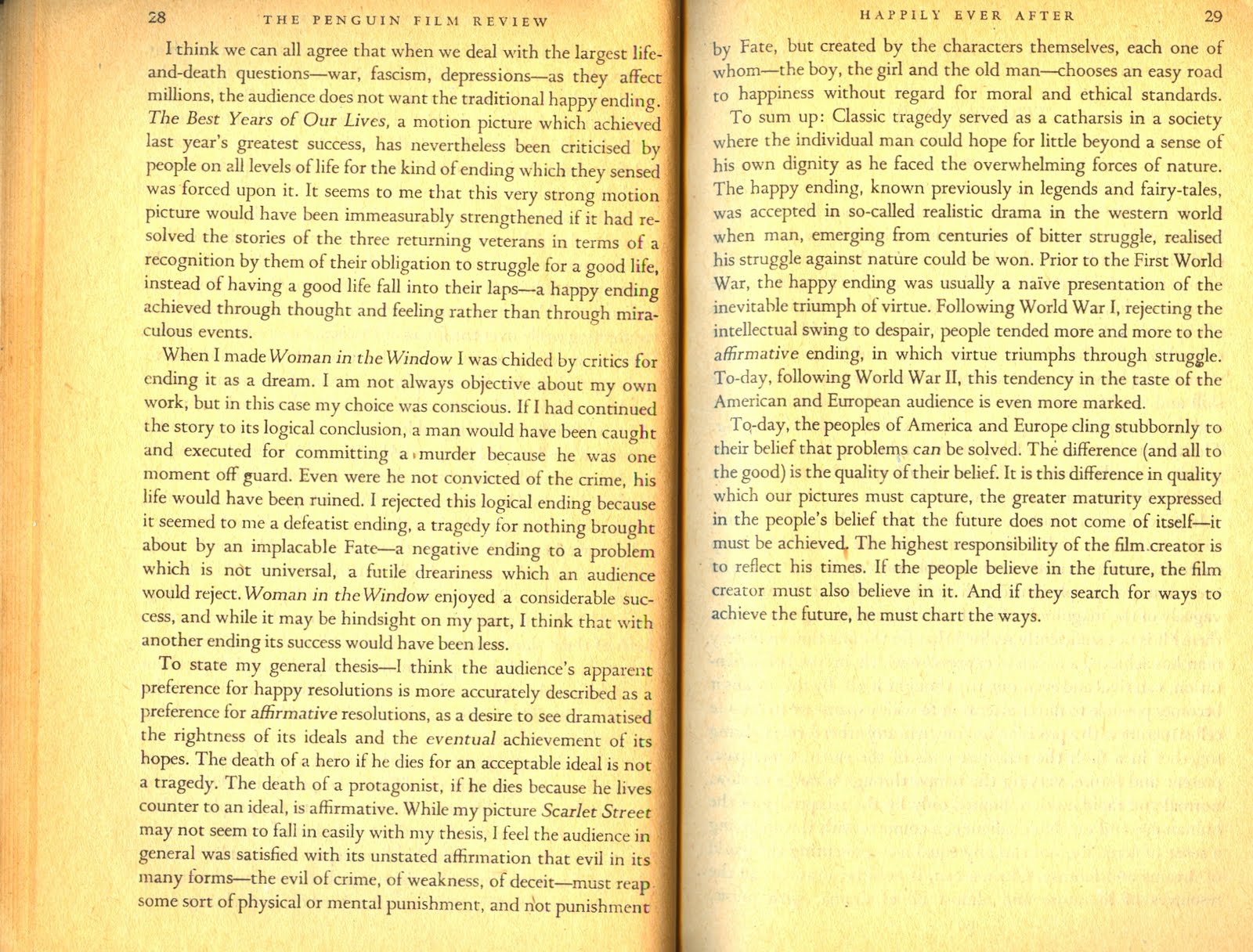
Do you ever forget what you have? And why you have it? I stumbled across a copy of "The Penguin Film Review," a slight paperback book from 1948. I think I picked it up at a tag sale and I had forgotten about it. When I found it I realized why I have bought it.

It has an essay by Fritz Lang, a director I much admire, about happy endings and it reveal interesting things about him. I was hooked when he admitted he didn't know how to create suspense.

He said that out his successes and failures he had "developed a kind of automatic reflex device that guides my work."

I thought my fellow film fans would appreciate the chance of reading what Lang thought about story construction and how a story ends. He was one of the greats.